• Fri frakt över 249 kr
  • •
  • Snabba leveranser
  • •
  • Billiga böcker
Kundservice

Du är på sajten för privatpersoner.

Företag, bibliotek eller offentlig verksamhet?

Du handlar på classic.bokus.com, där alla dina funktioner finns intakta.
Till classic.bokus.com
Bokus logotyp. Gå till startsidan.
  • Erbjudanden
  • Nyheter
  • Student
  • Topplistor
  • Barn & ungdom
  • Bokus Play
  • E-böcker
  • Pocketböcker
  • Spel & pussel

10% rabatt på allt med kod: NYSTART10 →

Sidfot

Mina sidor

    Hjälp

    • Kundservice
    • Vanliga frågor och svar
    • Frakt och leverans
    • Retur vid ångerrätt
    • Reklamera vara
    • Betalning
    • Köpvillkor
    • Allmänna villkor
    • Information om webbplatsens tillgänglighet

    Om Bokus

    • Om oss
    • Pressrum
    • För studenter
    • För företag
    • För bibliotek och offentlig verksamhet
    • För leverantörer
    • Hållbarhet

    Populärt

    • Aktuella erbjudanden
    • Presentkort
    • Studentlitteratur
    • Nya böcker
    • Topplistor
    • Signerade böcker
    • Engelska böcker

    Inspiration

    • Boktips
    • BookTok
    • Populära bokserier
    • Barnbokskaraktärer
    • Populära författare
    Logotyp för Bokus
    Följ oss på Facebook (extern länk)Följ oss på Instagram (extern länk)Följ oss på YouTube (extern länk)Följ oss på TikTok (extern länk)
    bokus @ CookiesAnpassa cookiesIntegritetspolicyKöpvillkor
    Till Citymail hemsida (extern länk)Till Budbee hemsida (extern länk)Till Postnord hemsida (extern länk)Till Schenker hemsida (extern länk)Till Early Bird hemsida (extern länk)Till Walleys hemsida (extern länk)
    1. Historia och arkeologi
    2. Historia
    3. Europas historia

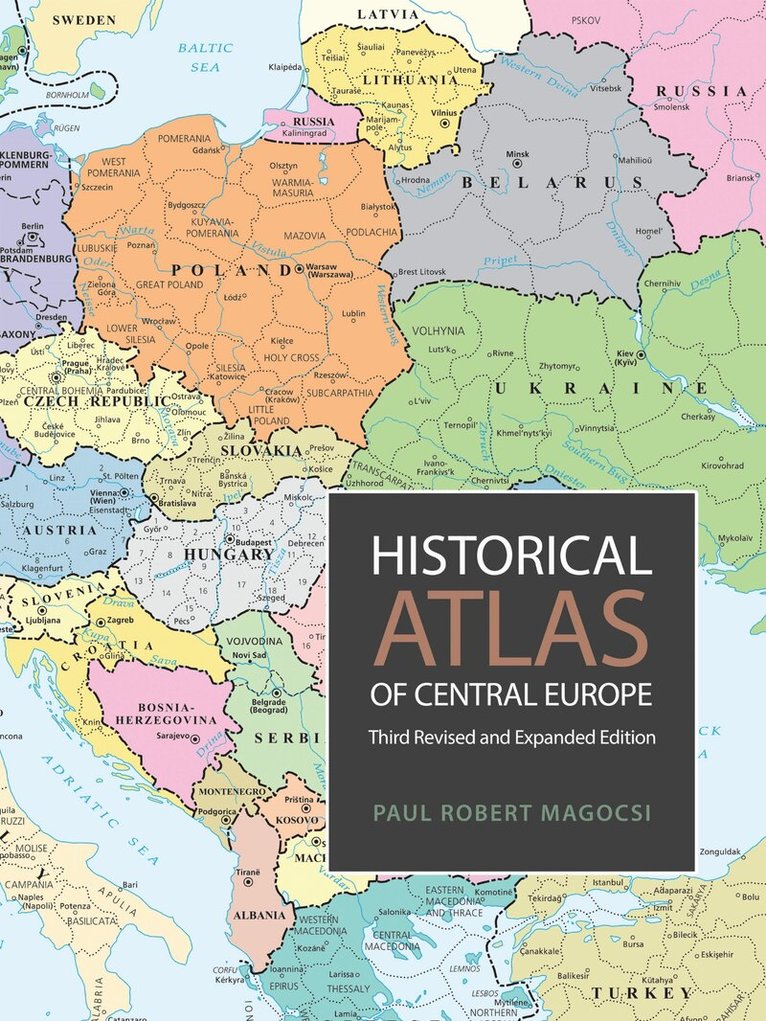
    Historical Atlas of Central Europe

    Third Revised and Expanded Edition

    AvPaul Robert Magocsi

    Häftad, Engelska, 2018

    768 kr

    Beställningsvara. Skickas inom 5-8 vardagar. Fri frakt över 249 kr.

    Beskrivning

    Central Europe remains a region of ongoing change and continuing significance in the contemporary world. This third, fully revised edition of the Historical Atlas of Central Europe takes into consideration recent changes in the region. The 120 full-colour maps, each accompanied by an explanatory text, provide a concise visual survey of political, economic, demographic, cultural, and religious developments from the fall of the Roman Empire in the early fifth century to the present. No less than 19 countries are the subject of this atlas. In terms of today's borders, those countries include Lithuania, Poland, and Belarus in the north; the Czech Republic, Austria, Slovenia, Croatia, Hungary, and Slovakia in the Danubian Basin; and Serbia, Bosnia-Herzegovina, Montenegro, Romania, Moldova, Bulgaria, Macedonia, Albania, and Greece in the Balkans. Much attention is also given to areas immediately adjacent to the central European core: historic Prussia, Venetia, western Anatolia, and Ukraine west of the Dnieper River.Embedded in the text are 48 updated administrative and statistical tables. The value of the Historical Atlas of Central Europe as an authoritative reference tool is further enhanced by an extensive bibliography and a gazetteer of place names – in up to 29 language variants – that appear on the maps and in the text.The Historical Atlas of Central Europe is an invaluable resource for scholars, students, journalists, and general readers who wish to have a fuller understanding of this critical area, with its many peoples, languages, and continued political upheaval.

    Produktinformation

    • Utgivningsdatum:2018-11-12
    • Mått:229 x 305 x 23 mm
    • Vikt:1 180 g
    • Format:Häftad
    • Språk:Engelska
    • Antal sidor:296
    • Upplaga:18003
    • Förlag:University of Toronto Press
    • ISBN:9781487523312

    Utforska kategorier

    • Europas historia inom Historia och arkeologi
    • Historisk geografi inom Historia och arkeologi

    Mer om författaren

    Paul Robert Magocsi is a professor of history and political science and the John Yaremko Chair of Ukrainian Studies at the University of Toronto.

    Recensioner i media

    "There is nothing comparable to this book in any language and its usefulness to the profession and interested public is beyond any doubt. The work is destined to exert considerable and lasting influence on generations of scholars, experts, diplomats, and politicians."- George Barany, University of Denver "The Historical Atlas of Central Europe is a marvellous work that deserves to be in every map library, history department, researcher’s office, or even one’s coffee table. Considering the current events transpiring in this region of Europe, this atlas may well become one of the most used in any collection or classroom."- James Boxall (Association of Canadian Map Libraries and Archives Bulletin) "A Superb reference tool for those interested in the region and as essential aid for those involved in teaching the history of East Central Europe." (Journal of Refugee Studies) "A valuable reference work for historians of Europe and a treasure house for the merely curious" (Business Library Review) "The Historical Atlas of Central Europe is a mammoth project, focusing on the history of a region underrepresented by Western historians for too long, while addressing a large public with excellent maps and coherent accompanying texts." - Nikolaus Schobesberger (Austrian History Yearbook) "Although the Historical Atlas of Central Europe is attractive enough to grace a coffee table it will mainly be used for teaching in higher education. It is admirably suited for that purpose. The individual chapters stand alone very well, and will make fine background readings for seminars on many aspects of Central Europe, particularly its modern history. Anyone teaching on these subjects will find this volume to be an invaluable resource." - Francis King, University of East Anglia (European History Quarterly) "The Historical Atlas of Central Europe is not only a very useful tool for research and (most of all) teaching, but also a very beautiful, very well-edited publication. And it is a very direct way to tell the history of this part of the continent with the help of short descriptions (mostly not longer than one to two pages), geographical maps, and statistics in sixty-one chapters."- Árpád von Klimó, The Catholic University of America (Hungarian Studies Review) "Any reader of Paul Robert Magocsi’s cartographic works can only admire and commend the efforts and scholarship of the author and his teammates. The results of their work have already been helpful to an entire generation of students of Central Europe wishing to become acquainted with the region, and these new editions will undoubtedly help introduce the area to newcomers."- Anton Kotenko, National Research University (Harvard Ukrainian Studies Journal) "Magocsi’s Atlas is an excellent visual-history enterprise and a great reference tool."- Andriy Tyushka, College of Europe in Natolin (East/West: Journal of Ukrainian Studies)

    Innehållsförteckning

    • Introduction to the Original EditionNote to the Second Revised and Expanded EditionNote to the Third Revised Edition1. Central Europe: geographic zones2. Central Europe, ca. 400 3. Central Europe, 7th–8th centuries4. Central Europe, 9th century5. Early medieval kingdoms, ca. 10506. The period of feudal subdivisions, ca. 12507. Poland, Lithuania, and Bohemia-Moravia, 13th–15th centuries8. Hungary-Croatia and Venetia, 14th–15th centuries9. Bulgaria, Serbia, Bosnia, and the Ottoman Empire, 14th–15th centuries10. Central Europe, ca. 148011. Economic patterns, ca. 145012. The city in medieval times13. Ecclesiastical jurisdictions, ca. 145014. Central Europe, ca. 157015. Protestant Reformation, 16th century16. Catholic Counter Reformation, 16th–17th centuries17. Education and culture through the 18th century18. Central Europe, 164819. Poland-Lithuania, the Habsburgs, Hungary-Croatia, and Transylvania, 16th–17th centuries20. The Ottoman Empire, the Habsburgs, Hungary-Croatia, and Transylvania, 16th–17th centuries21. Central Europe, ca. 172122. Poland, Austria, and the Ottoman Empire, 18th century23. The Napoleonic era, 1795–181424. Central Europe, 181525. The Austrian and Austro-Hungarian Empire, 1815–191426. The Balkan Peninsula, 1817–191227. The Balkan Peninsula on the eve of World War I28. Canal and railway development before 191429. Population, 1870–191030. Ethnolinguistic distribution, ca. 190031. Cultural and educational institutions before 191432. Germans in Central Europe, ca. 190033. Jews and Armenians in Central Europe, ca. 190034. The Catholic Church, 190035. The Orthodox Church, 190036. Central Europe, 191037. World War I, 1914–191838. Central Europe, 1918–192339. Poland, Danzig, and Lithuania in the 20th century40. Belarus and Ukraine in the 20th century41. Czechoslovakia, the Czech Republic, and Slovakia in the 20th century42. Austria and Hungary in the 20th century43. Romania and Moldova in the 20th century44. Yugoslavia, Serbia, and Kosovo in the 20th century45. Slovenia, Trieste, and Istria in the 20th century46. Croatia and Bosnia-Herzegovina in the 20th century47. Montenegro, Albania, and Macedonia in the 20th century48. Bulgaria and Greece in the 20th century49. Central Europe, ca. 193050. World War II, 1939–194251. World War II, 1943–194552. Central Europe after World War II53. Population movements, 1944–194854. Population in the 20th century55. Ethnolinguistic distribution, ca. 201056. Central Europe, 198057. Industrial development, 1945–198958. Education and re-education in the 20th century59. The Catholic Church in the 20th century60. The Orthodox Church in the 20th century61. Post-Communist Central EuropeMap sourcesBibliographyIndex