• Fri frakt över 249 kr
  • •
  • Snabba leveranser
  • •
  • Billiga böcker
Kundservice

Du är på sajten för privatpersoner.

Företag, bibliotek eller offentlig verksamhet?

Du handlar på classic.bokus.com, där alla dina funktioner finns intakta.
Till classic.bokus.com
Bokus logotyp. Gå till startsidan.
  • Erbjudanden
  • Nyheter
  • Student
  • Topplistor
  • Barn & ungdom
  • Bokus Play
  • E-böcker
  • Pocketböcker
  • Spel & pussel

10% rabatt på allt med kod: NYSTART10 →

Sidfot

Mina sidor

    Hjälp

    • Kundservice
    • Vanliga frågor och svar
    • Frakt och leverans
    • Retur vid ångerrätt
    • Reklamera vara
    • Betalning
    • Köpvillkor
    • Allmänna villkor
    • Information om webbplatsens tillgänglighet

    Om Bokus

    • Om oss
    • Pressrum
    • För studenter
    • För företag
    • För bibliotek och offentlig verksamhet
    • För leverantörer
    • Hållbarhet

    Populärt

    • Aktuella erbjudanden
    • Presentkort
    • Studentlitteratur
    • Nya böcker
    • Topplistor
    • Signerade böcker
    • Engelska böcker

    Inspiration

    • Boktips
    • BookTok
    • Populära bokserier
    • Barnbokskaraktärer
    • Populära författare
    Logotyp för Bokus
    Följ oss på Facebook (extern länk)Följ oss på Instagram (extern länk)Följ oss på YouTube (extern länk)Följ oss på TikTok (extern länk)
    bokus @ CookiesAnpassa cookiesIntegritetspolicyKöpvillkor
    Till Citymail hemsida (extern länk)Till Budbee hemsida (extern länk)Till Postnord hemsida (extern länk)Till Schenker hemsida (extern länk)Till Early Bird hemsida (extern länk)Till Walleys hemsida (extern länk)
    1. Naturvetenskap och teknik
    2. Matematik och naturvetenskap
    3. Biologi

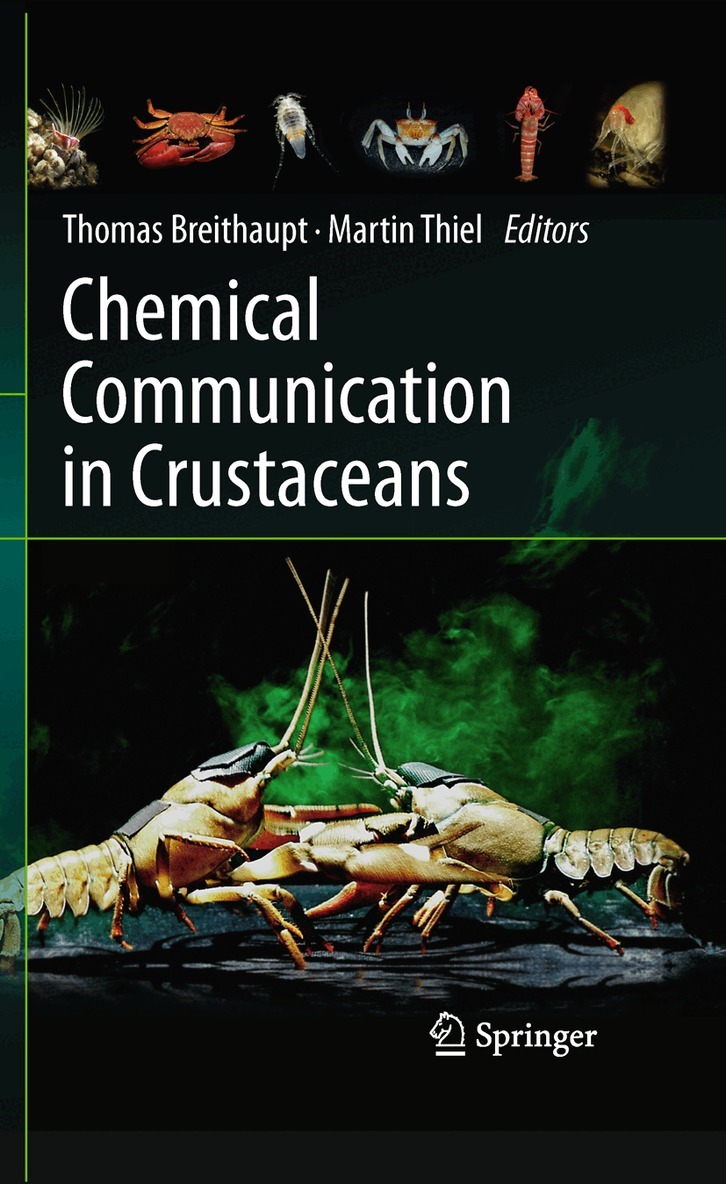
    Chemical Communication in Crustaceans

    AvThomas Breithaupt,Martin Thiel

    Häftad, Engelska, 2014

    3 244 kr

    Beställningsvara. Skickas inom 10-15 vardagar. Fri frakt över 249 kr.

    Beskrivning

    The crustaceans are ecologically and economically important organisms. They constitute one of the dominant invertebrate groups on earth, particularly within the aquatic realm. Crustaceans include some of the preferred scientific model organism, profitable aquaculture specimen, but also invasive nuisance species threatening native animal communities throughout the world. Chemoreception is the most important sensory modality of crustaceans, acquiring important information about their environment and picking up the chemical signals that mediate communication with conspecifics.Significant advances have been made in our understanding of crustacean chemical communication during the past decade. This includes knowledge about the identity, production, transfer, reception and behavioral function of chemical signals in selected crustacean groups. While it is well known that chemical communication is an integral part of the behavioral ecology of most living organisms, the intricate ways in which organisms allocate chemicals in communication remains enigmatic. How does the environment influence the evolution of chemical communication? What are the environmental cues that induce production or release of chemicals? How do individuals economize production and utilization of chemicals? What is the importance of molecule specificity or mix of a molecule cocktail in chemical communication? What is the role of chemical cues in multimodal communication? How does the ontogenetic stage, the sex or the physiological status of an individual affect its reaction to chemical cues? Many of these questions still represent important challenges to biologists.

    Produktinformation

    • Utgivningsdatum:2014-08-20
    • Mått:155 x 235 x 32 mm
    • Vikt:873 g
    • Format:Häftad
    • Språk:Engelska
    • Antal sidor:565
    • Förlag:Springer-Verlag New York Inc.
    • ISBN:9781489981493

    Utforska kategorier

    • Biologi inom Naturvetenskap och teknik
    • Vattendjur inom Djur och Natur

    Recensioner i media

    From the reviews: "This well-edited, multiauthored book reviews how crustaceans--mainly aquatic--orients to and communicates via chemical signals and cues and thus helps us understand the ocean's cryptic life. ... This volume will be of concern to anyone working with the chemical ecology of aquatic organisms as it represents steps toward deciphering the perceptive world of aquatic organisms and identifies future research avenues." (Thomas Kiorboe, The Quarterly Review of Biology, Vol. 87 (2), June, 2012)

    Innehållsförteckning

    • Part I. Introductory Section: General Introduction. Pheromones and behaviour - overview, definitions.- Part II. General Overview of Signal Characteristics and Reception: Finding the mate: Pheromone hydrodynamics and odour acquisition. Orientation to pheromone sources in turbulent plumes. Functional morphology of chemoreceptors. Olfaction and pheromone reception in crustaceans. Processing of chemical information in the crustacean brain. Beyond crustaceans: The nature of communication chemicals: their solubility and volatility, stability and specificity. Pheromone communication in aquatic and aerial environments.- Part III. Chemical Communication and Behaviour: Chemical communication in lobsters. Chemical communication in crayfish. Chemical modulation of aggressive interactions in stomatopods. Alarm substance and predator avoidance in crustaceans. Chemical communication in shrimp. Chemical communication in peracarid crustaceans. Chemical communication in anomurans. Chemical communication in terrestrial crustaceans. Chemical communication in copepods. Beyond crustaceans: Honest signals or deceit – how reliable are pheromones? Chemical communication in a multi-modal context.- Part IV. Towards Identification of Chemical Signals: Identification of a sex pheromone in decapod crustaceans. Chemical communication and hormones. Settlement cues of barnacles. Beyond crustaceans: A review of pheromone communication in fish.- Part V. Applied Aspects: The use of pheromones in integrated pest managements (IPM). Environmental contamination and effects on chemical communication. Principles of crustacean farming: Problems and solutions.