• Fri frakt över 249 kr
  • •
  • Snabba leveranser
  • •
  • Billiga böcker
Kundservice

Du är på sajten för privatpersoner.

Företag, bibliotek eller offentlig verksamhet?

Du handlar på classic.bokus.com, där alla dina funktioner finns intakta.
Till classic.bokus.com
Bokus logotyp. Gå till startsidan.
  • Erbjudanden
  • Nyheter
  • Student
  • Topplistor
  • Barn & ungdom
  • Bokus Play
  • E-böcker
  • Pocketböcker
  • Spel & pussel

Må bättre, för mindre! Upp till 50% rabatt på hälsoböcker

Sidfot

Mina sidor

    Hjälp

    • Kundservice
    • Vanliga frågor och svar
    • Frakt och leverans
    • Retur vid ångerrätt
    • Reklamera vara
    • Betalning
    • Köpvillkor
    • Allmänna villkor
    • Information om webbplatsens tillgänglighet

    Om Bokus

    • Om oss
    • Pressrum
    • För studenter
    • För företag
    • För bibliotek och offentlig verksamhet
    • För leverantörer
    • Hållbarhet

    Populärt

    • Aktuella erbjudanden
    • Presentkort
    • Studentlitteratur
    • Nya böcker
    • Topplistor
    • Signerade böcker
    • Engelska böcker

    Inspiration

    • Boktips
    • BookTok
    • Populära bokserier
    • Barnbokskaraktärer
    • Populära författare
    Logotyp för Bokus
    Följ oss på Facebook (extern länk)Följ oss på Instagram (extern länk)Följ oss på YouTube (extern länk)Följ oss på TikTok (extern länk)
    bokus @ CookiesAnpassa cookiesIntegritetspolicyKöpvillkor
    Till Citymail hemsida (extern länk)Till Budbee hemsida (extern länk)Till Postnord hemsida (extern länk)Till Schenker hemsida (extern länk)Till Early Bird hemsida (extern länk)Till Walleys hemsida (extern länk)
    1. Psykologi och pedagogik
    2. Psykologi
    3. Biologisk psykologi och neuropsykologi

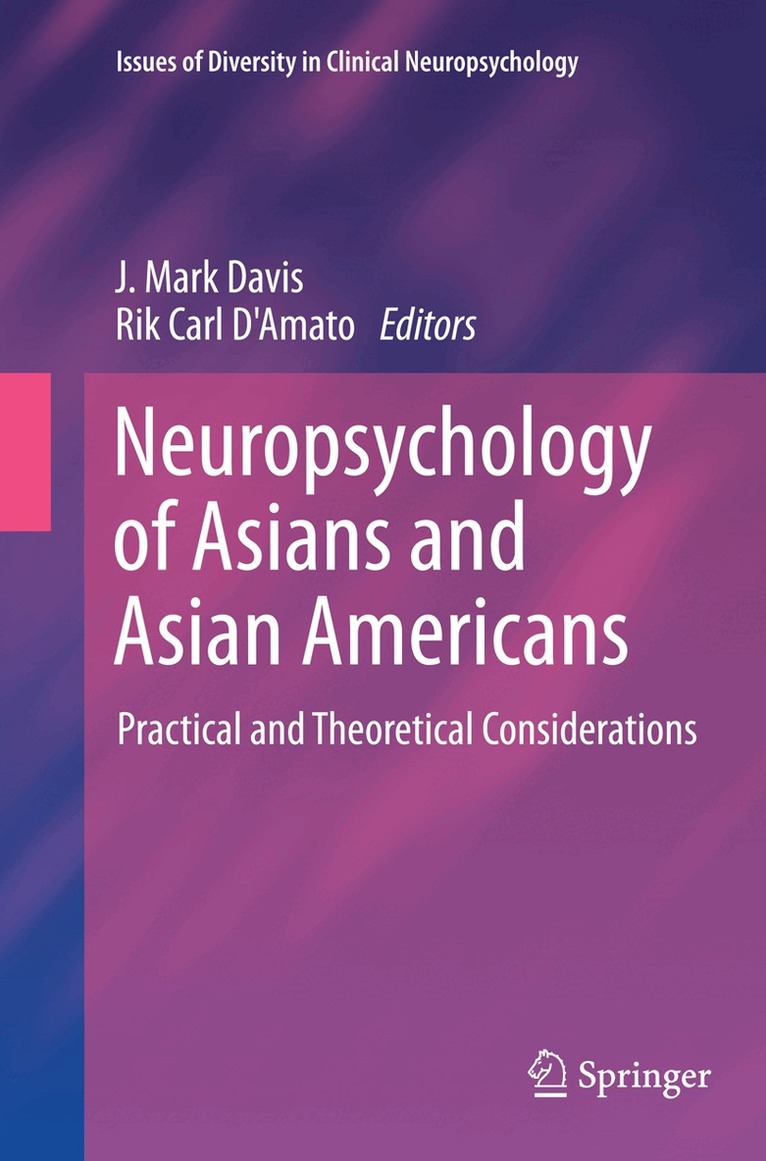
    Neuropsychology of Asians and Asian-Americans

    Practical and Theoretical Considerations

    AvJ. Mark Davis,Rik Carl D'Amato

    Häftad, Engelska, 2015

    Del i serien Issues of Diversity in Clinical Neuropsychology

    1 056 kr

    Beställningsvara. Skickas inom 10-15 vardagar. Fri frakt över 249 kr.

    Beskrivning

    Neuropschology with Asians and Asian Americans Practical and Theoretical Considerations J. Mark Davis and Rik Carl D'Amato, editors  The challenge of cultural competence for health providers is more than the recognition of other ethnicities: it entails the balancing of group and individual factors to apply relevant information in diagnostic and therapeutic settings. Particularly in need of culturally appropriate services are Asians and Asian Americans, populations that are diverse, growing, and underserved by Asian practitioners. Neuropsychology with Asians and Asian Americans takes cultural neuroscience to new levels in its variety and usefulness. Focusing on the largest groups of Far East and Southeast Asian descent, this leading-edge reference examines the influence of culture on psychological processes and identifies sociocultural factors as they influence neurological aspects of client presentation. This expert coverage goes beyond well-known constructs of "collectivism" and "family orientation" toward establishing an evidence base crucial to understanding, assessing, and treating Asian and Asian American clients, including:  Linguistic factors and language assessment of Asians.Society and acculturation in Asian and Asian American communitiesMental illness from  Asian and Asian American perspectives.Understanding cognitive differences across the lifespan: comparing Eastern and Western culturesClinical interviews and qualitative assessment with Asian clientsNeuropsychological test selection with Asian clients Unique in its scope and detail, Neuropsychology with  Asians and Asian Americans is a necessary resource for neuropsychologists and rehabilitation specialists as well as social workers and clinical, counseling, and school psychologists.

    Produktinformation

    • Utgivningsdatum:2015-08-14
    • Mått:155 x 235 x 12 mm
    • Vikt:330 g
    • Format:Häftad
    • Språk:Engelska
    • Serie:Issues of Diversity in Clinical Neuropsychology
    • Antal sidor:193
    • Förlag:Springer-Verlag New York Inc.
    • ISBN:9781489988645

    Utforska kategorier

    • Biologisk psykologi och neuropsykologi inom Psykologi och pedagogik
    • Socialpsykologi och gruppsykologi inom Psykologi och pedagogik

    Recensioner i media

    From the reviews: "The contributing authors address the most significant issues related to the neuropsychological assessment of Asian clients ... . Although the book is written for the neuropsychologist, it is relevant to the assessment of Asian clients in general. ... The book provides tremendously useful information about Asians and Asian Americans but also describes how to use that information to understand the individual." (Vincent G. Tsushima, PsycCRITIQUES, Vol. 59 (17), 2014)

    Innehållsförteckning

    • Chapter 1 Overview of Issues Related to Serving Asian and Asian American Clients.-1.1 Introduction.- 1.2 Cultural Competence.- 1.3 Who are “Asian Americans”?.- 1.4 Cultural variables that influence neuropsychological services.- 1.4.1 Client Characteristics.- 1.4.2 Variables related to tests and test batteries.- 1.5 Conclusions.- 1.6 References.- Chapter 2 Ethical considerations in neuropsychological assessment of Asian heritage clients.- 2.1 Introduction.- 2.2 The importance of values in cross-cultural neuropsychology practice.- 2.3 Culturally invariant ethical and moral principles.- 2.4 Internationalization of psychological ethics.- 2.5 Neuropsychology and the Interpreter.- 2.5.1 Use of interpreters.- 2.5.2 Ethical duties of the Interpreter.- 2.6 Some Issues Pertaining to Specific Ethical Standards.- 2.6.1 Competency.- 2.6.2 Informed consent and confidentiality.- 2.6.3 Assessment procedures.- 2.7 Some summary considerations.- 2.8 References.- Chapter 3 Linguistic Factors and Language Assessment of Asians.- 3.1 Introduction.- 3.2 Theoretical foundations in linguistic science.- 3.2.1 The Language Acquisition Device (LAD).- 3.2.2 The Critical Period Hypothesis.- 3.2.3 Language and linguistic features defined.- 3.2.4 Native versus non-native languages.- 3.2.5 L1 interference and transfer.- 3.2.6 Interlanguage and fossilization.- 3.3 Features of English that frequently pose problems to L2 speakers.- 3.3.1 Pronunciation: Consonants.- 3.3.2 Pronunciation: Vowels.- 3.3.3 Pronunciation: Supra-segmental phonology.- 3.3.4 Lexicon: Native and borrowed vocabulary.- 3.3.5 Lexicon: Noun characteristics.- 3.3.6 Morpho-syntax: Prepositions.- 3.3.7 Morphosyntax: Subject/verb agreement.- 3.4 Case studies of two Asian languages.- 3.4.1 Case study: Chinese.- 3.4.2 Case Study: Japanese.- 3.5 Testing English proficiency.- 3.6 Asian Englishes.- 3.7 Conclusions.- 3.8 References.- Chapter 4 Society and Acculturation in Asian American Communities.- 4.1 AsianPhilosophies and Religions.- 4.1.1 Confucianism.- 4.1.2 Taoism.- 4.1.3 Buddhism.- 4.2 Values, Beliefs, Emotions, and Interpersonal Behaviors of Asians.- 4.2.1 Valuing learning and education.- 4.2.2 Family orientation.- 4.2.3 Interdependency.- 4.2.4 Power distance.- 4.2.5 Face saving.- 4.2.6 Indirectness in communication.- 4.2.7 Avoid going to extremes and moderate emotions.- 4.2.8 Acceptance of contradictions, and mixed emotions.- 4.2.9 Suppression of emotional expression.- 4.3 Holistic thinking and test performance.- 4.4 Response biases.- 4.5 Acculturation.- 4.5.1 Acculturation Theory and Measurement.- 4.5.2 Acculturation Assessment.- 4.6 Conclusions.- 4.7 References.- Chapter 5 Mental Illness from an Asian American Perspective.- 5.1 Introduction.- 5.2 Prevalence rate of Mental Illness in Asia.- 5.3 Nosology and the medical model.- 5.4 The role of Eastern philosophies.- 5.5 Morita Therapy.- 5.6 Caveat.- 5.7 References.- Chapter 6 Understanding Differences in Cognition across the Lifespan: Comparing Eastern and Western Cultures.- 6.1 Introduction.- 6.2 Developmental Differences in Children and Adolescents.- 6.2.1 Academic Achievement.- 6.2.2 Cognitive Functioning.- 6.2.3 Social Cognition.- 6.2.4 Adaptive Functioning.- 6.2.5 Additional Influences on Culture-Based Differences in Cognitive Development.- 6.3 Differences in Cognition in Mature Adults.- 6.3.1 Academic Achievement.- 6.3.2 Cognitive Functioning.- 6.3.3 Visual Perception.- 6.3.4 Social Cognition.- 6.3.5 Influences Related to Individualism vs. Collectivism.- 6.4 Differences in cognition in older adults.- 6.5 Influence of Acculturation, Language, and Related Factors on Test Performance.- 6.6 Conclusions.- 6.7 References.- Chapter 7 Understanding the Neuroscience of Clients with Asian Heritage. 7.1 Cultural Neuroscience.- 7.2 The Influence of Culture on Psychological Processes.- 7.2.1 Perception.- 7.2.3 Attention.- 7.2.4 Arithmetic.- 7.2.5 Language.- 7.2.6 Independence and Interdependence.- 7.2.7 Emotion and Emotion Regulation.- 7.2.8 Conclusion.- 7.3  Structural and Functional MRI.- 7.3.1 Structural MRI and Ethnicity.- 7.3.2 Functional MRI and Ethnicity.-  7.4  Conclusion.- 7.5 References.- Chapter 8 Clinical Interviewing and Qualitative Assessment with Asian Heritage Clients.- 8.1 Introduction.- 8.2 Socio-cultural factors influencing the presentation of Asian Americans.- 8.2.1 Perception of psychological problems and services.- 8.2.2 The collectivist orientation and family system.- 8.2.3 Emphasis on modesty and courtesy.- 8.2.4 Respect for authority.- 8.3 Strategies in working with Asian Americans in neuropsychological interviews and qualitative assessment.- 8.3.1 General objectives in conducting a culturally-sensitive clinical interview and qualitative assessment.- 8.3.2 Assessing the need for a referral and making one when appropriate.- 8.3.3 Thorough briefing of the interpreter, if using one is absolutely necessary.- 8.3.4 Investing an effort in getting information and soliciting support from the family in rehabilitation plans.- 8.3.5 Taking the time to explain the neuropsychological evaluation.- 8.3.6 Working with the role-bound respect for authority.- 8.3.7 Creating an open environment for honest communication while maintaining harmony.- 8.3.8 Differentiating aptitude, opportunities, and cultural expectations in assessing attainment.- 8.3.9 Asking for clarification and cultural education from the patient and the family.- 8.3.10 Prudent adaptation of standardized tests to provide qualitative data.- 8.3.11 Development of a more flexible approach in neuropsychological assessment.- 8.4 Conclusions.- 8.5 Acknowledgement.- 8.6 References.- Chapter 9 Neuropsychological Test Selection with Clients who are Asian.- 9.1 Test Selection Issues for Neuropsychological Assessment.- 9.2 Language.- 9.2.1 Language Proficiency.- 9.2.2 Language Minimized/Nonverbal Tests.- 9.2.3 Adaptation of Existing Tests with Language Loading.-  9.2.4 Use of Interpreters as a Modification.- 9.3 Acculturation.- 9.3.1 Culture Specific Issues.- 9.4 Tests Standardized with or Developed for Asian Populations.- 9.5 Discussion and Conclusion.- 9.6 References.- Chapter 10 What Do We Need to Know before Serving Asian and Asian American Clients?.- 10.1 “Take home” points.- 10.2 Importance of a multimethod approach.- 10.3 Conclusions.- 10.4 References.-