• Fri frakt över 249 kr
  • •
  • Snabba leveranser
  • •
  • Billiga böcker
Kundservice

Du är på sajten för privatpersoner.

Företag, bibliotek eller offentlig verksamhet?

Du handlar på classic.bokus.com, där alla dina funktioner finns intakta.
Till classic.bokus.com
Bokus logotyp. Gå till startsidan.
  • Erbjudanden
  • Nyheter
  • Student
  • Topplistor
  • Barn & ungdom
  • Bokus Play
  • E-böcker
  • Pocketböcker
  • Spel & pussel

10% rabatt på allt med kod NYSTART10 →

Sidfot

Mina sidor

    Hjälp

    • Kundservice
    • Vanliga frågor och svar
    • Frakt och leverans
    • Retur vid ångerrätt
    • Reklamera vara
    • Betalning
    • Köpvillkor
    • Allmänna villkor
    • Information om webbplatsens tillgänglighet

    Om Bokus

    • Om oss
    • Pressrum
    • För studenter
    • För företag
    • För bibliotek och offentlig verksamhet
    • För leverantörer
    • Hållbarhet

    Populärt

    • Aktuella erbjudanden
    • Presentkort
    • Studentlitteratur
    • Nya böcker
    • Topplistor
    • Signerade böcker
    • Engelska böcker

    Inspiration

    • Boktips
    • BookTok
    • Populära bokserier
    • Barnbokskaraktärer
    • Populära författare
    Logotyp för Bokus
    Följ oss på Facebook (extern länk)Följ oss på Instagram (extern länk)Följ oss på YouTube (extern länk)Följ oss på TikTok (extern länk)
    bokus @ CookiesAnpassa cookiesIntegritetspolicyKöpvillkor
    Till Citymail hemsida (extern länk)Till Budbee hemsida (extern länk)Till Postnord hemsida (extern länk)Till Schenker hemsida (extern länk)Till Early Bird hemsida (extern länk)Till Walleys hemsida (extern länk)
    1. Psykologi och pedagogik
    2. Psykologi

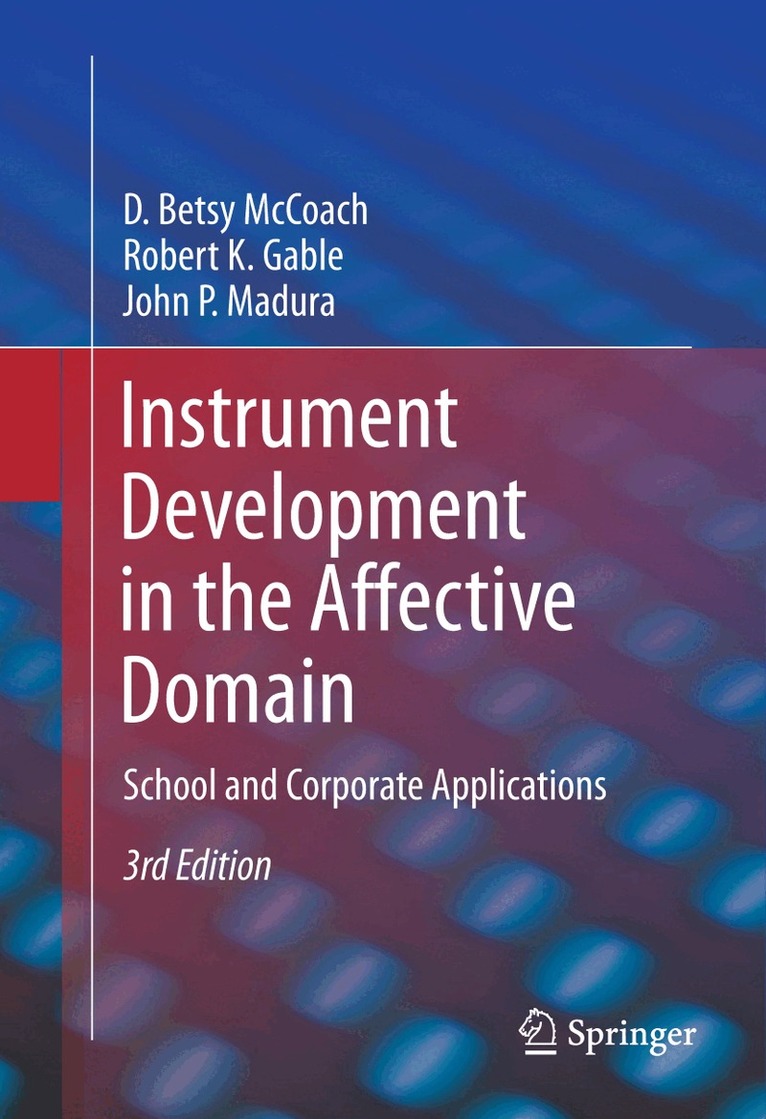
    Instrument Development in the Affective Domain

    School and Corporate Applications

    AvD. Betsy McCoach,Robert K. Gable

    Häftad, Engelska, 2015

    2 313 kr

    Beställningsvara. Skickas inom 10-15 vardagar. Fri frakt över 249 kr.

    Fler format och utgåvor

    Inbunden

    2 313 kr

    Beskrivning

    Whether the concept being studied is job satisfaction, self-efficacy, or student motivation, values and attitudes--affective characteristics--provide crucial keys to how individuals think, learn, and behave. And not surprisingly, as measurement of these traits gains importance in the academic and corporate worlds, there is an ongoing need for valid, scientifically sound instruments. For those involved in creating self-report measures, the completely updated Third Edition of Instrument Development in the Affective Domain balances the art and science of instrument development and evaluation, covering both its conceptual and technical aspects. The book is written to be accessible with the minimum of statistical background, and reviews affective constructs from a measurement standpoint. Examples are drawn from academic and business settings for insights into design as well as the relevance of affective measures to educational and corporate testing. This systematic analysis of all phases of the design process includes:  Measurement, scaling, and item-writing techniques.Validity issues: collecting evidence based on instrument content.Testing the internal structure of an instrument: exploratory and confirmatory factor analyses.  Measurement invariance and other advanced methods for examining internal structure.Strengthening the validity argument: relationships to external variables. Addressing reliability issues. As a graduate course between covers and an invaluable professional tool, the Third Edition of Instrument Design in the Affective Domain will be hailed as a bedrock resource by researchers and students in psychology, education, and the social sciences, as well as human resource professionals in the corporate world.

    Produktinformation

    • Utgivningsdatum:2015-06-18
    • Mått:155 x 235 x 18 mm
    • Vikt:493 g
    • Format:Häftad
    • Språk:Engelska
    • Antal sidor:307
    • Upplaga:3
    • Förlag:Springer-Verlag New York Inc.
    • ISBN:9781493900619

    Utforska kategorier

    • Psykologi inom Psykologi och pedagogik
    • Examination och betygsättning inom Psykologi och pedagogik
    • Ledarskapsböcker inom Ekonomi och Ledarskap

    Mer om författaren

    D. Betsy McCoach  Dr. D. Betsy McCoach, Ph.D. is an associate professor in the Measurement, Evaluation and Assessment program at the University of Connecticut, where she teaches coursework in structural equation modeling, multilevel modeling, and instrument design. Dr. McCoach is the current Director of the Data Analysis Training Institute of Connecticut (DATIC), housed in the Educational Psychology Department of the Neag School of Education at UCONN. DATIC offers week-long summer workshops in advanced modeling techniques to researchers, professors, and graduate students who wish to learn to utilize techniques in their own research. Dr. McCoach co-teaches a weeklong workshop (with Ann O’Connell) on hierarchical linear modeling also teaches the week-long workshop on Structural Equation Modeling. In addition, Dr. McCoach is the founder and program chair of the Modern Modeling Methods Conference, hosted at the University of Connecticut every May.   Dr. McCoach has extensive experience in hierarchical linear modeling, and has used multilevel modeling techniques to analyze large national datasets. She and Ann O'Connell co-edited a book, Multilevel Modeling of Educational Data, available from Information Age Publishing. In addition, Dr. McCoach also has extensive experience in the areas of instrument design, factor analysis, structural equation modeling, and longitudinal analysis. Dr. McCoach has published over 55 peer review journal articles and 15 book chapters in the areas of quantitative research methodology, gifted education, and educational research.  She has also authored, co-authored, or helped to develop dozens of affective instruments, including the School Attitude Assessment Survey-Revised (SAAS-R) and the Challenges to Scholastic Achievement Scale (CSAS). Dr. McCoach was the founding co-editor of the Journal of Advanced Academics, and she is the current co-editor ofGifted Child Quarterly. She is an associate editor of Frontiers in Quantitative Psychology and Measurement. She currently serves on the review board for the Review of Educational Research (RER), and she has also served on the editorial review boards for the American Educational Research Journal (AERJ), the Journal of Educational Psychology (JEP), the Journal of Educational Research (JER) and the Journal for Primary Prevention (JPP).  Robert K. Gable Robert K. Gable, Ed.D., M.A., B.A., State University of New York at Albany, 1970/1967/1966. Gable is the director of the Center of Research and Evaluation in the Graduate School and former director of the Educational Leadership Doctoral Program at Johnson & Wales University in Providence RI. He is an emeritus professor of educational psychology in the Neag School of Education at the University of Connecticut, where he taught courses in research methodology, statistics, survey development and program evaluation from 1970 to 2000. He is a former director of the Bureau of Educational Research and Service at the University of Connecticut, and served as director of research for the Leadership Research Institute consulting firm. Gable has published numerous texts, journal articles, tests and research reports. He is the co-author of the Postpartum Depression Screening Scale (Beck & Gable), the School Situation Survey (Helms & Gable) and the My Class Activities survey (Gentry & Gable). He has received the Outstanding Leadership and Service award from the Northeastern Educational Research Association, an Excellence in Teaching award from the University of Connecticut Alumni Association, co-authored the 1999 “Manuscript of the Year” (Rong & Gable) in The Journal of College and University Student Housing, co-authored the “Best Original Research of 2012 in the Journal of Midwifery & Women’sHealth, and received “Distinguished Paper” awards in 1995 and 2011 from the Northeastern Educational Research Association.    John P. Madura John P. Madura began his academic career with a B.A. in Mathematics (Logic and Computability) from Boston University and completed a M.A. in History and Education from Teachers College, Columbia University in 2000.  After serving in the United States Navy as a cryptologic officer for five years, John taught secondary mathematics for four years in Connecticut and became interested in assessment and educational measurement, particularly in the affective domain.  In 2010, he entered the Measurement, Evaluation and Assessment doctoral program at the Neag School of Education at the University of Connecticut.  At the University of Connecticut, he has worked to develop affective instruments in the fields of teacher evaluation, school science achievement, and public health.  His substantive research interests center on aspects of interpersonal perception that occur in school settings and impact both school achievement and teacher evaluation.  His methodological research focuses broadly on connections between theory development and statistical model specification.  As a result, his work focuses on factor analysis, structural equation modeling (SEM), multilevel modeling (MLM), latent growth curve modeling (LGM), model fit, model invariance theories, and mediation and moderation effects.

    Innehållsförteckning

    • Affective characteristics in school and corporate environments: Their conceptual differences.- Defining measuring and scaling affective constructs.- Evidence based on test content.- Evidence based on the internal structure of the instrument: Factor analysis.- Additional evidence based on the internal structure of the instrument.- Evidence based on relations to other variables: Bolstering the empirical validity argument for constructs.- The reliability of scores from affective instruments.- Review of the steps for designing an instrument.