• Fri frakt över 249 kr
  • •
  • Snabba leveranser
  • •
  • Billiga böcker
Kundservice

Du är på sajten för privatpersoner.

Företag, bibliotek eller offentlig verksamhet?

Du handlar på classic.bokus.com, där alla dina funktioner finns intakta.
Till classic.bokus.com
Bokus logotyp. Gå till startsidan.
  • Erbjudanden
  • Nyheter
  • Student
  • Topplistor
  • Barn & ungdom
  • Bokus Play
  • E-böcker
  • Pocketböcker
  • Spel & pussel

10% rabatt på allt med kod NYSTART10 →

Sidfot

Mina sidor

    Hjälp

    • Kundservice
    • Vanliga frågor och svar
    • Frakt och leverans
    • Retur vid ångerrätt
    • Reklamera vara
    • Betalning
    • Köpvillkor
    • Allmänna villkor
    • Information om webbplatsens tillgänglighet

    Om Bokus

    • Om oss
    • Pressrum
    • För studenter
    • För företag
    • För bibliotek och offentlig verksamhet
    • För leverantörer
    • Hållbarhet

    Populärt

    • Aktuella erbjudanden
    • Presentkort
    • Studentlitteratur
    • Nya böcker
    • Topplistor
    • Signerade böcker
    • Engelska böcker

    Inspiration

    • Boktips
    • BookTok
    • Populära bokserier
    • Barnbokskaraktärer
    • Populära författare
    Logotyp för Bokus
    Följ oss på Facebook (extern länk)Följ oss på Instagram (extern länk)Följ oss på YouTube (extern länk)Följ oss på TikTok (extern länk)
    bokus @ CookiesAnpassa cookiesIntegritetspolicyKöpvillkor
    Till Citymail hemsida (extern länk)Till Budbee hemsida (extern länk)Till Postnord hemsida (extern länk)Till Schenker hemsida (extern länk)Till Early Bird hemsida (extern länk)Till Walleys hemsida (extern länk)
    1. Naturvetenskap och teknik
    2. Matematik och naturvetenskap
    3. Biologi
    4. Cellbiologi

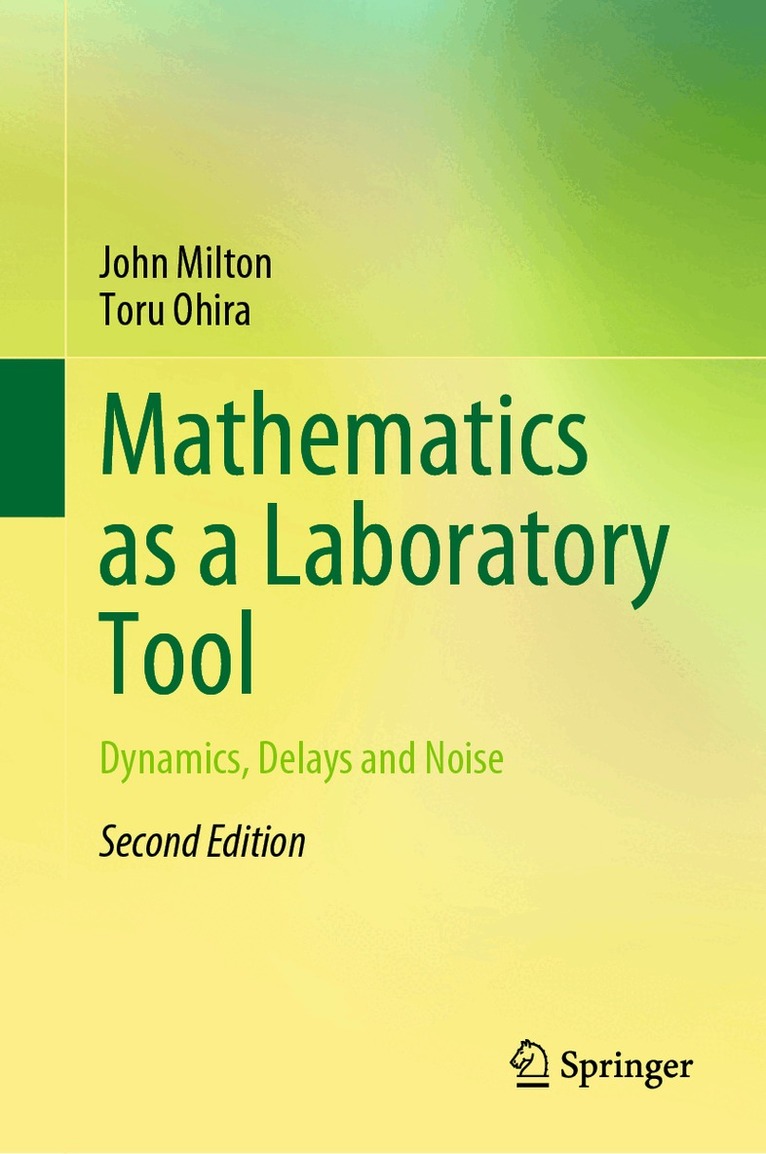
    Mathematics as a Laboratory Tool

    Dynamics, Delays and Noise

    AvJohn Milton,Toru Ohira

    Häftad, Engelska, 2016

    683 kr

    Beställningsvara. Skickas inom 5-8 vardagar. Fri frakt över 249 kr.

    Fler format och utgåvor

    Inbunden

    673 kr

    Häftad

    673 kr

    Beskrivning

    This introductory textbook is based on the premise that the foundation of good science is good data. The educational challenge addressed by this introductory textbook is how to present a sampling of the wide range of mathematical tools available for laboratory research to well-motivated students with a mathematical background limited to an introductory course in calculus.

    Produktinformation

    • Utgivningsdatum:2016-08-23
    • Mått:155 x 235 x 29 mm
    • Vikt:791 g
    • Format:Häftad
    • Språk:Engelska
    • Antal sidor:500
    • Förlag:Springer-Verlag New York Inc.
    • ISBN:9781493952540

    Utforska kategorier

    • Cellbiologi inom Naturvetenskap och teknik
    • Biovetenskap inom Naturvetenskap och teknik
    • Neurologi och klinisk neurofysiologi inom Medicin

    Mer om författaren

    John Milton, Professor of Biology and William R. Kenan Jr Chair n Computational Neuroscience, The Claremont Colleges; Adjunct Professor of Biotechnology, Keck Graduate Institute Toru Ohira, Professor Mathematics, Graduate School of Mathematics, Nagoya University, Japan

    Recensioner i media

    "This book, written in an engaging and intuitive style, is aimed at undergraduate biology students; its primary goal is to provide a clear, comprehensive overview of the appropriate mathematical instruments for data collection and analysis, both deterministic and stochastic. ... the book also has the stated goal of contributing to a better shaping of the curricula for undergraduate biology education towards a better coverage of analytic, mathematical and computational methods." (Paul Georgescu, zbMATH 1319.92001, 2015)

    Innehållsförteckning

    • Science and the mathematics of black boxes.- The mathematics of change.- Equilibria and steady states.- Stability.- Fixed–points: Creation and destruction.- Transient dynamics.- Frequency domain I: Bode plots and transfer functions.- Frequency domain II: Fourier analysis and power spectra.- Feedback and control systems.- Oscillations.- Beyond limit cycles.- Random perturbations.- Noisy dynamical systems.- Random walkers.- Thermodynamic perspectives.