• Fri frakt över 249 kr
  • •
  • Snabba leveranser
  • •
  • Billiga böcker
Kundservice

Du är på sajten för privatpersoner.

Företag, bibliotek eller offentlig verksamhet?

Du handlar på classic.bokus.com, där alla dina funktioner finns intakta.
Till classic.bokus.com
Bokus logotyp. Gå till startsidan.
  • Erbjudanden
  • Nyheter
  • Student
  • Topplistor
  • Barn & ungdom
  • Bokus Play
  • E-böcker
  • Pocketböcker
  • Spel & pussel

10% rabatt på allt med kod NYSTART10 →

Sidfot

Mina sidor

    Hjälp

    • Kundservice
    • Vanliga frågor och svar
    • Frakt och leverans
    • Retur vid ångerrätt
    • Reklamera vara
    • Betalning
    • Köpvillkor
    • Allmänna villkor
    • Information om webbplatsens tillgänglighet

    Om Bokus

    • Om oss
    • Pressrum
    • För studenter
    • För företag
    • För bibliotek och offentlig verksamhet
    • För leverantörer
    • Hållbarhet

    Populärt

    • Aktuella erbjudanden
    • Presentkort
    • Studentlitteratur
    • Nya böcker
    • Topplistor
    • Signerade böcker
    • Engelska böcker

    Inspiration

    • Boktips
    • BookTok
    • Populära bokserier
    • Barnbokskaraktärer
    • Populära författare
    Logotyp för Bokus
    Följ oss på Facebook (extern länk)Följ oss på Instagram (extern länk)Följ oss på YouTube (extern länk)Följ oss på TikTok (extern länk)
    bokus @ CookiesAnpassa cookiesIntegritetspolicyKöpvillkor
    Till Citymail hemsida (extern länk)Till Budbee hemsida (extern länk)Till Postnord hemsida (extern länk)Till Schenker hemsida (extern länk)Till Early Bird hemsida (extern länk)Till Walleys hemsida (extern länk)
    1. Historia och arkeologi
    2. Historia
    3. Historia: särskilda händelser och ämnen
    4. Socialhistoria och kulturhistoria

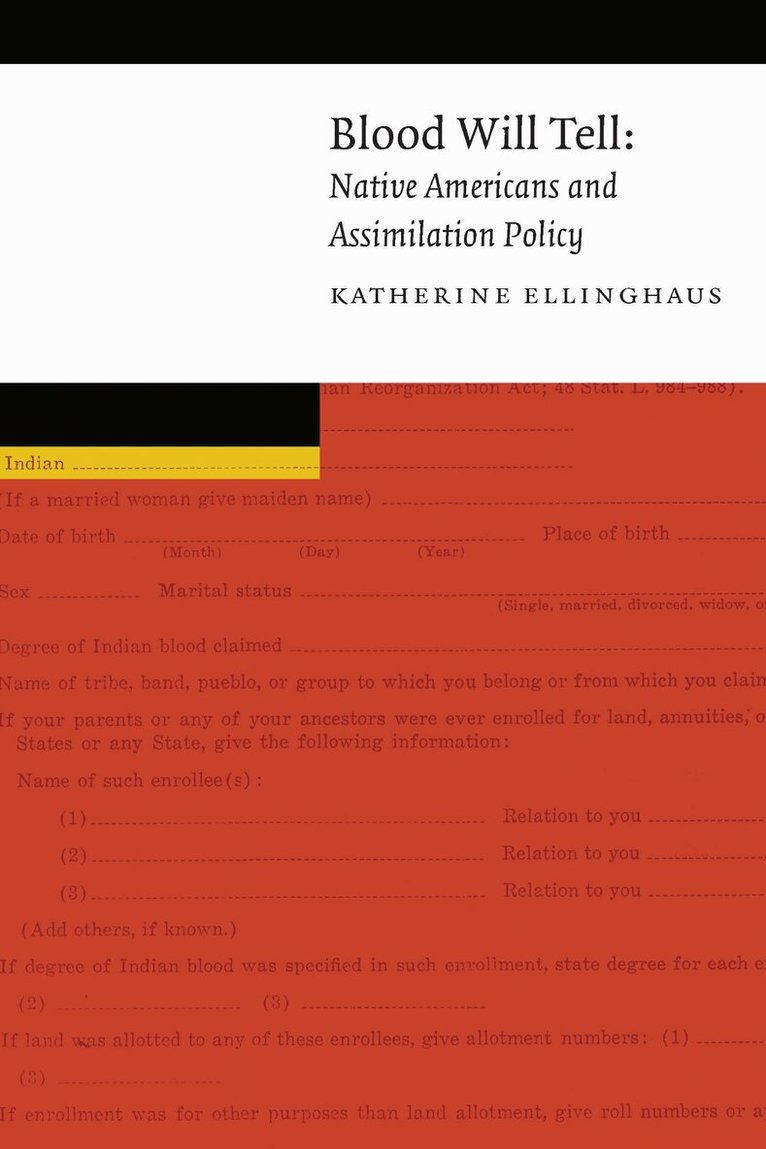
    Blood Will Tell

    Native Americans and Assimilation Policy

    AvKatherine Ellinghaus

    Häftad, Engelska, 2022

    Del i serien New Visions in Native American and Indigenous Studies

    279 kr

    Beställningsvara. Skickas inom 10-15 vardagar. Fri frakt över 249 kr.

    Fler format och utgåvor

    Inbunden

    465 kr

    Beskrivning

    Blood Will Tell reveals the underlying centrality of blood in shaping official ideas about who was eligible to be defined as Indian by the General Allotment Act in the United States. Katherine Ellinghaus traces the idea of blood quantum and how the concept came to dominate Native identity and national status between 1887 and 1934 and how related exclusionary policies functioned to dispossess Native people of their land. The U.S. government’s unspoken assumption at the time was that Natives of mixed descent were undeserving of tribal status and benefits, notwithstanding that these people played crucial roles in the national implementation of allotment policy.Ellinghaus explores on-the-ground case studies of Anishinaabeg, Arapahos, Cherokees, Eastern Cherokees, Cheyennes, Chickasaws, Choctaws, Creeks, Lakotas, Lumbees, Ojibwes, Seminoles, and Virginia tribes. Documented in these cases, the history of blood quantum as a policy reveals assimilation’s implications and legacy. The role of blood quantum is integral to understanding how Native Americans came to be one of the most disadvantaged groups in the United States, and it remains a significant part of present-day debates about Indian identity and tribal membership. Blood Will Tell is an important and timely contribution to current political and scholarly debates.

    Produktinformation

    • Utgivningsdatum:2022-05-01
    • Mått:152 x 229 x 13 mm
    • Vikt:354 g
    • Format:Häftad
    • Språk:Engelska
    • Serie:New Visions in Native American and Indigenous Studies
    • Antal sidor:234
    • Förlag:University of Nebraska Press
    • ISBN:9781496230379

    Utforska kategorier

    • Socialhistoria och kulturhistoria inom Historia och arkeologi
    • Amerikas historia inom Historia och arkeologi
    • Etnicitet inom Samhälle och politik

    Mer om författaren

    Katherine Ellinghaus is an associate professor of history at La Trobe University in Melbourne. She is the author of Taking Assimilation to Heart: Marriages of White Women and Indigenous Men in Australia and the United States, 1887–1937 (Nebraska, 2006) and coeditor of Historicising Whiteness: Transnational Perspectives on the Construction of an Identity.

    Recensioner i media

    "Ellinghaus has taken a nuanced approach to an incredibly complex and wide-ranging topic with successful results. The book is thoroughly researched, well argued, and will be especially useful to scholars of nineteenth-century American Indian history and federal Indian policy."-Natalie Panther, Chronicles of Oklahoma "Blood Will Tell engages with and makes important contributions to the historical scholarship and contemporary political debates on race and citizenship in the academy, as well as in American Indian families, communities, and nations."-Jill Doerfler, American Historical Review "This book makes a significant contribution to how we interpret assumptions about ethnicity, skin color, and cultural behavior-from low-level civil servants to official ideology to indigenous notions of identity. It is a welcome addition to furthering our understanding of blood quantum and Native American policy."-Ryan W. Schmidt, Great Plains Quarterly "Blood Will Tell makes a brilliant and original contribution to historical scholarship on Indians, race, and settler colonialism in western American history and merits a wide readership."-Baligh Ben Taleb, Pacific Historical Review "Blood Will Tell is a valuable contribution to studies of the allotment era in particular and to studies of U.S.–American Indian relations and settler colonialism in general."-John R. Gram, Southwestern Historical Quarterly "Ellinghaus's work shines a light on a crucial component of federal Indian policy."-Christopher Steinke, Nebraska History “Ellinghaus utilizes an impressive amount of archival research and specific case studies to show how the concept of blood permeated the policies of the Office of Indian Affairs during [the late nineteenth and early twentieth century].”-Paul Spruhan, Canadian Journal of Native Studies  "Ellinghaus offers this book as a means for critiquing and analyzing the phenomenon of settler colonialism which allowed for tropes of authenticity to persist to today. It also adds to the story of Native Americans' unrelenting resistance with racial science and white structures. In light of the semi-recent events at Standing Rock, Native American persistence throughout history is again highlighted by their ability to resist and act against their oppressors."-Hannah Blubaugh, Origins “Katherine Ellinghaus brilliantly traces the uneven practices that produced a powerful discourse of American Indian blood quantum. With sure hand and subtle interpretation, Blood Will Tell offers a compelling new reading of a technology of identity at once complicated and crude.”-Philip J. Deloria, Carroll Smith-Rosenberg Collegiate Professor at the University of Michigan, Ann Arbor, and author of Indians in Unexpected Places “Written with great clarity and precision. . . . Ellinghaus develops several key insights that will make contributions to historical scholarship on Indians, race, and western American history.”-Margaret Jacobs, Chancellor’s Professor of History at the University of Nebraska–Lincoln and author of A Generation Removed: The Fostering and Adoption of Indigenous Children in the Postwar World

    Innehållsförteckning

    • List of Illustrations    Introduction: The Discourse of Blood in the Assimilation Period    1. Fraud: The Allotment of the Anishinaabeg    2. Chaos: The Dawes Commission and the Five Tribes    3. Practically White: The Federal Policy of Competency    4. The Same Old Deal: The 1934 Indian Reorganization Act    5. Colored: The Indian Nations of Virginia and the 1924 Racial Integrity Act    Conclusion: Writing Blood into the Assimilation Period    Acknowledgments    Notes    Bibliography    Index