• Fri frakt över 249 kr
  • •
  • Snabba leveranser
  • •
  • Billiga böcker
Kundservice

Du är på sajten för privatpersoner.

Företag, bibliotek eller offentlig verksamhet?

Du handlar på classic.bokus.com, där alla dina funktioner finns intakta.
Till classic.bokus.com
Bokus logotyp. Gå till startsidan.
  • Erbjudanden
  • Nyheter
  • Student
  • Topplistor
  • Barn & ungdom
  • Bokus Play
  • E-böcker
  • Pocketböcker
  • Spel & pussel

10% rabatt på allt med kod NYSTART10 →

Sidfot

Mina sidor

    Hjälp

    • Kundservice
    • Vanliga frågor och svar
    • Frakt och leverans
    • Retur vid ångerrätt
    • Reklamera vara
    • Betalning
    • Köpvillkor
    • Allmänna villkor
    • Information om webbplatsens tillgänglighet

    Om Bokus

    • Om oss
    • Pressrum
    • För studenter
    • För företag
    • För bibliotek och offentlig verksamhet
    • För leverantörer
    • Hållbarhet

    Populärt

    • Aktuella erbjudanden
    • Presentkort
    • Studentlitteratur
    • Nya böcker
    • Topplistor
    • Signerade böcker
    • Engelska böcker

    Inspiration

    • Boktips
    • BookTok
    • Populära bokserier
    • Barnbokskaraktärer
    • Populära författare
    Logotyp för Bokus
    Följ oss på Facebook (extern länk)Följ oss på Instagram (extern länk)Följ oss på YouTube (extern länk)Följ oss på TikTok (extern länk)
    bokus @ CookiesAnpassa cookiesIntegritetspolicyKöpvillkor
    Till Citymail hemsida (extern länk)Till Budbee hemsida (extern länk)Till Postnord hemsida (extern länk)Till Schenker hemsida (extern länk)Till Early Bird hemsida (extern länk)Till Walleys hemsida (extern länk)
    1. Biografier
    2. Biografier

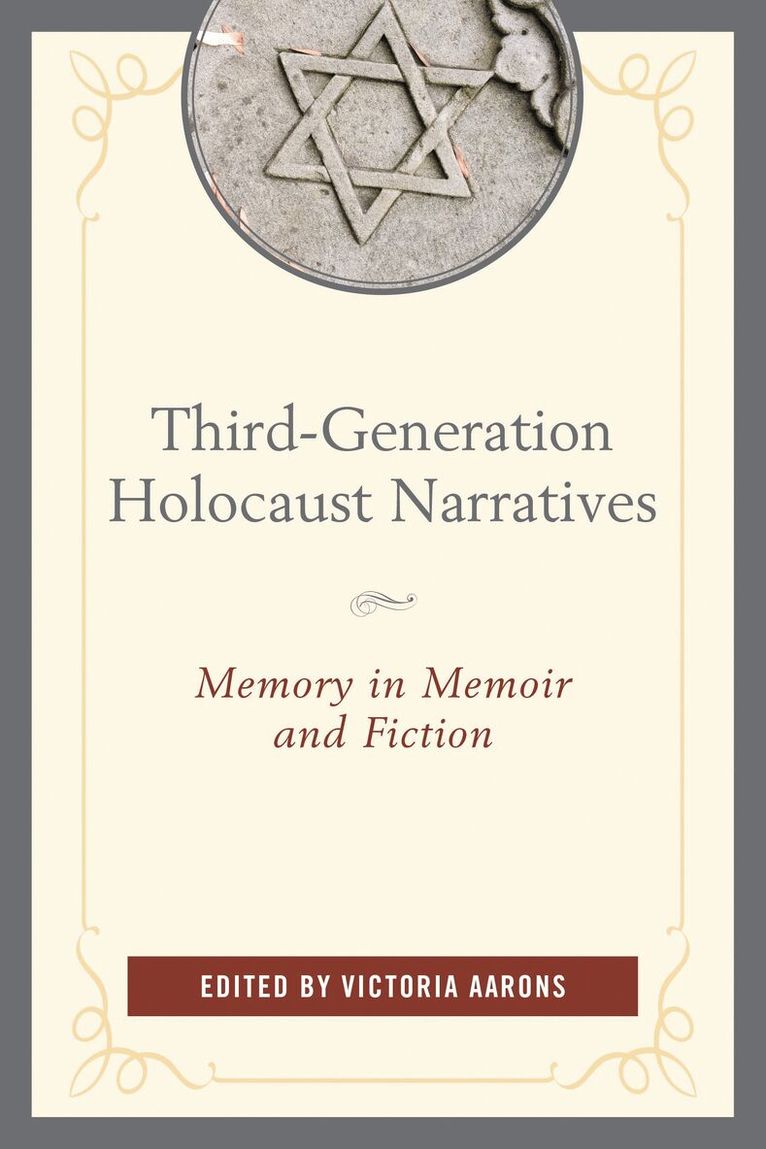
    Third-Generation Holocaust Narratives

    Memory in Memoir and Fiction

    AvVictoria Aarons

    Häftad, Engelska, 2018

    Del i serien Lexington Books

    656 kr

    Beställningsvara. Skickas inom 10-15 vardagar. Fri frakt över 249 kr.

    Beskrivning

    This collection of new essays examines third-generation Holocaust narratives and the inter-generational transmission of trauma and memory. This collection demonstrates the ways in which memory of the Holocaust has been passed along inter-generationally from survivors to the second-generation—the children of survivors—to a contemporary generation of grandchildren of survivors—those writers who have come of literary age at a time that will mark the end of direct survivor testimony. This collection, in drawing upon a variety of approaches and perspectives, suggests the rich and fluid range of expression through which stories of the Holocaust are transmitted to and by the third generation, who have taken on the task of bearing witness to the enormity of the Holocaust and the ways in which this pronounced event has shaped the lives of the descendants of those who experienced the trauma first-hand. The essays collected—essays written by renowned scholars in Holocaust literature, philosophy, history, and religion as well as by third-generation writers—show that Holocaust literary representation has continued to flourish well into the twenty-first century, gaining increased momentum as a third generation of writers has added to the growing corpus of Holocaust literature. Here we find a literature that laments unrecoverable loss for a generation removed spatially and temporally from the extended trauma of the Holocaust. The third-generation writers, in writing against a contemporary landscape of post-apocalyptic apprehension and anxiety, capture and penetrate the growing sense of loss and the fear of the failure of memory. Their novels, short stories, and memoirs carry the Holocaust into the twenty-first century and suggest the future of Holocaust writing for extended generations.

    Produktinformation

    • Utgivningsdatum:2018-03-23
    • Mått:152 x 231 x 19 mm
    • Vikt:358 g
    • Format:Häftad
    • Språk:Engelska
    • Serie:Lexington Books
    • Antal sidor:234
    • Förlag:Bloomsbury Publishing Plc
    • ISBN:9781498517188

    Utforska kategorier

    • Biografier inom Biografier
    • Sociala grupper och identitet inom Samhälle och politik
    • Litteraturvetenskap inom Skönlitteratur

    Mer om författaren

    Victoria Aarons is O.R. & Eva Mitchell Distinguished Professor of Literature in the English Department at Trinity University.

    Recensioner i media

    This collection considers works written by grandchildren, great nieces and nephews, and other relatives about family members who lived during the Hitler years. The term third generation raises some issues. In speaking about the literature of the Holocaust, “the literature of the first generation” meant the testimony of those who lived through the horrors of the Third Reich, those who either survived the death camps (Primo Levi, Ellie Wiesel, Imre Kertesz, et al.) or lived in hiding in the ghettos or as partisan fighters. It did not include those who lived safely through the Nazi years in protected areas or foreign countries. When critics and scholars begin to use terms such as 3G literature and introduce expressions such as 1.5G, 2G, 2.5G, and 3G, one senses that 3.5G and 4G loom in the future; lost is the emphasis on the quality of the story, novel, memoir, biography, film, or research being produced. Generational criticism privileges familial relationships. At its worse, it exploits the experiences of others. Important in this regard is critique of how writers far removed from the Holocaust preserve memory and provide witness to a past they never experienced. The best of these essays do that well, and this book is valuable for doing that service. Summing Up: Recommended. Graduate students, researchers, faculty.

    Innehållsförteckning

    • 1. A Special Kind of Kinship: On Being a ‘3G’ Writer, Erika Dreifus2. Memory’s Afterimage: Post-Holocaust Writing and the Third Generation, Victoria Aarons 3. A Visible Bridge: Contemporary Jewish Fiction and the Return to the Shoah, Avinoam Patt4. Story-telling, Photography, and Mourning in Daniel Mendelsohn’s The Lost, Paule Lévy5. Life After Death: A Third Generation Journey in Jérémie Dres’ We Won't See Auschwitz, Alan Berger6. The “generation without grandparents”: Witnesses and Companions to an Unfinished Search, Malena Chinski7. Avatars of Third-Generation Holocaust Narrative in French and Spanish, Alan Astro8. Measure for Measure: Narrative and Numbers in Holocaust Textual Memorials, Jessica Lang9. Against Generational Thinking in Holocaust Studies, Gary Weissman10. Simon and Mania, Henri Raczymow, translated by Alan AstroPreface: Henri Raczymow, Writer of the Second-and-a-Half Generation in France, Alan Astro