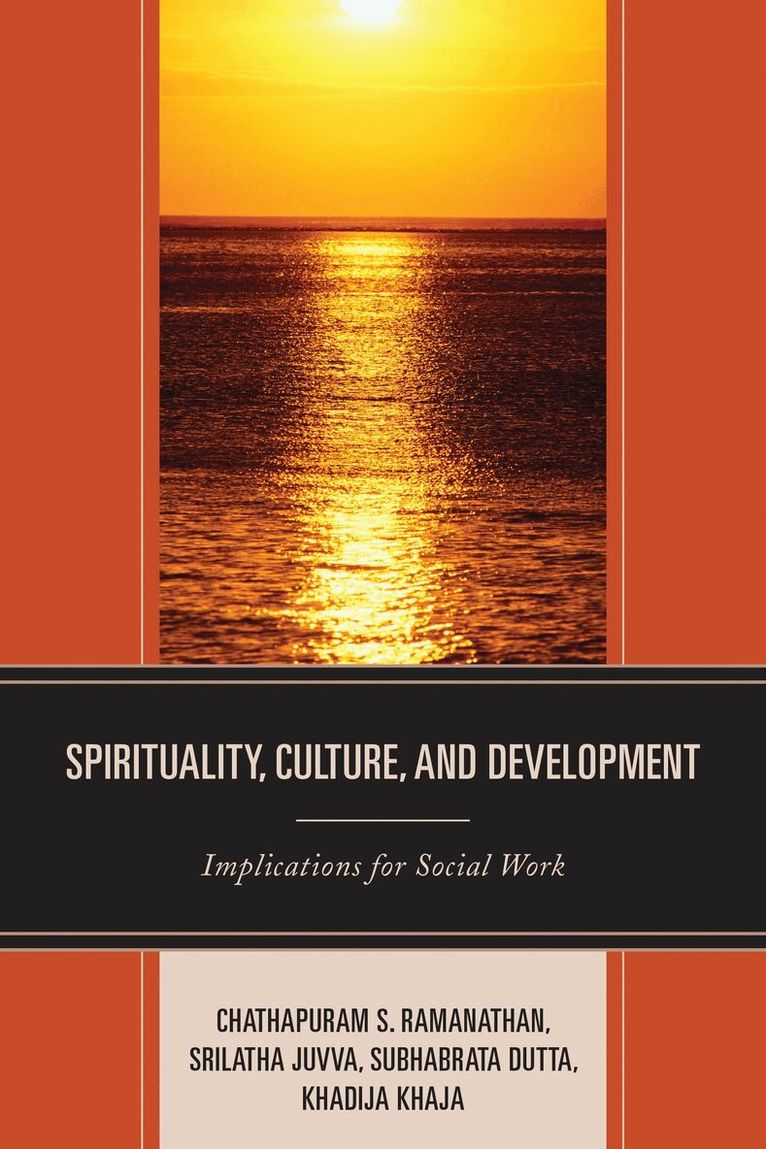
Häftad, Engelska, 2018
Spirituality, Culture, and Development
Implications for Social Work
Av Chathapuram S. Ramanathan, Srilatha Juvva, Subhabrata Dutta, Khadija Khaja
570 kr
Beställningsvara. Skickas inom 10-15 vardagar. Fri frakt över 249 kr.
Beskrivning
Produktinformation
- Utgivningsdatum: 2018-11-06
- Mått: 151 x 219 x 22 mm
- Vikt: 449 g
- Format: Häftad
- Språk: Engelska
- Antal sidor: 298
- Förlag: Bloomsbury Publishing Plc
- ISBN: 9781498519694
Utforska kategorier
Mer om författaren
Chathapuram S. Ramanathan is chief executive of Human Service Enterprises.Srilatha Juvva is professor of social work at the Tata Institute of Social Sciences. Subhabrata Dutta is professor and head of the Department of Social Work and dean of students’ welfare at Assam University.Khadija Khaja is associate professor at Indiana University's School of Social Work.
Recensioner i media
This book goes far in presenting wide-ranging political, economic, social, cultural, and religious differences among nations for social work readers around the world. The authors assert that the wisdom or truth of the individual—and therefore motivating factor for social justice—is often a spiritual one. “Spirituality” is writ large here, from organized religions to a mindful connection with self, others, and the world. The book is equally valuable to global western and northern social workers in that it challenges not only the terms “first-world” and “third-world,” but also the idea of degree of a country’s “development.” The authors argue that countries are continuously creating their states, economies and civil societies within their cultures and histories and there is no single desired “developed” endpoint. In fact, the typical development measures of Gross National Product (GNP) or Gross Domestic Product (GDP) rely heavily on measures of the market. These minimize the value of civil society and progressive state policies evident in the Social Progress Index (SPI) such as ecosystem sustainability, access to healthcare and education, gender equality, attitudes toward immigrants and minorities, religious freedom, and nutrition measures. Understanding “development” in this way would provide a rather different assessment of the global stage. This book is ambitious and creates an important theoretical foundation on which to build the next installment regarding global development and its relation to spirituality.
Betyg & recensioner
0 recensioner
Inga recensioner tillgängliga.