• Fri frakt över 249 kr
  • •
  • Snabba leveranser
  • •
  • Billiga böcker
Kundservice

Du är på sajten för privatpersoner.

Företag, bibliotek eller offentlig verksamhet?

Du handlar på classic.bokus.com, där alla dina funktioner finns intakta.
Till classic.bokus.com
Bokus logotyp. Gå till startsidan.
  • Erbjudanden
  • Nyheter
  • Student
  • Topplistor
  • Barn & ungdom
  • Bokus Play
  • E-böcker
  • Pocketböcker
  • Spel & pussel

10% rabatt på allt med kod NYSTART10 →

Sidfot

Mina sidor

    Hjälp

    • Kundservice
    • Vanliga frågor och svar
    • Frakt och leverans
    • Retur vid ångerrätt
    • Reklamera vara
    • Betalning
    • Köpvillkor
    • Allmänna villkor
    • Information om webbplatsens tillgänglighet

    Om Bokus

    • Om oss
    • Pressrum
    • För studenter
    • För företag
    • För bibliotek och offentlig verksamhet
    • För leverantörer
    • Hållbarhet

    Populärt

    • Aktuella erbjudanden
    • Presentkort
    • Studentlitteratur
    • Nya böcker
    • Topplistor
    • Signerade böcker
    • Engelska böcker

    Inspiration

    • Boktips
    • BookTok
    • Populära bokserier
    • Barnbokskaraktärer
    • Populära författare
    Logotyp för Bokus
    Följ oss på Facebook (extern länk)Följ oss på Instagram (extern länk)Följ oss på YouTube (extern länk)Följ oss på TikTok (extern länk)
    bokus @ CookiesAnpassa cookiesIntegritetspolicyKöpvillkor
    Till Citymail hemsida (extern länk)Till Budbee hemsida (extern länk)Till Postnord hemsida (extern länk)Till Schenker hemsida (extern länk)Till Early Bird hemsida (extern länk)Till Walleys hemsida (extern länk)
    1. Samhälle och politik
    2. Politik och statsskick
    3. Statsvetenskap och politisk teori

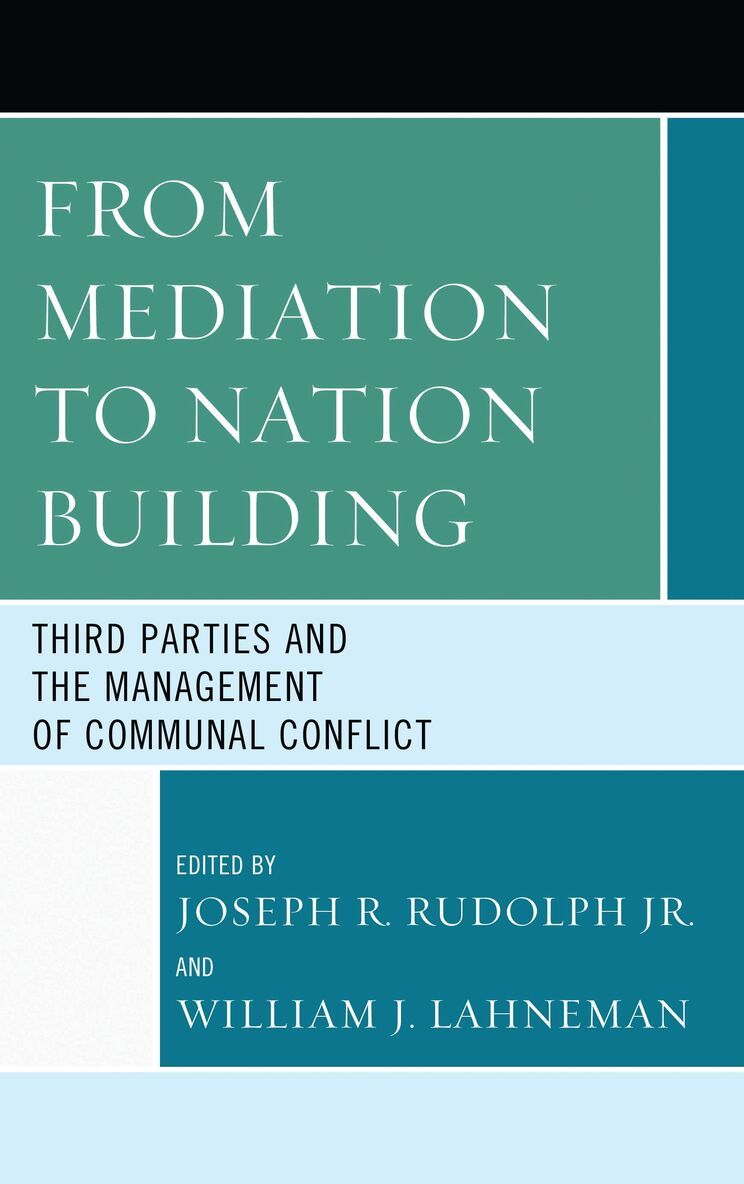
    From Mediation to Nation-Building

    Third Parties and the Management of Communal Conflict

    AvJoseph R. Rudolph Jr.,William J. Lahneman

    Häftad, Engelska, 2017

    910 kr

    Beställningsvara. Skickas inom 10-15 vardagar. Fri frakt över 249 kr.

    Beskrivning

    The eruption in the early 1990s of highly visible humanitarian crises and exceedingly bloody civil wars in the Horn of Africa, imploding Yugoslavia, and Rwanda, set in motion a trend towards third party intervention in communal conflict in areas as far apart as the Balkans and East Timor. However haltingly and selectively, that trend towards extra-systemic means of managing ethnic and national conflict is still discernible, motivated as it was in the 1990s by the inability of in-house accommodation methods to resolve ethno-political conflicts peacefully and the tendency of such conflicts to spill into the international system in the form of massive refugee flows, regional instability, and failed states hosting criminal and terrorist elements. In its various forms, third party intervention has become a fixed part of the current international systemOur book examines the various forms in which that intervention occurs, from the least intrusive and costly forms of third party activity to the most intrusive and expensive endeavors. More specifically, organized in the form of overview essays followed by case studies that explore the utility and limitations, successes and failures of various forms of third party activity in managing conflict, the book begins by examining diplomatic intervention and then proceeds to cover, in turn, legal, economic, and military instruments of conflict management before concluding with a section on political tutelage arrangements and nation/capacity building operations.The chapters themselves are authored by a mix of contributors drawn from relevant disciplines, both senior and younger scholars, academics and practitioners, and North Americans and Europeans. All treat a common theme but no attempt was made to solicit work from contributors with a common orientation towards the value of third party intervention. Nor were the authors straight-jacketed with heavy content guidelines from the editors. Their essays validate the value of this approach. Far from being chaotic in nature, they generally supplement one another, while offering opposing viewpoints on the overall topic; for example, our Italian contributor who specializes in non-government organizations offers a chapter illustrating their utility under certain conditions, whereas the chapter from an Afghan practitioner notes the downside of too much reliance on NGOs in nation-building operations. The essays also cover topics not often treated, and are written from the viewpoint of those on the ground. The chapter on creating a police force in post-Dayton Bosnia-Herzegovina, for example, reads much like a diary from the American colonel who was sent to Bosnia in early 1996 charged with that task.

    Produktinformation

    • Utgivningsdatum:2017-03-01
    • Mått:150 x 230 x 40 mm
    • Vikt:812 g
    • Format:Häftad
    • Språk:Engelska
    • Antal sidor:534
    • Förlag:Bloomsbury Publishing Plc
    • ISBN:9781498556552

    Utforska kategorier

    • Statsvetenskap och politisk teori inom Samhälle och politik
    • Politiskt förtryck inom Samhälle och politik
    • Internationella relationer inom Samhälle och politik

    Mer om författaren

    Joseph R. Rudolph, Jr., is a professor of Political Science at Towson University, has served as a Fulbright appointee to Czechoslovakia (1991-2) and Kosovo (2011-2), and has published in the field of ethnic and nationalist politics for more than 30 years. He has also frequently been a part of the democratization operations of the Organization for Security and Cooperation in Europe (OSCE) in areas of the former Yugoslavia since 1997. His more recent work includes The Encyclopedia of Modern Ethnic Conflicts (ed., 2003), Politics and Ethnicity: A Comparative Study (2006), and Hotspots in North America and Europe (2008).William J. Lahneman is an associate professor of Political Science at Towson University, and a Senior Research Scholar at the Center for International and Security Studies at Maryland (CISSM) at the University of Maryland’s School of Public Policy. He holds a Ph.D. in International Relations from the Johns Hopkins University’s School of Advanced International Studies, an M.A. in National Security Affairs from the Naval Postgraduate School, and a B.S. from the U. S. Naval Academy. He has held academic positions as Associate Director for Programs at CISSM and as Associate Chair of the Political Science Department at the U.S. Naval Academy. A former U.S. Navy Commander with specializations in Surface Warfare, Strategic Planning, International Negotiations, and Nuclear Propulsion, his publications include Military Intervention: Cases in Context for the Twenty-first Century (ed., 2004) and Keeping U.S. Intelligence Effective: The Need for a Revolution in Intelligence Affairs (2011).

    Recensioner i media

    A hugely comprehensive presentation of conflict management, rich with concepts and case studies to guide third party intervenors and analysts, written by a broad mixture of younger scholars and established authorities, and designed to improve understanding and practice with a ‘responsibility to perfect’ the world.

    Innehållsförteckning

    • DedicationAcknowledgmentsIntroduction: Communal Conflict and Third Party Intervention in a “Responsibility to Protect” WorldJoseph R. Rudolph, Jr.Part 1. DiplomacyChapter 2: “Peace Without Victory:” The Promise and Constraints of Third-Party Mediation in Civil WarsPaul McCartneyChapter 3: Ending the “Troubles”: Brokering Peace in Northern IrelandElham AtashiChapter 4: Implementing the Liberal Peace: Observations from the FieldLinda S. BishaiChapter 5: Election Observers, Democratization, and Preventive DiplomacyJoseph R. Rudolph, Jr.Part 2. Legal ApproachesChapter 6: International Law and Internal ConflictsI.M. Lobo de SouzaChapter 7: Turbulent Transition: From the UN Human Rights Commission to the CouncilDavid P. ForsytheChapter 8: Transitional Justice in Divided Societies: Using Hybrid Courts to Manage ConflictJames DeShaw RaePart 3. Economic MeasuresChapter 9: Economic Instruments of Internal Conflict ResolutionStephen D. CollinsChapter 10: Externally Mandated Economic Liberalization and the Onset of Civil ConflictMatthew Hoddie and Caroline HartzellChapter 11: Conditional Conditionality: The European Union, International Justice, and the Democratic Transition in SerbiaVictor Peskin and Mieczyslaw P. BoduszynskiChapter 12: The EU and Roma RightsNeil CruickshankPart 4. Military Operations and Communal ConflictChapter 13: Military Intervention as a Tool of Conflict Resolution and Institution BuildingWilliam J. LahnemanChapter 14: Somalia: Intervention in Internal ConflictDavid D. LaitinChapter 15: Intervention in Internal Conflict: Lessons from Bosniaand KosovoSteven L. BurgChapter 16: The Bosnian Intervention: Stabilization Without GuidelinesBrigid Myers PavilonisChapter 17: Rebuilding a Democratic Iraqi Police Force: The Effects of the Militia on the Rebuilding ProcessDiJon JonesChapter 18: Security Without Weapons: The Nonviolent Peace Force in Sri LankaM.S. WallacePart 5. Mentoring, Political Tutelage, and Nation-building as Toolsof Conflict Prevention and ManagementChapter 19: Third Party Nation-Building Today: Fifth Time Charmed?Joseph R. Rudolph, Jr.Chapter 20: Nation Building and Democratization in Afghanistan: The Need to Rethink the “Democratic Reconstruction Model”Mohammad AshrafChapter 21: International Intervention and Ethnic Tolerance in Bosnia-Herzegovina: Evidence from Public OpinionSam WhittChapter 22: Wither Sovereignty? The Limits of Building States through International AdministrationsMateja PeterChapter 23: Bosnia Herzegovina and the Development of Democratic PolicingDonald R. ZoufalChapter 24: NGOs, Peace Support Activity, and the UNPREDEP Mission in MacedoniaDaniela IrreraPart 6. ConclusionConclusions: Third Parties and the Management of Communal ConflictWilliam J. LahnemanBibliographyIndexAbout the Contributors