• Fri frakt över 249 kr
  • •
  • Snabba leveranser
  • •
  • Billiga böcker
Kundservice

Du är på sajten för privatpersoner.

Företag, bibliotek eller offentlig verksamhet?

Du handlar på classic.bokus.com, där alla dina funktioner finns intakta.
Till classic.bokus.com
Bokus logotyp. Gå till startsidan.
  • Erbjudanden
  • Nyheter
  • Student
  • Topplistor
  • Barn & ungdom
  • Bokus Play
  • E-böcker
  • Pocketböcker
  • Spel & pussel

10% rabatt på allt med kod: NYSTART10 →

Sidfot

Mina sidor

    Hjälp

    • Kundservice
    • Vanliga frågor och svar
    • Frakt och leverans
    • Retur vid ångerrätt
    • Reklamera vara
    • Betalning
    • Köpvillkor
    • Allmänna villkor
    • Information om webbplatsens tillgänglighet

    Om Bokus

    • Om oss
    • Pressrum
    • För studenter
    • För företag
    • För bibliotek och offentlig verksamhet
    • För leverantörer
    • Hållbarhet

    Populärt

    • Aktuella erbjudanden
    • Presentkort
    • Studentlitteratur
    • Nya böcker
    • Topplistor
    • Signerade böcker
    • Engelska böcker

    Inspiration

    • Boktips
    • BookTok
    • Populära bokserier
    • Barnbokskaraktärer
    • Populära författare
    Logotyp för Bokus
    Följ oss på Facebook (extern länk)Följ oss på Instagram (extern länk)Följ oss på YouTube (extern länk)Följ oss på TikTok (extern länk)
    bokus @ CookiesAnpassa cookiesIntegritetspolicyKöpvillkor
    Till Citymail hemsida (extern länk)Till Budbee hemsida (extern länk)Till Postnord hemsida (extern länk)Till Schenker hemsida (extern länk)Till Early Bird hemsida (extern länk)Till Walleys hemsida (extern länk)
    1. Samhälle och politik
    2. Samhälle och kultur
    3. Sociala grupper och identitet

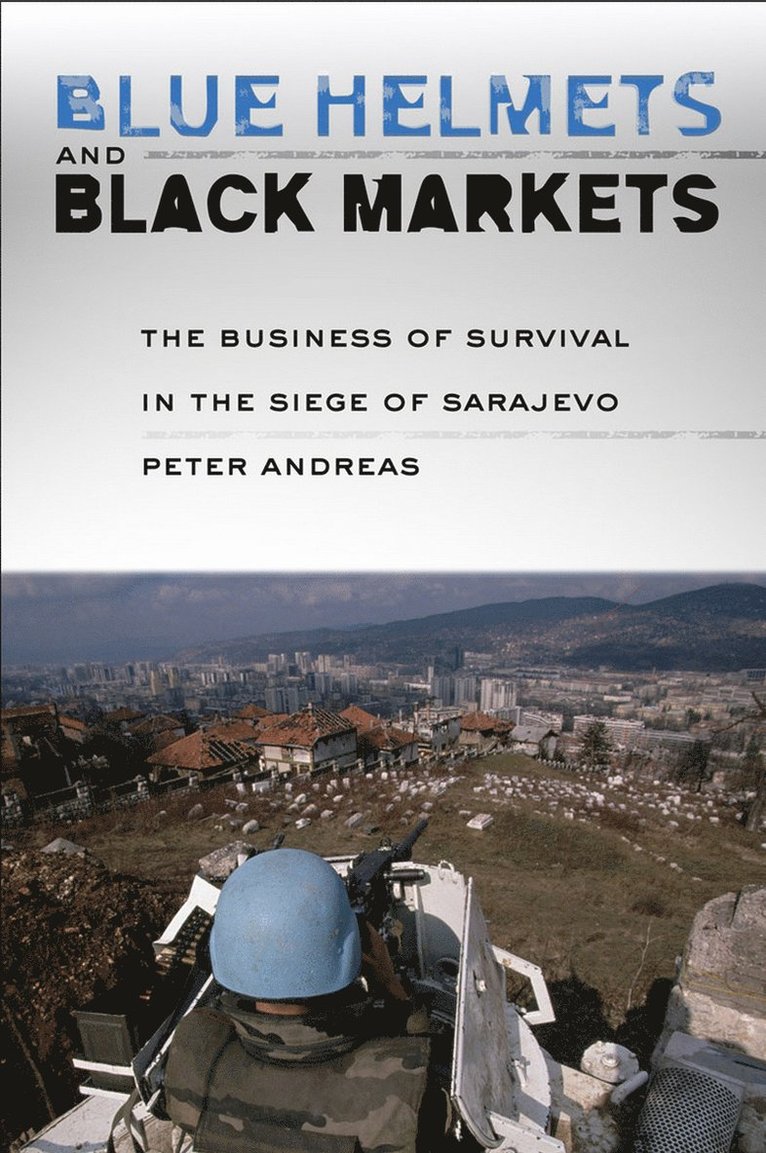
    Blue Helmets and Black Markets

    The Business of Survival in the Siege of Sarajevo

    AvPeter Andreas

    Häftad, Engelska, 2016

    243 kr

    Beställningsvara. Skickas inom 10-15 vardagar. Fri frakt över 249 kr.

    Fler format och utgåvor

    Inbunden

    313 kr

    Beskrivning

    The 1992–1995 battle for Sarajevo was the longest siege in modern history. It was also the most internationalized, attracting a vast contingent of aid workers, UN soldiers, journalists, smugglers, and embargo-busters. The city took center stage under an intense global media spotlight, becoming the most visible face of post-Cold War conflict and humanitarian intervention. However, some critical activities took place backstage, away from the cameras, including extensive clandestine trading across the siege lines, theft and diversion of aid, and complicity in the black market by peacekeeping forces.In Blue Helmets and Black Markets, Peter Andreas traces the interaction between these formal front-stage and informal backstage activities, arguing that this created and sustained a criminalized war economy and prolonged the conflict in a manner that served various interests on all sides. Although the vast majority of Sarajevans struggled for daily survival and lived in a state of terror, the siege was highly rewarding for some key local and international players. This situation also left a powerful legacy for postwar reconstruction: new elites emerged via war profiteering and an illicit economy flourished partly based on the smuggling networks built up during wartime.Andreas shows how and why the internationalization of the siege changed the repertoires of siege-craft and siege defenses and altered the strategic calculations of both the besiegers and the besieged. The Sarajevo experience dramatically illustrates that just as changes in weapons technologies transformed siege warfare through the ages, so too has the arrival of CNN, NGOs, satellite phones, UN peacekeepers, and aid convoys. Drawing on interviews, reportage, diaries, memoirs, and other sources, Andreas documents the business of survival in wartime Sarajevo and the limits, contradictions, and unintended consequences of international intervention. Concluding with a comparison of the battle for Sarajevo with the sieges of Leningrad, Grozny, and Srebrenica, and, more recently, Falluja, Blue Helmets and Black Markets is a major contribution to our understanding of contemporary urban warfare, war economies, and the political repercussions of humanitarian action.

    Produktinformation

    • Utgivningsdatum:2016-04-06
    • Mått:152 x 229 x 16 mm
    • Vikt:454 g
    • Format:Häftad
    • Språk:Engelska
    • Antal sidor:224
    • Förlag:Cornell University Press
    • ISBN:9781501704338
    • Utmärkelser:Honorable Mention, 2009 Wayne S. Vucinich Book Pri

    Utforska kategorier

    • Sociala grupper och identitet inom Samhälle och politik
    • Brottslighet och kriminologi inom Samhälle och politik

    Mer om författaren

    Peter Andreas is John Hay Professor of International Studies at Brown University. He is the author of Border Games and coeditor of Sex, Drugs, and Body Counts, both from Cornell. He is also the author of Smuggler Nation and coauthor of Policing the Globe and Drug War Politics.

    Recensioner i media

    Blue Helmets and Black Markets provides a template for analyzing international interventions, suggesting that looking beyond the standard actors and actions yields some significant insights.(International Studies Review) Andreas does not deny the suffering or the heroism of those caught in the siege of Sarajevo or the deadly earnestness of those who maintained it. But he wants to make this savage tale whole by exposing corruption's part in exploiting and sustaining the violence. Andreas, with prose as lean as his analysis is rich, avoids moral judgments and focuses instead on the two-sided aspects of this sort of war: the illicit commerce between the warring parties, the profiteering by politicians struggling to save a community, the indulgences of outside agencies sent to help the victims.(Foreign Affairs) In this provocative study, Andreas examines the unexpected consequences of humanitarian intervention.... Drawing on extensive interviews, diaries, and memoirs of participants, and newspaper accounts, among other sources, Andreas argues that the internationalization of the siege paradoxically prolonged the conflict. Humanitarian assistance the international community provided to the people of Sarajevo became incorporated into the criminalized war economy that flourished in the besieged city.... The study also reveals the much more complex social dynamics that emerged and flourished during the conflict. In particular, far from severing ties between ethnic groups, the war economy sustained informal contacts and cross-ethnic collaboration in the midst of conflict. Andreas argues that the example of Sarajevo strongly suggests that uncovering the hidden dynamics of war economies is important because their legacies outlast a conflict's end and continue to shape postconflict reconstruction. Highly recommended.(Choice)

    Innehållsförteckning

    • Preface1. The Longest SiegeSarajevo on Center StageThe Cast of CharactersFront Stage and Backstage: Formal and Informal RolesConflict NarrativesCriminalized Conflict NarrativesPreview2. Imposing the SiegeThe Road to Siege WarfareThe Start of the Siege and the Criminally Aided DefenseThe International Response3. Sustaining the SiegeDiverting and Manipulating Humanitarian AidExploiting the Privileges of Mobility and AccessThe UN-Controlled Airport as Smuggling HubTunneling under the Siege: Lifeline and Profit CenterTrading with the EnemyThe Media and Its Dependence on the Black MarketThe Money Letter Smuggling SystemThe Smugglers' Markets and Cigarettes as Currency4. The Siege WithinCriminal Defenders as PredatorsPolitical Corruption, Abuse, and OpportunismObstructing Access to Water5. Lifting the SiegeFront Stage:Triggering NATO Air StrikesBackstage: Shifting the Military Balance by Evading the UN Arms Embargo6. AftermathThe Criminalized Aftermath of WarThe Criminalized New EliteSarajevo as Transit Point for Migrant SmugglingSex Trafficking and PeacekeepingThe Arizona Market: Peace through Illicit Trade?7. ExtensionsSrebrenicaLeningradGroznyFallujaConclusionsRevisiting SarajevoLessons from SarajevoNotesIndex