• Fri frakt över 249 kr
  • •
  • Snabba leveranser
  • •
  • Billiga böcker
Kundservice

Du är på sajten för privatpersoner.

Företag, bibliotek eller offentlig verksamhet?

Du handlar på classic.bokus.com, där alla dina funktioner finns intakta.
Till classic.bokus.com
Bokus logotyp. Gå till startsidan.
  • Erbjudanden
  • Student
  • Topplistor
  • Barn & ungdom
  • Bokus Play
  • E-böcker
  • Ljudböcker
  • Pocketböcker
  • Spel och pussel

Pocketfynda! Hundratals böcker för 49 kr/st →

Sidfot

Mina sidor

    Hjälp

    • Kundservice
    • Vanliga frågor och svar
    • Frakt och leverans
    • Retur vid ångerrätt
    • Reklamera vara
    • Betalning
    • Köpvillkor
    • Allmänna villkor
    • Information om webbplatsens tillgänglighet

    Om Bokus

    • Om oss
    • Pressrum
    • För studenter
    • För företag
    • För bibliotek och offentlig verksamhet
    • För leverantörer
    • Hållbarhet

    Populärt

    • Aktuella erbjudanden
    • Presentkort
    • Studentlitteratur
    • Nya böcker
    • Topplistor
    • Signerade böcker
    • Engelska böcker

    Inspiration

    • Boktips
    • BookTok
    • Barnbokskaraktärer
    • Populära författare
    Logotyp för Bokus
    Följ oss på Facebook (extern länk)Följ oss på Instagram (extern länk)Följ oss på YouTube (extern länk)Följ oss på TikTok (extern länk)
    bokus @ CookiesAnpassa cookiesIntegritetspolicyKöpvillkor
    Till Citymail hemsida (extern länk)Till Budbee hemsida (extern länk)Till Postnord hemsida (extern länk)Till Schenker hemsida (extern länk)Till Early Bird hemsida (extern länk)Till Walleys hemsida (extern länk)
    1. Skönlitteratur
    2. Litteraturvetenskap
    3. Litteraturvetenskap

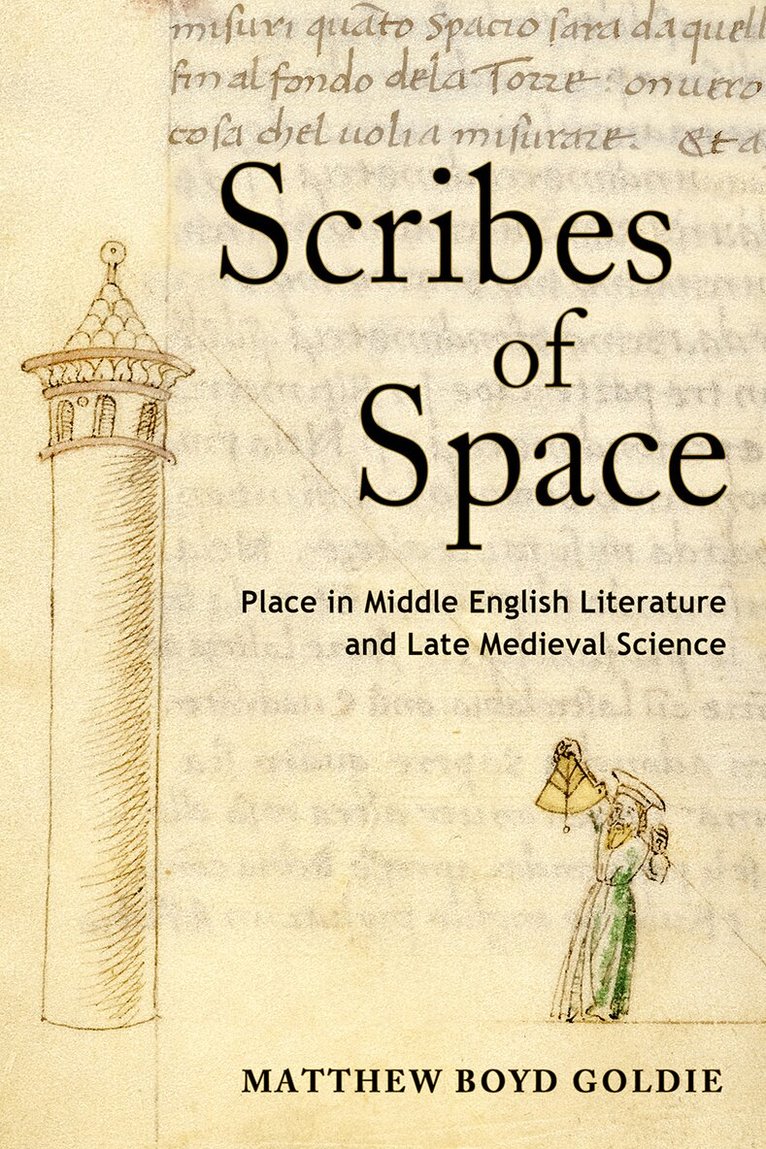
    Scribes of Space

    Place in Middle English Literature and Late Medieval Science

    AvMatthew Boyd Goldie

    Inbunden, Engelska, 2019

    818 kr

    Beställningsvara. Skickas inom 10-15 vardagar. Fri frakt över 249 kr.

    Beskrivning

    Scribes of Space posits that the conception of space—the everyday physical areas we perceive and through which we move—underwent critical transformations between the thirteenth and fifteenth centuries. Matthew Boyd Goldie examines how natural philosophers, theologians, poets, and other thinkers in late medieval Britain altered the ideas about geographical space they inherited from the ancient world. In tracing the causes and nature of these developments, and how geographical space was consequently understood, Goldie focuses on the intersection of medieval science, theology, and literature, deftly bringing a wide range of writings—scientific works by Nicole Oresme, Jean Buridan, the Merton School of Oxford Calculators, and Thomas Bradwardine; spiritual, poetic, and travel writings by John Lydgate, Robert Henryson, Margery Kempe, the Mandeville author, and Geoffrey Chaucer—into conversation. This pairing of physics and literature uncovers how the understanding of spatial boundaries, locality, elevation, motion, and proximity shifted across time, signaling the emergence of a new spatial imagination during this era.

    Produktinformation

    • Utgivningsdatum:2019-03-15
    • Mått:152 x 229 x 27 mm
    • Vikt:907 g
    • Format:Inbunden
    • Språk:Engelska
    • Antal sidor:312
    • Förlag:Cornell University Press
    • ISBN:9781501734045

    Utforska kategorier

    • Litteraturvetenskap inom Skönlitteratur
    • Naturvetenskapens historia inom Naturvetenskap och teknik

    Mer om författaren

    Matthew Boyd Goldie is Professor of English at Rider University, a founding member of MAPS: The Medieval Association of Place and Space, and author of The Idea of the Antipodes.

    Recensioner i media

    A wide, precise, and fascinating tour of ideas of space, motion, and measurement, interleaved with readings of literature (Chaucer, Margery Kempe, Mandeville, Lydgate, Henryson) considered in terms of these and other spatial ideas. The author shows how the 14th century combined traditional ideas of movement toward 'natural place' with the new idea of impetus; how new and old notions of horizon interacted; and how challenges to Aristotelean physics produced the first graphs charting variable velocity.... The readings of local maps offer good ways to approach any historical map, and the analysis of the portrait of Lydgate joining the Canterbury pilgrims, found in one medieval copy of Lydgate's 'addition' to The Canterbury Tales, is a model for analyzing art at the dawn of perspective.(Choice) An exceptionally spacious study... that focuses, with acute particularism, on premodern mentalities and material conditions in place, yielding insights into several literary landscapes.... Scribes of Space is a most welcome contribution to the study of medieval practices of space, articulating a cogent view of emplacement across various media and modalities. It is also a substantial and rewarding addition to the ongoing 'scientific turn' in medieval literary studies, expertly navigating medieval physics, geography, practical geometry, and poetry.(Studies in the Age of Chaucer) Scribes of Space does more than evince Goldie's erudition and wide-ranging interests; it evinces the need to understand the innovations of medieval scientific and mechanical knowledge as representative of an evolving understanding of the human mind.- Lynn Staley, Colgate University (SPECULUM) Goldie discerns a unique, if rarely encountered, sense of space in some medieval texts...An impressive volume that deserves to be carefully studied by those interested in literary history, early science, physics, and ancient history as it is grounded in the works of both Aristotle and Ptolemy.- Cliff Cunningham, University of Southern Queensland (Sun News Tucson) In just over two hundred pages, Goldie offers a richly capacious and wide-ranging account of late medieval ideas of space... Scribes of Space is a rich and fascinating study; if we have indeed returned to the "spatial turn," on the evidence of Goldie's excellent book, there is much that remain to be learned.(Journal of British Studies)

    Innehållsförteckning

    • List of IllustrationsAcknowledgmentsIntroduction: Late Medieval Space1. Local Space, Edges, and Contents: Chorography and Late Medieval English Maps2. Local Literature: Vernacular Local Space and John Lydgate's Siege of Thebes3. Horizonal Space: Measuring Local Area with Astrolabes, Quadrants, and Topographia4. Horizonal and Abstracted Spaces: The Book of Margery Kempe and The Book of Sir John Mandeville5. The Science of Motion: New Ideas of Impetus and Measurement6. Motion in Literature: Place and Movement in The House of Fame7. Intense Proximate Affect: Nicole Oresme's Tractatus de configurationibus qualitatum et motuum8. Proximal Literature: Nearness and Distinction in the Legend of Good WomenAfterword: Ubiquitous Being in the Pardoner's Prologue and TaleNotesBibliographyIndex