• Fri frakt över 249 kr
  • •
  • Snabba leveranser
  • •
  • Billiga böcker
Kundservice

Du är på sajten för privatpersoner.

Företag, bibliotek eller offentlig verksamhet?

Du handlar på classic.bokus.com, där alla dina funktioner finns intakta.
Till classic.bokus.com
Bokus logotyp. Gå till startsidan.
  • Erbjudanden
  • Nyheter
  • Student
  • Topplistor
  • Barn & ungdom
  • Bokus Play
  • E-böcker
  • Pocketböcker
  • Spel & pussel

10% studentrabatt med kod TERM26

Sidfot

Mina sidor

    Hjälp

    • Kundservice
    • Vanliga frågor och svar
    • Frakt och leverans
    • Retur vid ångerrätt
    • Reklamera vara
    • Betalning
    • Köpvillkor
    • Allmänna villkor
    • Information om webbplatsens tillgänglighet

    Om Bokus

    • Om oss
    • Pressrum
    • För studenter
    • För företag
    • För bibliotek och offentlig verksamhet
    • För leverantörer
    • Hållbarhet

    Populärt

    • Aktuella erbjudanden
    • Presentkort
    • Studentlitteratur
    • Nya böcker
    • Topplistor
    • Signerade böcker
    • Engelska böcker

    Inspiration

    • Boktips
    • BookTok
    • Populära bokserier
    • Barnbokskaraktärer
    • Populära författare
    Logotyp för Bokus
    Följ oss på Facebook (extern länk)Följ oss på Instagram (extern länk)Följ oss på YouTube (extern länk)Följ oss på TikTok (extern länk)
    bokus @ CookiesAnpassa cookiesIntegritetspolicyKöpvillkor
    Till Citymail hemsida (extern länk)Till Budbee hemsida (extern länk)Till Postnord hemsida (extern länk)Till Schenker hemsida (extern länk)Till Early Bird hemsida (extern länk)Till Walleys hemsida (extern länk)
    1. Historia och arkeologi
    2. Historia
    3. Historia: särskilda händelser och ämnen
    4. Socialhistoria och kulturhistoria

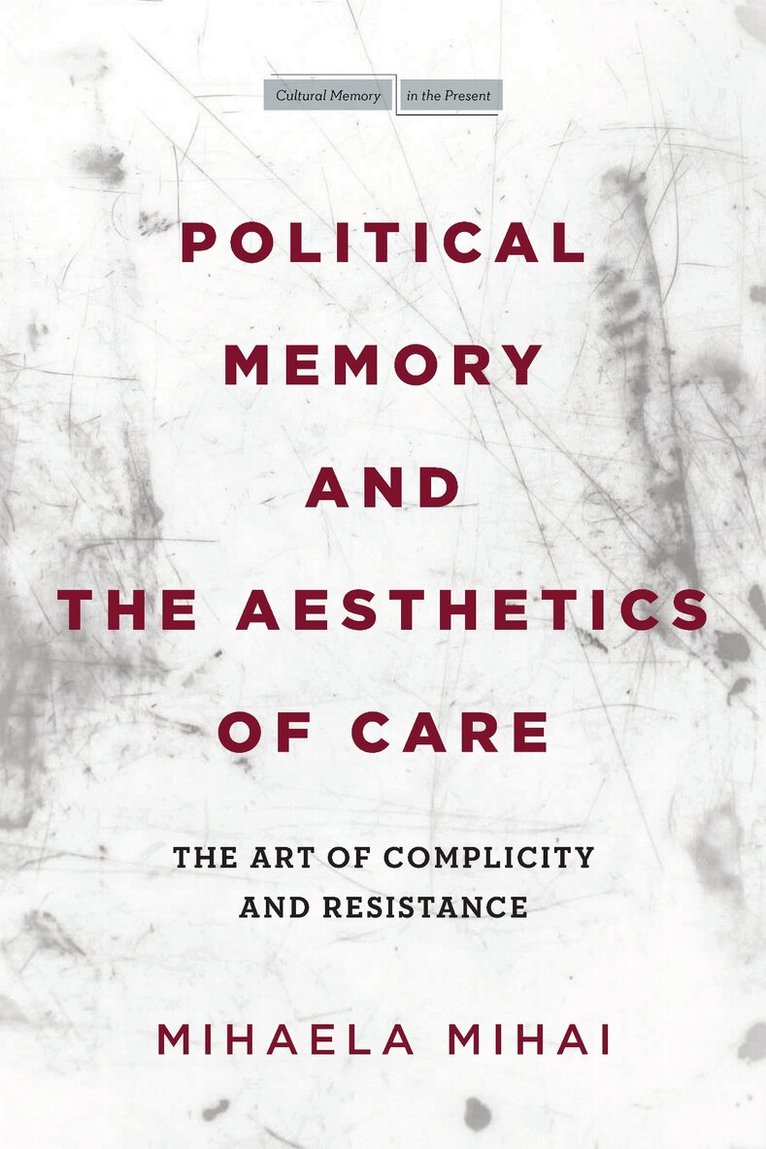
    Political Memory and the Aesthetics of Care

    The Art of Complicity and Resistance

    AvMihaela Mihai

    Häftad, Engelska, 2022

    Del i serien Cultural Memory in the Present

    302 kr

    Skickas . Fri frakt över 249 kr.

    Fler format och utgåvor

    Inbunden

    966 kr

    E-bok

    503 kr

    Beskrivning

    With this nuanced and interdisciplinary work, political theorist Mihaela Mihai tackles several interrelated questions: How do societies remember histories of systemic violence? Who is excluded from such histories' cast of characters? And what are the political costs of selective remembering in the present? Building on insights from political theory, social epistemology, and feminist and critical race theory, Mihai argues that a double erasure often structures hegemonic narratives of complex violence: of widespread, heterogeneous complicity and of "impure" resistances, not easily subsumed to exceptionalist heroic models. In dialogue with care ethicists and philosophers of art, she then suggests that such narrative reductionism can be disrupted aesthetically through practices of "mnemonic care," that is, through the hermeneutical labor that critical artists deliver—thematically and formally—within communities' space of meaning. Empirically, the book examines both consecrated and marginalized artists who tackled the memory of Vichy France, communist Romania, and apartheid South Africa. Despite their specificities, these contexts present us with an opportunity to analyze similar mnemonic dynamics and to recognize the political impact of dissenting artistic production. Crossing disciplinary boundaries, the book intervenes in debates over collective responsibility, historical injustice, and the aesthetics of violence within political theory, memory studies, social epistemology, and transitional justice.

    Produktinformation

    • Utgivningsdatum:2022-01-11
    • Mått:152 x 229 x 24 mm
    • Vikt:478 g
    • Format:Häftad
    • Språk:Engelska
    • Serie:Cultural Memory in the Present
    • Antal sidor:312
    • Förlag:Stanford University Press
    • ISBN:9781503630123

    Utforska kategorier

    • Socialhistoria och kulturhistoria inom Historia och arkeologi
    • Filosofiska discipliner inom Filosofi och religion

    Mer om författaren

    Mihaela Mihai teaches political theory at the University of Edinburgh. Her research focuses on political memory, art and politics, social epistemology and political emotions.

    Recensioner i media

    "Elegantly written and masterfully argued, Mihai's book contributes to debates about the critical role of art in resisting systemic violence and its political oblivion. With outstanding theoretical sophistication, exceptional interdisciplinary breadth, and remarkable empirical depth,it theorizes critical artistic practices as forms of mnemonic care for healthy hermeneutical climates. This book is a must-read for anyone interested in the difficult work of resisting the mystification of the past and working toward social justice."—José Medina, Northwestern University "An eloquent and pathbreaking work of political theory that is deeply engaged with history and culture. Resolutely interdisciplinary and comparative, it provides stunningly illuminating insights into the everyday forms of complicity that prop up unjust regimes and the ordinary forms of resistance through which citizens contest domination."—Michael Rothberg, University of California, Los Angeles "Mihai once again challenges received wisdoms about the right way for nations to deal with histories of systemic violence. She makes a compelling case for messier, less triumphalist narratives of the past in favour of the ethical ambiguity of how resistance and complicity actually unfold."—Danielle Celermajer, University of Sydney "Mihaela Mihai has written a daring book that transcends disciplinary, linguistic, and national boundaries."—Catherine Guisan, Contemporary Political Theory "Mihai's book shows us how to understand action differently. In the present moment, as we struggle against the writing of political memory within enclosed perceptual experiences and hermeneutics, we might draw from Mihai's theorization of mnemonic care."—Sue Shon, Krisis: A Journal for Contemporary Philosophy "With Political Memory and the Aesthetics of Care... Mihai not only offers a rich resource for scholars working on questions of complicity and implication across different fields and disciplines – from history, to sociology, to political theory and philosophy, to memory studies, and to comparative literature among others. She also lays the foundation for new and deeper critical inquiries into the ethical demands and political stakes of studying complex involvement in violence."—Sofía Forchieri, CLCWeb: Comparative Literature and Culture "In an argumentative tour de force, Mihai manages to dislocate petrified demarcation lines 'between the good and the bad, to reveal the relationality that underpins even the most exemplary practices of resistance'."—Maria Alina Asavei, The Review of Politics "Mihai explores conflict situations where moral impurities and ambiguities are entrenched in practices of resistance. She offers a sharp critique of the moralizing and absolutist discourses of political struggles and provides us with a vocabulary for thinking about unsaintly resistance in the face of injustice. Mihai's analysis, in essence, provokes thoughts on the ideas of complicit resistance and resistant complicity in the aftermath of violence."—Sakiru Adebayo, Identities "Mihai's book is revelatory."—Lawrie Balfour, Identities "Political Memory and the Aesthetics of Care is a thought-provoking meditation on the potential of artistic practices to contribute to the ongoing work of coming to terms with the past in transitional societies, following a history of state violence."—Andrew Schaap, Identities

    Innehållsförteckning

    • Introduction1. Tracing the Double Erasure2. The Aesthetics of Care3. France's "Dark Years"4. Romania's Horizons of Hope and Despair5. The Spectrum of Apartheid in South AfricaConclusion: Heretic Visions, Responsible Futures