• Fri frakt över 249 kr
  • •
  • Snabba leveranser
  • •
  • Billiga böcker
Kundservice

Du är på sajten för privatpersoner.

Företag, bibliotek eller offentlig verksamhet?

Du handlar på classic.bokus.com, där alla dina funktioner finns intakta.
Till classic.bokus.com
Bokus logotyp. Gå till startsidan.
  • Erbjudanden
  • Nyheter
  • Student
  • Topplistor
  • Barn & ungdom
  • Bokus Play
  • E-böcker
  • Pocketböcker
  • Spel & pussel

Må bättre, för mindre! Upp till 50% rabatt på hälsoböcker

Sidfot

Mina sidor

    Hjälp

    • Kundservice
    • Vanliga frågor och svar
    • Frakt och leverans
    • Retur vid ångerrätt
    • Reklamera vara
    • Betalning
    • Köpvillkor
    • Allmänna villkor
    • Information om webbplatsens tillgänglighet

    Om Bokus

    • Om oss
    • Pressrum
    • För studenter
    • För företag
    • För bibliotek och offentlig verksamhet
    • För leverantörer
    • Hållbarhet

    Populärt

    • Aktuella erbjudanden
    • Presentkort
    • Studentlitteratur
    • Nya böcker
    • Topplistor
    • Signerade böcker
    • Engelska böcker

    Inspiration

    • Boktips
    • BookTok
    • Populära bokserier
    • Barnbokskaraktärer
    • Populära författare
    Logotyp för Bokus
    Följ oss på Facebook (extern länk)Följ oss på Instagram (extern länk)Följ oss på YouTube (extern länk)Följ oss på TikTok (extern länk)
    bokus @ CookiesAnpassa cookiesIntegritetspolicyKöpvillkor
    Till Citymail hemsida (extern länk)Till Budbee hemsida (extern länk)Till Postnord hemsida (extern länk)Till Schenker hemsida (extern länk)Till Early Bird hemsida (extern länk)Till Walleys hemsida (extern länk)
    1. Samhälle och politik
    2. Social välfärd och brottslighet
    3. Brottslighet och kriminologi

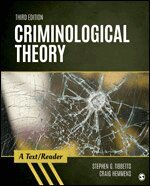
    Criminological Theory

    A Text/Reader

    AvStephen G. Tibbetts,Craig T. Hemmens

    Häftad, Engelska, 2018

    Del i serien SAGE Text/Reader Series in Criminology and Criminal Justice

    3 005 kr

    Beställningsvara. Skickas inom 3-6 vardagar. Fri frakt över 249 kr.

    Fler format och utgåvor

    Häftad

    1 831 kr

    E-bok

    884 kr

    Beskrivning

    “Arguably, the complete package. A very good overview of topics and additional learning opportunities together with research articles all in one place.  This book is a ‘one-stop shop.’”
    —Stuart Agnew, University of Suffolk

    Criminological Theory: A Text/Reader, Third Edition helps students understand criminological theory, with each authored section of the text enhanced by empirical research articles that put theory into context. Key criminological theories are introduced and followed by articles that show how criminological theory can be applied to current policies, challenges, and issues, making it easier for students to connect theory and application.

    New to the Third Edition:

    • Updated journal articles introduce students to important topics, such as media consumption and support for capital punishment, gender differences in delinquency, bias and police stops, and the effectiveness of reintegrative shaming and restorative justice.
    • A new section dedicated entirely to feminist perspectives introduces students to feminist models of crime and underscores the importance of examining research related to female offending. 
    • A stronger global view integrated throughout the book increases students’ exposure to criminological research and theory across nations and continents. Several of the new readings are written by authors or use samples from outside the United States, including South Africa, Brazil, Canada, Korea, and more.  
    • New case studies examine offender motives to help students apply the theories discussed to interesting and memorable examples.
    • Policy is now integrated into each section, allowing students to see the practical policy implications of each theory. 
    • Coverage of critical topics has been expanded throughout to introduce students to important issues, such as the influence of employment on criminal behavior, the success of school programs in reducing delinquent behavior, and federal sentencing guidelines in regard to crack versus powder cocaine.
    • Statistics, graphs, and tables have all been updated to demonstrate the most recent trends in criminology.

    Produktinformation

    • Utgivningsdatum:2018-06-14
    • Mått:187 x 231 x 28 mm
    • Vikt:980 g
    • Format:Häftad
    • Språk:Engelska
    • Serie:SAGE Text/Reader Series in Criminology and Criminal Justice
    • Antal sidor:656
    • Upplaga:3
    • Förlag:SAGE Publications
    • ISBN:9781506367828

    Utforska kategorier

    • Brottslighet och kriminologi inom Samhälle och politik

    Mer om författaren

    Stephen G. Tibbetts, currently a Professor at California State University, San Bernardino, has been pursuing an understanding of criminal offending for over the past two decades. He has attempted to discover the extent to which individuals’ inherent dispositions and attitudinal traits contribute to their offending decisions, especially in relation to other factors, such as demographic, developmental, and situational factors. Dr. Tibbetts’ research has included work on the differences between men and women in their decisions to commit deviant behavior, as well as their perceptions of risk and consequences of getting caught. His additional research interests include the effects of perinatal disorders as an influence in future criminality, the etiology of white-collar crime, and gang intervention.  Dr. Tibbetts has published nine books and more than 50 scholarly papers examining various issues in criminology. He received the 2011 Outstanding Professor Award at CSU, San Bernardino. He previously worked extensively as an Officer of the Court in providing recommendations for dispositions of numerous juvenile court cases from 1997 to 2008. Craig Hemmens is a professor in the Department of Criminal Justice and Criminology at Washington State University. He holds a JD from North Carolina Central University School of Law and a PhD in criminal justice from Sam Houston State University. Professor Hemmens has published 20 books and more than 200 articles, many dealing with legal issues in criminal justice. He currently serves as editor of the Criminal Law Bulletin and previously served as the editor of the Journal of Criminal Justice Education and as president of the Academy of Criminal Justice Sciences. His current research interests include criminal law and procedure.

    Recensioner i media

    "Arguably, the complete package. A very good overview of topics and additional learning opportunities together with research articles all in one place.  This book is a ‘one-stop shop.’"

    Innehållsförteckning

    • ForewordPrefaceSECTION I. Introduction to the Book: An Overview of Issues in Criminological TheoryWhat Is Criminology, and How Does It Differ from Other Examinations of Crime?What Is Theory?What Is Crime?How Are Criminological Theories Classified? The Major Theoretical ParadigmsCharacteristics of Good TheoriesMeasures of CrimeRates of CrimePolicy ImplicationsConclusionSECTION SUMMARYKEY TERMSDISCUSSION QUESTIONSWEB RESOURCESREADING 1. The Use and Usefulness of Criminology, 1751–2005: Enlightened Justice and Its FailuresSECTION II. Preclassical and Classical Theories of CrimePreclassical Perspectives of Crime and PunishmentThe Age of EnlightenmentThe Classical School of CriminologyThe Neoclassical School of CriminologyLoss of Dominance of Classical and Neoclassical TheoryPolicy ImplicationsConclusionSECTION SUMMARYKEY TERMSDISCUSSION QUESTIONSWEB RESOURCESREADING 2. On Crimes and PunishmentsREADING 3. Media Consumption and Support for Capital PunishmentSECTION III. Modern Applications of the Classical Perspective: Deterrence, Rational Choice, and Routine Activities or Lifestyle Theories of CrimeThe Rebirth of Deterrence Theory and Contemporary ResearchRational Choice TheoryRoutine Activities TheoryPolicy ImplicationsConclusionSECTION SUMMARYKEY TERMSDISCUSSION QUESTIONSWEB RESOURCESREADING 4. The Effects of Focused Deterrence Strategies on Crime: A Systematic Review and Meta-Analysis of the Empirical EvidenceREADING 5. Specifying the Direct and Indirect Effects of Low Self-Control and Situational Factors in Offenders’ Decision Making: Toward a More Complete Model of Rational OffendingREADING 6. Crime and Public Transportation: A Case Study of Ottawa’s O-Train SystemSECTION IV. Early Positive School Perspectives of CriminalityLombroso’s Theory of Atavism and Born CriminalsThe IQ Testing EraBody Type Theory: Sheldon’s Model of SomatotypingPolicy ImplicationsConclusionSECTION SUMMARYKEY TERMSDISCUSSION QUESTIONSWEB RESOURCESREADING 7. The Criminal Man (L’uomo delinquente)READING 8. IQ and Delinquency: The Differential Detection Hypothesis RevisitedSECTION V. Modern Biosocial Perspectives of Criminal BehaviorNature versus Nurture: Studies Examining the Influence of Genetics and EnvironmentCytogenetic Studies: The XYY FactorHormones and Neurotransmitters: Chemicals That Determine Criminal BehaviorBrain InjuriesCentral and Autonomic Nervous System ActivityBiosocial Approaches to Explaining Criminal BehaviorPolicy ImplicationsConclusionSECTION SUMMARYKEY TERMSDISCUSSION QUESTIONSWEB RESOURCESREADING 9. A Theory Explaining Biological Correlates of CriminalityREADING 10. Criminal Behavior: The Need for an Integrative Approach That Incorporates Biological InfluencesREADING 11. A Life-Course Analysis of the Criminogenic Effects of Maternal Cigarette Smoking duringSECTION VI. Early Social Structure and Strain Theories of CrimeEarly Theories of Social Structure: Early to Mid-1800sStrain TheoriesPolicy ImplicationsConclusionSECTION SUMMARYKEY TERMSDISCUSSION QUESTIONSWEB RESOURCESREADING 12. Social Structure and AnomieREADING 13. Anomic Strain and External Constraints: A Reassessment of Merton’s Anomie/Strain Theory Using Data from UkraineREADING 14. Gender and General Strain Theory: A Comparison of Strains, Mediating, and Moderating Effects Explaining Three Types of DelinquencySECTION VII. The Chicago School and Cultural and Subcultural Theories of CrimeThe Ecological School and the Chicago School of CriminologyCultural and Subcultural Theories of CrimePolicy ImplicationsConclusionSECTION SUMMARYKEY TERMSDISCUSSION QUESTIONSWEB RESOURCESREADING 15. Delinquency Rates and Community CharacteristicsREADING 16. Social Disorganization and Homicide in Recife, BrazilREADING 17. Peaceful Warriors: Codes for Violence among Adult Male Bar FightersSECTION VIII. Social Process and Learning Theories of CrimeLearning TheoriesControl TheoriesPolicy ImplicationsConclusionSECTION SUMMARYKEY TERMSDISCUSSION QUESTIONSWEB RESOURCESREADING 18. A Sociological Theory of Criminal BehaviorREADING 19. A Social Learning Theory of CrimeREADING 20. Do Women and Men Differ in Their Neutralizations of Corporate Crime?READING 21. Peers and Delinquency among Girls and Boys: Are Sex Differences in Delinquency Explained by Peer Factors?SECTION IX. Social Reaction and Critical Models of CrimeLabeling and Social Reaction TheoryMarxist Theories of CrimeConflict Theories of CrimePolicy ImplicationsConclusionSECTION SUMMARYKEY TERMSDISCUSSION QUESTIONSWEB RESOURCESREADING 22. Informal Reactions and DelinquencyREADING 23. Neighborhood Variation in Police Stops and Searches: A Test of Consensus and Conflict PerspectivesSECTION X. Feminist Models of CrimeFeminist Theories of CrimeKey Terms in the Feminist PerspectiveKey Issues in Research on Gender Differences in OffendingTypes of FeminismCritiques of Feminist TheoriesPolicy ImplicationsConclusionSECTION SUMMARYKEY TERMSDISCUSSION QUESTIONSWEB RESOURCESREADING 24. Patriarchy, Crime, and Justice: Feminist Criminology in an Era of BacklashREADING 25. The Intersectional Alternative: Explaining Female CriminalitySECTION XI. Life-Course Perspectives of CriminalityDevelopmental TheoriesPolicy ImplicationsConclusionSECTION SUMMARYKEY TERMSDISCUSSION QUESTIONSWEB RESOURCESREADING 26. Criminal Career Paradigm: Background, Recent Developments, and the Way ForwardREADING 27. Serious, Violent Young Offenders in South Africa: Are They Life-Course Persistent Offenders?READING 28. Unintended Consequences: Policy Implications of the NAS Report on Criminal Careers and Career CriminalsSECTION XII. Integrated Theoretical Models and New Perspectives of CrimeIntegrated TheoriesPolicy ImplicationsConclusionSECTION SUMMARYKEY TERMSDISCUSSION QUESTIONSWEB RESOURCESREADING 29. An Integrated Theoretical Perspective on Delinquent BehaviorREADING 30. The Effectiveness of Reintegrative Shaming and Restorative Justice Conferences: Focusing on Juvenile Offenders’ Perceptions in Australian Reintegrative Shaming ExperimentsREADING 31. Toward an Interactional Theory of DelinquencyGlossaryIndexAbout the Authors