• Fri frakt över 249 kr
  • •
  • Snabba leveranser
  • •
  • Billiga böcker
Kundservice

Du är på sajten för privatpersoner.

Företag, bibliotek eller offentlig verksamhet?

Du handlar på classic.bokus.com, där alla dina funktioner finns intakta.
Till classic.bokus.com
Bokus logotyp. Gå till startsidan.
  • Erbjudanden
  • Nyheter
  • Student
  • Topplistor
  • Barn & ungdom
  • Bokus Play
  • E-böcker
  • Pocketböcker
  • Spel & pussel

10% rabatt på allt med kod: NYSTART10 →

Sidfot

Mina sidor

    Hjälp

    • Kundservice
    • Vanliga frågor och svar
    • Frakt och leverans
    • Retur vid ångerrätt
    • Reklamera vara
    • Betalning
    • Köpvillkor
    • Allmänna villkor
    • Information om webbplatsens tillgänglighet

    Om Bokus

    • Om oss
    • Pressrum
    • För studenter
    • För företag
    • För bibliotek och offentlig verksamhet
    • För leverantörer
    • Hållbarhet

    Populärt

    • Aktuella erbjudanden
    • Presentkort
    • Studentlitteratur
    • Nya böcker
    • Topplistor
    • Signerade böcker
    • Engelska böcker

    Inspiration

    • Boktips
    • BookTok
    • Populära bokserier
    • Barnbokskaraktärer
    • Populära författare
    Logotyp för Bokus
    Följ oss på Facebook (extern länk)Följ oss på Instagram (extern länk)Följ oss på YouTube (extern länk)Följ oss på TikTok (extern länk)
    bokus @ CookiesAnpassa cookiesIntegritetspolicyKöpvillkor
    Till Citymail hemsida (extern länk)Till Budbee hemsida (extern länk)Till Postnord hemsida (extern länk)Till Schenker hemsida (extern länk)Till Early Bird hemsida (extern länk)Till Walleys hemsida (extern länk)
    1. Samhälle och politik
    2. Samhälle och kultur
    3. Sociala grupper och identitet
    4. Genusvetenskap

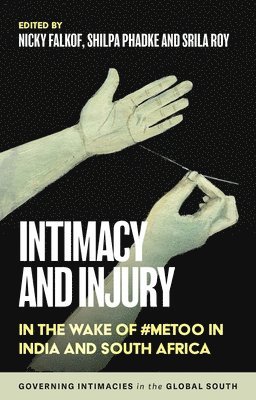
    Intimacy and Injury

    In the Wake of #Metoo in India and South Africa

    AvNicky Falkof,Srila Roy

    Inbunden, Engelska, 2022

    Del i serien Governing Intimacies in the Global South

    1 257 kr

    Beställningsvara. Skickas inom 5-8 vardagar. Fri frakt över 249 kr.

    Beskrivning

    Both India and South Africa have shared the infamy of being labelled the world’s ‘rape capitals’, with high levels of everyday gender-based and sexual violence. At the same time, both boast long histories of resisting such violence and its location in wider cultures of patriarchy, settler colonialism and class and caste privilege.Through the lens of the #MeToo moment, the book tracks histories of feminist organising in both countries, while also revealing how newer strategies extended or limited these struggles. Intimacy and injury is a timely mapping of a shifting political field around gender-based violence in the global south. In proposing comparative, interdisciplinary, ethnographically rich and analytically astute reflections on #MeToo, it provides new and potentially transformative directions to scholarly debates this book builds transnational feminist knowledge and solidarity in and across the global south.

    Produktinformation

    • Utgivningsdatum:2022-05-10
    • Mått:138 x 216 x 22 mm
    • Vikt:581 g
    • Format:Inbunden
    • Språk:Engelska
    • Serie:Governing Intimacies in the Global South
    • Antal sidor:376
    • Förlag:Manchester University Press
    • ISBN:9781526157621

    Utforska kategorier

    • Genusvetenskap inom Samhälle och politik
    • Sociologi inom Samhälle och politik

    Mer om författaren

    Nicky Falkof is Professor of Media Studies at the University of the WitwatersrandShilpa Phadke is Professor at the School of Media and Cultural Studies, Tata Institute of Social Sciences, MumbaiSrila Roy is Professor of Sociology at the University of the Witwatersrand

    Recensioner i media

    'The contributors have relied on intersectionality, transnationalism, inclusivity, and reflexivity in their exploration of the landscape of violence and violation in India and South Africa.'Ipshita Mitra, Feminism in India'This brilliant collection brings together incisive and critical accounts of feminist organising, written by, for and from scholars of colour from India and South Africa. By refuting the claim that #MeToo has travelled to the Global South, the book suggests the need for a radical re-imagining of the raced, classed gender politics of sexual violence at scalar level and offers a different perspective “from the margins”.'Sweta Rajan-Rankin, The Sociological Review'Intimacy and injury is a timely mapping of a shifting political field around gender-based violence in the global south.'Gary Edwards, Institute of Development Studies 'Must Reads of 2022''The call for collaborative work across disciplines, modalities and other spaces of knowledge unrecognised by the academy is clearly a priority for decolonial, feminist and queer scholarship. The book models this admirably, it is threaded through with art, images and poetry, both in the chapters and in the reflective pieces that so poignantly draw the sections together. This is indeed a strength of this book which also presents us with a rich account of #MeToo and other feminist activisms within these two global Southern contexts, offering an important contribution to the larger scholarship around #MeToo and extending the lens of the recent international handbook (Chandra and Erlingsdóttir, 2021) which, while providing a valuable and wide scan of geopolitical contexts, included a minority of global Southern voices.'Tamara Shefer, Feminist Encounters (6(2), 34)

    Innehållsförteckning

    • Introduction:Intimacy, injury and #MeToo in India and South Africa - Srila Roy, Nicky Falkof and Shilpa PhadkePart I: Pre-histories1 South Africa’s own ‘Delhi moment’: news coverage of the murders of Jyoti Singh and Anene Booysen - Nechama Brodie2 Hokkolorob, campus politics and the pre-histories of #MeToo - Paromita Chakravarti and Jhelum Roy3 Reading in-between the sheets: in conversation about SWEAT’s #SayHerName - Ntokozo Yingwana and Nosipho VidimaReflection: ‘When will the State be #MeToo’d?’ - Jyotsna SiddharthPart II MeToo’s silences4 Moments of Erasure of the testimonies of sexual violence against Dalit women - Rupali Bansode5 #Metoo and the troubling of the rural public sphere in India: a feminist media house reports from the hinterland - Disha Mullick6 Contesting the meaning/s of sexual violence in the South African postcolony: where are the male victims? - Louise du Toit7 Rebuilding precarious solidarities: a feminist debate in internet time - Shilpa PhadkeReflection: Progressive men and Predatory Practices - Jessica BreakeyPart III Institutional locations: The university and the State8 #EndRapeCulture and #MeToo: of intersectionality, rage and injury - Amanda Gouws9 From harassment to transgression: understanding changes in the legal landscape of sexual harassment in India - Rukmini Sen10 Feminism and fallism in institutions: in conversation with Jackie Dugard - Zuziwe Khuzwayo and Ragi BashongaReflection: Beyond the media storm: on sexual harassment in the news and the newsrooms - Nithila KanagasabaiPart IV: Affect and aesthetics11 Fury, pain, resentment … and fierceness: configurations of con/destructive affective activism in women’s organising - Peace Kiguwa12 Queer feminism and India’s #MeToo - Jaya Sharma13 Fugitive aesthetics: performing refusal in four acts - Swati AroraReflection: ‘Gay boys don’t cry when we’re raped’: queer shame and secrecy - Jamil F. Khan