• Fri frakt över 249 kr
  • •
  • Snabba leveranser
  • •
  • Billiga böcker
Kundservice

Du är på sajten för privatpersoner.

Företag, bibliotek eller offentlig verksamhet?

Du handlar på classic.bokus.com, där alla dina funktioner finns intakta.
Till classic.bokus.com
Bokus logotyp. Gå till startsidan.
  • Erbjudanden
  • Nyheter
  • Student
  • Topplistor
  • Barn & ungdom
  • Bokus Play
  • E-böcker
  • Pocketböcker
  • Spel & pussel

10% rabatt på allt med kod: NYSTART10 →

Sidfot

Mina sidor

    Hjälp

    • Kundservice
    • Vanliga frågor och svar
    • Frakt och leverans
    • Retur vid ångerrätt
    • Reklamera vara
    • Betalning
    • Köpvillkor
    • Allmänna villkor
    • Information om webbplatsens tillgänglighet

    Om Bokus

    • Om oss
    • Pressrum
    • För studenter
    • För företag
    • För bibliotek och offentlig verksamhet
    • För leverantörer
    • Hållbarhet

    Populärt

    • Aktuella erbjudanden
    • Presentkort
    • Studentlitteratur
    • Nya böcker
    • Topplistor
    • Signerade böcker
    • Engelska böcker

    Inspiration

    • Boktips
    • BookTok
    • Populära bokserier
    • Barnbokskaraktärer
    • Populära författare
    Logotyp för Bokus
    Följ oss på Facebook (extern länk)Följ oss på Instagram (extern länk)Följ oss på YouTube (extern länk)Följ oss på TikTok (extern länk)
    bokus @ CookiesAnpassa cookiesIntegritetspolicyKöpvillkor
    Till Citymail hemsida (extern länk)Till Budbee hemsida (extern länk)Till Postnord hemsida (extern länk)Till Schenker hemsida (extern länk)Till Early Bird hemsida (extern länk)Till Walleys hemsida (extern länk)
    1. Samhälle och politik
    2. Samhälle och kultur
    3. Kultur och medier
    4. Referensverk och tvärvetenskap

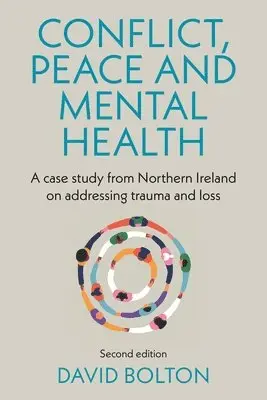
    Conflict, peace and mental health

    A case study from Northern Ireland on addressing trauma and loss:

    AvDavid Bolton

    Inbunden, Engelska, 2025

    1 188 kr

    Beställningsvara. Skickas inom 5-8 vardagar. Fri frakt över 249 kr.

    Fler format och utgåvor

    Inbunden

    1 224 kr

    Häftad

    371 kr

    Häftad

    214 kr

    Beskrivning

    A powerful guide for dealing with traumatised communities in the wake of conflict and disaster.What are the human consequences of conflict, and how should healthcare and social services respond? In this book, David Bolton provides an answer to these urgent questions, drawing on more than twenty-five years of service experience in Northern Ireland and elsewhere.Focusing on the work he undertook with colleagues following the devastating Omagh bombing in 1998, Bolton reveals how needs were assessed and how evidence-based services were put in place. He describes the training and education programmes that were developed to assist first those communities directly affected by the bombing and later the wider population traumatised by the years of conflict. Crucially, he places the mental-health needs of affected communities at the heart of the political and peace processes that follow.The second edition of this clear and practical book includes new chapters on the challenges of promoting justice and reconciliation in a post-conflict situation. It is essential reading for those planning for and responding to conflict-related disasters, policy makers, service commissioners and providers, politicians, civil servants and peace makers.

    Produktinformation

    • Utgivningsdatum:2025-11-11
    • Mått:156 x 234 x 19 mm
    • Vikt:626 g
    • Format:Inbunden
    • Språk:Engelska
    • Antal sidor:320
    • Förlag:Manchester University Press
    • ISBN:9781526190482

    Utforska kategorier

    • Referensverk och tvärvetenskap inom Samhälle och politik
    • Olycksfalls- och akutmedicin inom Medicin
    • Socialpsykologi och gruppsykologi inom Psykologi och pedagogik

    Mer om författaren

    David Bolton is a trauma researcher, writer and practitioner. He trained as a social worker in Belfast from 1974 to 1978, during some of the worst years of the civil conflict. At the time of the Omagh bombing of 1998 he coordinated the immediate and longer-term responses of community services, including establishing the Omagh Community Trauma and Recovery Team. In 2002 he became the founding director of the Northern Ireland Centre for Trauma and Transformation, which closed in 2011. He lives in County Fermanagh in Northern Ireland.

    Recensioner i media

    'The author writes from the heart, with the experience of a highly respected practitioner and researcher, and with a very personal yet professional relationship with victims and survivors.'Rev. Harold Good, Former President of the Methodist Church in Ireland and witness to the decommissioning of the IRA and ETA weaponry.'This is a magnificent contribution not just to the British/Irish troubles but to every region and every country where the agony and horror of violence has penetrated and mangled the human spirit.'Denis Bradley, Co-Chair Consultative Group on the Past'This is a book full of civility, humanism and evidence in relation to the psychological consequences of societal violence.'Brendan Bunting, Professor of Psychology, Ulster University'David Bolton writes with insight in this admirable book. I have rarely encountered an individual so committed and dedicated to making the ragged edges of peace less painful.'David McKittrick, co-author of Lost Lives, the compilation of Troubles related deaths in Northern Ireland.'David Bolton brings over 30 years of field experience in Northern Ireland to this book through which he shares his insights of conflict-related trauma and recovery, supported with empirical research evidence, with all humanitarians working in conflicted societies.'Fergus Cooper OBE, Former Save the Children Head of Country in Northern Ireland‘If there is one book that should be required reading for our MLAs, it is [this]. The book is a timely reminder that while the Assembly remains suspended and political progress remains stalled, victims and survivors of violence continue to live with the consequences of the past…The book is also designed to appeal to an international audience. There is much to be learned and applied from the examples of good practice developed in the aftermath of Omagh and in the research/evidence-based approach of the partnership between NICTT and Ulster University…I am heartened that people in other parts of the world may learn from those who have suffered in Northern Ireland. But I hope that the learning in Northern Ireland itself has not stopped, and that our politicians and policy makers heed Bolton’s message about what remains to be done.’Gladys Ganiel, Slugger O’toole‘What prompted Bolton to write the book was the conflict in Syria and, before that, in Iraq. He hopes it will be of use to counsellors and psychiatrists and psychotherapists and anyone trying to deal with the traumatic impact of conflict.’Gerry Moriarty, Irish Times‘This is a timely book to remind us what happens when we don’t nourish peace or build public infrastructures to ensure that violence and injustice cannot succeed. It is timely not only because of recent events in Northern Ireland that might evoke divisions from the past, but also because of recent events in London and Manchester, hate crime, and the shortcomings of democratic voting- not to mention also the importance of looking now at the intergenerational problems that await the people in Syria and other Middle East Countries.’Derek Indoe, British Journal of Psychology‘The first edition of his book was very well received by commentators and practitioners alike. This second edition maintains the qualities of precision, breadth of vision and readability, providing a valuable and comprehensive update on Northern Ireland’s Troubles-related mental-health needs and provision. This is a major and powerful contribution to understanding and to charting the way forward.’Fabian Monds, Chairman, Northern Ireland Centre for Trauma and Transformation

    Innehållsförteckning

    • Preface to the second editionIntroduction1 The Omagh bombing and the community’s response2 The Omagh Community Trauma and Recovery Team3 Assessing the mental-health impact of the Omagh bombing4 The mental-health impact of the conflict in Northern Ireland, 1969–995 The mental-health impact of the conflict in Northern Ireland, 2000–156 The Northern Ireland Centre for Trauma and Transformation: a comprehensive trauma centre7 The development of a trauma-focused therapy programme8 Trauma-focused skills training for practitioners9 Research, advocacy and policy support10 Developments in responding to the needs of victims of the conflict in Northern Ireland11 From conflict management to conflict transformation: progress in Northern Ireland since 201712 Rethinking how to address the needs of the victims of conflict and to build the post-conflict communityPostscript: the rupture of loss and traumaIndex