• Fri frakt över 249 kr
  • •
  • Snabba leveranser
  • •
  • Billiga böcker
Kundservice

Du är på sajten för privatpersoner.

Företag, bibliotek eller offentlig verksamhet?

Du handlar på classic.bokus.com, där alla dina funktioner finns intakta.
Till classic.bokus.com
Bokus logotyp. Gå till startsidan.
  • Erbjudanden
  • Nyheter
  • Student
  • Topplistor
  • Barn & ungdom
  • Bokus Play
  • E-böcker
  • Pocketböcker
  • Spel & pussel

10% rabatt på allt med kod: NYSTART10 →

Sidfot

Mina sidor

    Hjälp

    • Kundservice
    • Vanliga frågor och svar
    • Frakt och leverans
    • Retur vid ångerrätt
    • Reklamera vara
    • Betalning
    • Köpvillkor
    • Allmänna villkor
    • Information om webbplatsens tillgänglighet

    Om Bokus

    • Om oss
    • Pressrum
    • För studenter
    • För företag
    • För bibliotek och offentlig verksamhet
    • För leverantörer
    • Hållbarhet

    Populärt

    • Aktuella erbjudanden
    • Presentkort
    • Studentlitteratur
    • Nya böcker
    • Topplistor
    • Signerade böcker
    • Engelska böcker

    Inspiration

    • Boktips
    • BookTok
    • Populära bokserier
    • Barnbokskaraktärer
    • Populära författare
    Logotyp för Bokus
    Följ oss på Facebook (extern länk)Följ oss på Instagram (extern länk)Följ oss på YouTube (extern länk)Följ oss på TikTok (extern länk)
    bokus @ CookiesAnpassa cookiesIntegritetspolicyKöpvillkor
    Till Citymail hemsida (extern länk)Till Budbee hemsida (extern länk)Till Postnord hemsida (extern länk)Till Schenker hemsida (extern länk)Till Early Bird hemsida (extern länk)Till Walleys hemsida (extern länk)
    1. Samhälle och politik
    2. Politik och statsskick
    3. Internationella relationer

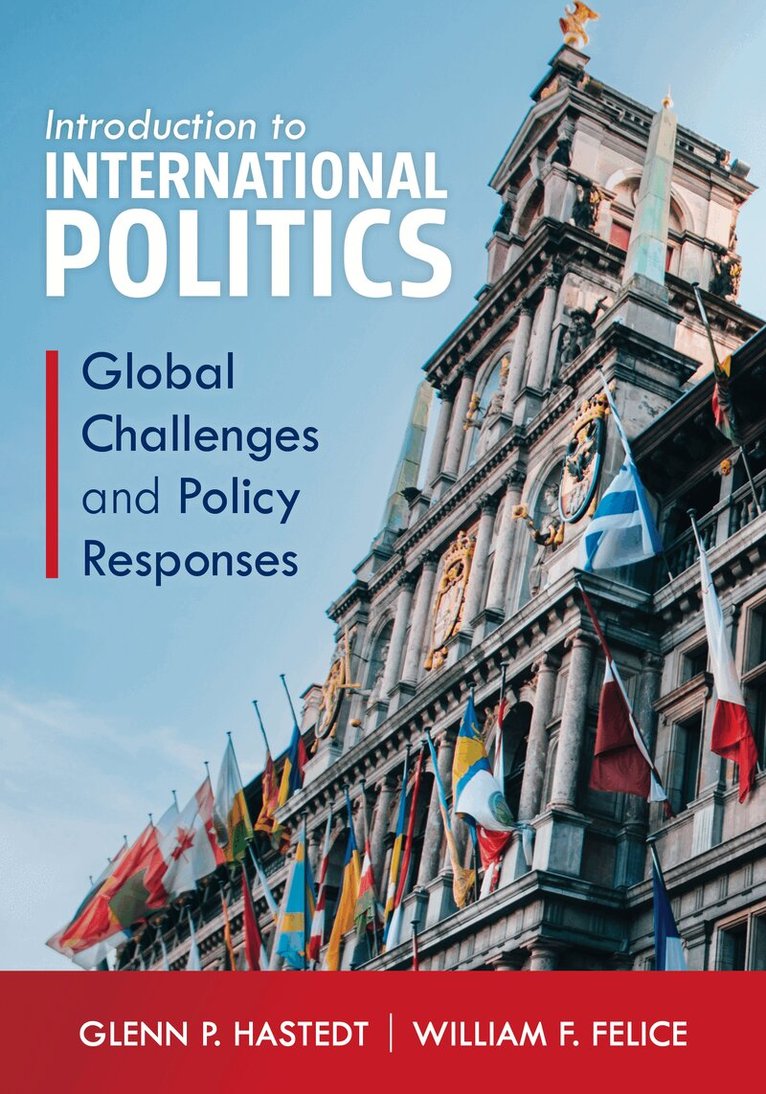
    Introduction to International Politics

    Global Challenges and Policy Responses

    AvGlenn P. Hastedt,William F. Felice

    Häftad, Engelska, 2019

    1 033 kr

    Beställningsvara. Skickas inom 5-8 vardagar. Fri frakt över 249 kr.

    Beskrivning

    Introduction to International Politics makes systematic linkages between theory and policy that do not ignore or slight the conceptual discussion of international relations or simply chase newspaper headlines. Chapters are organized around “Global Challenges and Policy Responses.” The challenges are presented as concrete policy problems relevant to the theme of the chapter. The discussion of responses emphasize concrete actions taken or proposed by international organizations, the foreign policies of key states, international agreements, and actions taken by NGOs. Theoretical insights are used to help students understand challenges, think about solutions, and learn from the past. Based on a combined fifty years of classroom teaching, Hastedt and Felice possess the uncanny ability to boil down complex ideas and make them meaningful for students. Written in a style that is direct and accessible, Introduction to International Politics offers a concise foundation for any introductory-level student taking an international relations or world politics course. The text offers students a full suite of pedagogical features and learning aids, including a box program consisting of Policy Spotlights, Theory Spotlights, and Regional Spotlights. Each chapter opens with a Historical Perspective case study of a policy challenge, and closes with a related Contemporary Perspectivecase study of a similar challenge. Chapter study aids include learning objective at the outset, with a list of key terms and critical thinking questions provided at the end.A full suite of teaching and learning ancillaries include a companion website with self-study quizzes, a test bank, testing software, PowerPoint lecture slides that are WCAG 2.0-compliant, and an E-book with links to the companion website.

    Produktinformation

    • Utgivningsdatum:2019-08-19
    • Mått:190 x 234 x 18 mm
    • Vikt:660 g
    • Format:Häftad
    • Språk:Engelska
    • Antal sidor:408
    • Förlag:Bloomsbury Publishing Plc
    • ISBN:9781538104910

    Utforska kategorier

    • Internationella relationer inom Samhälle och politik

    Mer om författaren

    Glenn P. Hastedt is professor and chair of the justice studies department at James Madison University. He is the author of twelve editions of American Foreign Policy: Past, Present, Future. Hastedt has served as coeditor of White House Studies and is on the editorial board of Intelligence and National Security. William F. Felice is professor of political science at Eckerd College. He was named the 2006 Florida Professor of the Year by the Carnegie Foundation for the Advancement of Teaching. Felice is the author of The Ethics of Interdependence: Global Human Rights and Duties, The Global New Deal: Economic and Social Human Rights in World Politics, and numerous articles on the theory and practice of human rights.

    Recensioner i media

    “This is an effective framework. Most instructors want students to grow in terms of familiarity with the major contours and debates of international politics. They also typically seek to create better “citizens,” or adults who can evaluate new situations and make informed voting and other choices based upon that assessment. The challenges and responses framework is a useful way to present that type of information alongside academic theories.”

    Innehållsförteckning

    • List of Figures, Tables, and MapsPrefaceAbout the AuthorsChapter 1: Thinking Critically About International PoliticsMaking Sense of International PoliticsKorea Then and NowLearning from Personal ExperienceLearning from HistoryLearning from TheoryUsing Challenges and Responses to Make Sense of International PoliticsSummary/ Key Terms/ Critical Thinking QuestionsChapter 2: The Theory ChallengeHistorical Perspective: The Fall of the Berlin WallRealismLiberalismTheory Spotlight: Prisoner’s DilemmaEconomic StructuralismConstructivismFeminismApplying Theory to the ArcticPolicy Spotlight: Fights, Games, DebatesRegional Spotlight: The Third PoleA Contemporary Perspective: The UkraineSummary/ Key Terms/ Critical Thinking QuestionsChapter 3: The Sovereignty Challenge: Who Is in Charge in World Politics?Historical Perspective: The Common Market to the European Union StatesPolicy Spotlight: When is a State a State?International OrganizationsTheory Spotlight: Integration TheoryRegional Spotlight: Association of Southeast Asian Nations (ASEAN)Non-state ActorsContemporary Perspective: Leaving the EU—Grexit and BrexitLooking to the FutureSummary/ Key Terms/ Critical Thinking QuestionsChapter 4: The Values Challenge: Deciding What to DoHistorical Perspective: The Nansen PassportInternational Politics ValuesTheory Spotlight: The Global Community and Global JusticeA Two Level GameSocietal Influences on Foreign Policy Making Global Influences on Foreign Policy MakingThe Pathway from Ideas to PolicyPolicy Spotlight: The Democratic PeaceContemporary Perspective: The Refugee Flow into EuropeRegional Spotlight: Internally Displaced People in AfricaLooking to the FutureSummary/ Key Terms/ Critical Thinking QuestionsChapter 5: The Power Challenge: The Ability to ActHistorical Perspective: The Case for Strategic BombingPower and International PoliticsPolicy Spotlight: Why Strong States Lose WarTheory Spotlight: Measuring Soft PowerThe Challenge of Using PowerCyber PowerInstruments of PowerRegional Spotlight: China’s PowerContemporary Perspective: Armed DronesLooking to the FutureSummary/ Key Terms/ Critical Thinking QuestionsChapter 6: The Cooperation Challenge: Working TogetherHistorical Perspective: Ebola in 1976 and 2000The Dynamics of International CooperationPolicy Spotlight: Negotiating with the EnemyAlliancesDiplomacyTheory Spotlight: Regimes and Regime ComplexesInternational LawRegional Spotlight: The OceansContemporary Perspective: Ebola in 2013Looking to the FutureSummary/ Key Terms/ Critical Thinking QuestionsChapter 7: The Security ChallengeHistorical Context: The Arab—Israeli ConflictPeace and War/War and PeaceTheory Spotlight: Peace Studies21st Century WarsRegional Spotlight: The Colombian Civil WarPeace OperationsNuclear StabilityPolicy Spotlight: A New Arms Race?Contemporary Perspective: SyriaLooking into the FutureSummary/ Key Terms/ Critical Thinking QuestionsChapter 8: Economic Challenges: Who Is in Charge of the Global Economy?Historical Perspective: The North American Free Trade Agreement, 1994The Challenge of Economic Globalization Theories of International Political Economy and Economic GlobalizationRegional Spotlight: China’s Belt and Road InitiativeTheory Spotlight: Feminist International Political EconomyFrom the UN’s Millennium Development Goals to the Sustainable Development GoalsPolicy Spotlight: Eliminating Poverty in Mexico and BrazilThe United Nations 2030 Agenda for Sustainable DevelopmentContemporary Perspective: The North American Free Trade Agreement, 2019Looking to the Future: Controlling Speculative Capital and Excessive Military SpendingSummary/ Key Terms/ Critical Thinking Questions Chapter 9: Human Rights Challenges: Protecting Human DignityHistorical Perspective: The Nuremberg War Crimes Tribunal, 1945-1946The Global Roots of Human RightsFrom Westphalia to the U.N. Human Rights SystemRegional Spotlight: Genocide or Ethnic Cleansing in Myanmar? Is there a difference or does it matter?Policy Spotlight: The Global Struggle for LGBT RightsContemporary Perspective: The International Criminal Court, 1998-2019Looking to the Future: The United States, China and the U.N. Human Rights SystemTheory Spotlight: Cultural Relativism versus Universality Summary / Key Terms/ Critical Thinking Questions Chapter 10: Global Environmental Challenges: The Global CommonsHistorical Perspective: Global Environmental Governance 1870-1992Global Environmental Challenges: Climate Change, Overfishing, Species ExtinctionPolicy Spotlight: Is a Carbon Tax a Viable Policy Option?Regional Spotlight: The Antarctica Treaty Regime Theory Spotlight: Human Rights & EnvironmentContemporary Perspective: Global Environmental Governance, 2002-2019Looking to the Future: The Potential Environmental Impact of Trade and the Precautionary PrincipleSummary / Key Terms/ Critical Thinking Questions Chapter 11: Looking Forward: New Policy Challenges and Responses Trade WarsCreating Images of the FutureGlobal Trends 2035Future Foundations of International Politics New Actors in the Future International SystemNew Traditional ChallengesNew Global Challenges Summary/ Key Terms/ Critical Thinking Questions GlossaryNotesIndex