• Fri frakt över 249 kr
  • •
  • Snabba leveranser
  • •
  • Billiga böcker
Kundservice

Du är på sajten för privatpersoner.

Företag, bibliotek eller offentlig verksamhet?

Du handlar på classic.bokus.com, där alla dina funktioner finns intakta.
Till classic.bokus.com
Bokus logotyp. Gå till startsidan.
  • Erbjudanden
  • Nyheter
  • Student
  • Topplistor
  • Barn & ungdom
  • Bokus Play
  • E-böcker
  • Pocketböcker
  • Spel & pussel

10% rabatt på allt med kod: NYSTART10 →

Sidfot

Mina sidor

    Hjälp

    • Kundservice
    • Vanliga frågor och svar
    • Frakt och leverans
    • Retur vid ångerrätt
    • Reklamera vara
    • Betalning
    • Köpvillkor
    • Allmänna villkor
    • Information om webbplatsens tillgänglighet

    Om Bokus

    • Om oss
    • Pressrum
    • För studenter
    • För företag
    • För bibliotek och offentlig verksamhet
    • För leverantörer
    • Hållbarhet

    Populärt

    • Aktuella erbjudanden
    • Presentkort
    • Studentlitteratur
    • Nya böcker
    • Topplistor
    • Signerade böcker
    • Engelska böcker

    Inspiration

    • Boktips
    • BookTok
    • Populära bokserier
    • Barnbokskaraktärer
    • Populära författare
    Logotyp för Bokus
    Följ oss på Facebook (extern länk)Följ oss på Instagram (extern länk)Följ oss på YouTube (extern länk)Följ oss på TikTok (extern länk)
    bokus @ CookiesAnpassa cookiesIntegritetspolicyKöpvillkor
    Till Citymail hemsida (extern länk)Till Budbee hemsida (extern länk)Till Postnord hemsida (extern länk)Till Schenker hemsida (extern länk)Till Early Bird hemsida (extern länk)Till Walleys hemsida (extern länk)
    1. Samhälle och politik
    2. Samhälle och kultur
    3. Sociala grupper och identitet
    4. Genusvetenskap

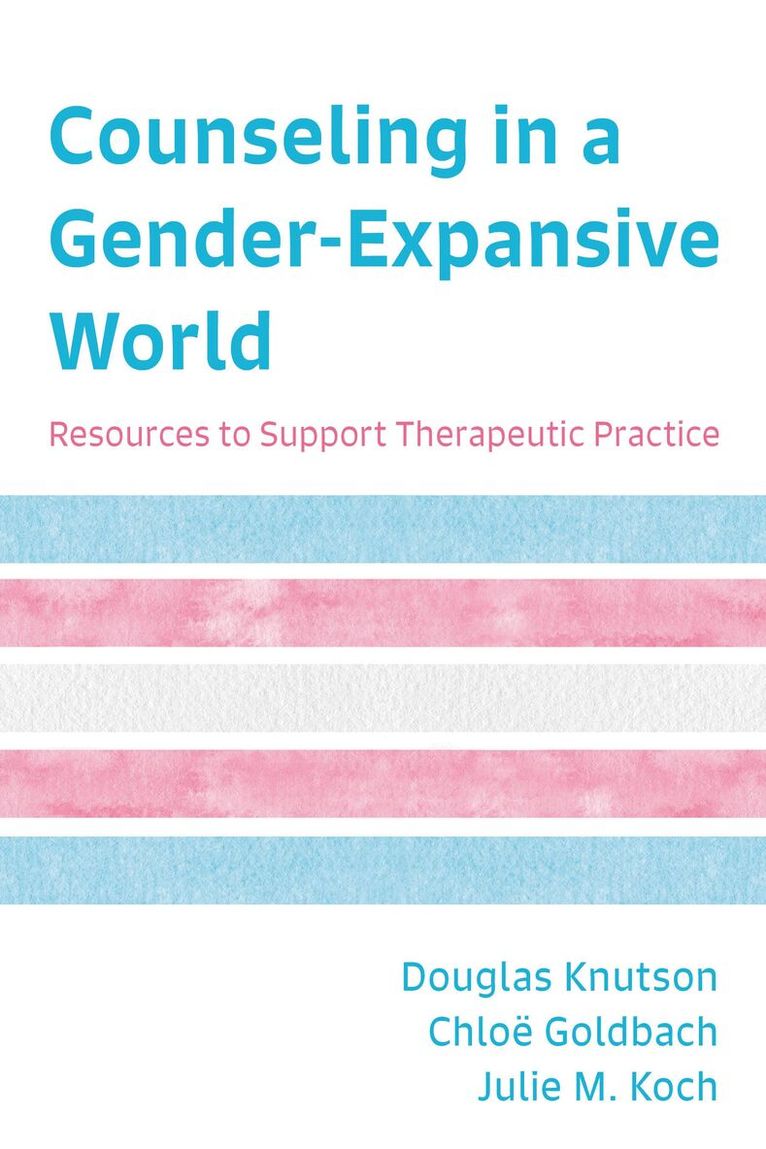
    Counseling in a Gender-Expansive World

    Resources to Support Therapeutic Practice

    AvDouglas Knutson,Chloë Goldbach

    Inbunden, Engelska, 2022

    1 436 kr

    Beställningsvara. Skickas inom 10-15 vardagar. Fri frakt över 249 kr.

    Fler format och utgåvor

    Häftad

    464 kr

    Beskrivning

    A 2023 Choice Reviews Outstanding Academic TitleTransgender and gender-expansive people are increasingly becoming the focus of media, politics, and of public conversation. With this increased attention comes greater visibility and counselors are now, more than ever, likely to clinically engage with openly transgender or gender-expansive clients during their careers. This is in spite of the fact that many counselors have not received specific training in skills, knowledge, and awareness necessary to provide affirming, informed care for these populations. In this book, the authors provide practical, real-life suggestions and interventions to help therapists, supervisors, and trainees increase in their competence and confidence in working with transgender and gender-expansive clients. The resources provided here are informed by evidence-based practice, scholarship on intersectionality, and by social justice and advocacy movements. This book is a useful supplement to clinical work with transgender and gender-expansive people, especially for the many clinicians who work in regions with limited transgender-specific resources.

    Produktinformation

    • Utgivningsdatum:2022-10-20
    • Mått:162 x 231 x 19 mm
    • Vikt:503 g
    • Format:Inbunden
    • Språk:Engelska
    • Antal sidor:252
    • Förlag:Bloomsbury Publishing Plc
    • ISBN:9781538129418
    • Utmärkelser:Winner of Distinguished Book Award 2023

    Utforska kategorier

    • Genusvetenskap inom Samhälle och politik
    • Psykoterapi som behandlingsmetod inom Medicin

    Mer om författaren

    Douglas Knutson (he, him), PhD, LHSP, is an assistant professor in the School of Community Health Sciences, Counseling and Counseling Psychology at Oklahoma State University. He serves as director of the Diversity and Rural Advocacy Group (DRAG), a consortium of international researchers and advocates who focus on health and resilience in LGBTQ+ populations. Dr. Knutson has published 38 peer-reviewed articles, book chapters, professional papers, and encyclopedia entries. He has coauthored 74 presentations delivered at international, national, and local conferences and professional meetings. His work has been referenced in USA Today, Stateline, and NPR News. He currently serves on the editorial boards of The Counseling Psychologist and Psychology of Sexual Orientation and Gender Diversity. Dr. Knutson’s work is focused on the development and implementation of transgender- and nonbinary-affirming interventions with an emphasis on rural populations.Chloë Goldbach (she/her/hers), MS, MA, is a White, lesbian, transgender woman and PhD candidate in counseling psychology at Southern Illinois University Carbondale (SIUC). She organizes community-wide events on transgender and nonbinary issues as an officer of the SIUC Women, Gender, and Sexuality Studies organization, serves as an associate researcher of the Diversity and Rural Advocacy Group (DRAG) at Oklahoma State University, teaches courses on LGBTQ+ and workplace diversity issues, leads a YouTube channel on transgender and nonbinary topics, and is a therapist-in-training with a focus on serving LGBTQ+ clients and clients with eating and body image concerns. Chloë has published 10 peer-reviewed articles, encyclopedia entries, and professional papers, all related to issues impacting LGBTQ+ individuals. She has delivered more than 40 presentations at international, national, and local conferences, training workshops, and professional meetings. She is currently conducting research on barriers to healthcare access for transgender and nonbinary people, experiences of LGBTQ+ people during the COVID-19 pandemic, and centering the voices and experiences of transgender and nonbinary people in the treatment and conceptualization of gender dysphoria.Julie M. Koch (she/they), PhD, is professor of counseling psychology in the College of Education at the University of Iowa. She/they has extensive experience with clinical practice with LGBTQ+ rural populations. Dr. Koch is a former high school teacher and school counselor. Dr. Koch enjoys working with schools and international collaborations. She/they was a Monbusho Scholar at University of Hokkaido and received a Fulbright Specialist Grant to work with the LGBT Centre in Mongolia.

    Recensioner i media

    This book is an essential reference for counselors, therapists, educators, and human services staff. As the authors point out, "gender-expansive" clients typically have faced traumatizing rejections, betrayal, disenfranchisement, and violence. They need an affirmative counseling environment. Understanding the foundations of their experience, gender terminology and identities, pronouns and pitfalls (e.g., so-called deadnaming) is critical. Counselors need to explore and understand the assumptions, biases, theoretical knowledge, and values surrounding gender-expansive clients and issues. Building a therapeutic relationship requires understanding how gender identity intersects with life span development, geographic location, privilege, race, ethnicity, disability, sexual orientation, the intersectional self, and socioeconomic realities. Counselors need to provide affirming professional interactions. One consequence of geographic location is that clients may confront safety, transportation, or service fee issues, and may find teletherapy more practical. Building a trusting relationship is vital, as are goodness-of-fit of assessment and diagnostic frameworks. Common pitfalls include ignoring gender-expansive identities and interactions, deadnaming, and homogenizing the population. Positive ethics, legal issues, and practice concerns require consideration, as well as attention to transitions and providing an affirming environment. This is an excellent book that includes poignant vignettes, powerful examples, thoughtful "reflection questions," references, and suggested readings. Practical recommendations are also described. The "Binary and Me" exercises and "Pitfalls" sections are especially useful. Highly recommended. All readers.

    Innehållsförteckning

    • IntroductionSection I: Laying the Foundation for Affirmative WorkChapter 1: Building an Understanding of GenderBillMollyRowanGender TerminologyGender BinaryGender IdentityGender ExpressionGender ContinuumGender IdentitiesCisgenderTransgenderNonbinaryIntersexTranssexualPronounsSummary and RecommendationsReflection QuestionsReferences and Suggested ReadingsChapter 2: Exploring your Gender IdentityBillMolly RowanThe Unexplored LifeCisnormativityMisgendering/MispronouningDeadnamingGender Identity and Your EnvironmentFamily and FriendsWorkplaceCommunityPrivilegeThe Binary and Me ExerciseSummary and RecommendationsReflection QuestionsReferences and Suggested ReadingsChapter 3: Gender Identity and the Intersectional SelfBillMollyRowanClient IntersectionalityPrivilege and PowerRace and EthnicitySexual Orientation(Dis)ability StatusSocioeconomic StatusHuman Service Professional IntersectionalityGender IdentityExploring Intersectional Gender IdentityConnecting with OthersClient-Professional InteractionsPoints of InteractionSocioeconomic StatusSexual OrientationMinoritized Racial StatusSocial SupportAgeSummary and RecommendationsReflection QuestionsReferences and Suggested ReadingsChapter 4: Gender Identity and Lifespan DevelopmentBillMollyRowanEarly AwarenessGender AssumptionsChildhood and AdolescenceChildhoodAdolescencePubertySchoolEarly AdulthoodWorkMiddle to Late AdulthoodSummary and RecommendationsReflection QuestionsReferences and Suggested ReadingsChapter 5: Gender Identity and Geographic LocationBillMollyRowanCultural NuanceTeletherapyUrban AreasTransportationViolence and SafetyFees for ServiceDiscretionFamily, Partners, and FriendsPositive Aspects of Rural AreasProximity to FamilyFaith, Friends, and ChurchThe Beauty of NatureAccess to ServicesLimiting Aspects of Rural AreasProximity to FamilyFaith, Friends, and ChurchSeclusionInternet Access and Remote ConnectionsTravel and Resource AccessAccess to Competent ProvidersSemi-Rural and Semi-Urban AreasPeople Who ImmigrateGeneral GuidelinesExplore the Geographic Culture of OriginAccess Distance and Physical Access to ResourcesExplore Spatial Connections to Community and ReligionAddress Family Businesses, Ties, and ExpectationsExplore the Impact of Local Laws and PoliciesAccess Availability, Longevity, and CommitmentSummary and RecommendationsReflection QuestionsReferences and Suggested ReadingsSection II: Elements of Affirmative PracticeChapter 6: Relationship BuildingBillMollyRowanPrior to Meeting a ClientFirst AppointmentEarly Stages of RelationshipStrengthening the RelationshipTermination and BeyondSummary and RecommendationsReflection QuestionsReferences and Suggested ReadingsChapter 7: Assessment and Diagnosis FrameworksBillMollyRowanA Brief History of Mental Health Diagnostic CategoriesAssessmentFormal MeasuresInformal or Interview-Based AssessmentIntake ProtocolsDiagnosisDefault DiagnosisDifferential DiagnosesStabilizationDiagnoses as Permission or Endorsement for TreatmentEthics and DiagnosesCommon PitfallsRefusing to Write a LetterIgnoring Gender Expansive Identities and IntersectionsHomogenizing the PopulationBeing Unprepared to Provide Affirming ServicesSummary and RecommendationsReflection QuestionsReferences and Suggested ReadingsChapter 8: Ethics and Professional StandardsBillMollyRowanPositive EthicsTaking a Positive Ethics ApproachPositive Ethics and Decision-MakingNonmaleficence and Positive EthicsEthics and Legal IssuesConversion TherapyEthics and Practice ConcernsMultiple Relationships with a Single ClientRelationships with Client FamiliesRural ConsiderationsInformed ConsentCompetenceMulticultural and Social Justice PracticeSummary and RecommendationsReflection QuestionsReferences and Suggested ReadingsChapter 9: Transition, Care Teams, and Clinical ProcessBillMollyRowanTransitionsSocial TransitionMedical TransitionGender DysphoriaDiagnosis and Access to CareGender EuphoriaPassingDiverse PathwaysCare TeamsClinical ProcessesSummary and RecommendationsReflection QuestionsReferences and Suggested ReadingsChapter 10: Resources and Letter WritingBillMollyRowanResourcesLettersAffirming Hormone TherapyAffirming SurgeriesCarry LettersOther ResourcesCompetence Building ResourcesTransition Care ResourceWeb-Based ResourcesSummary and RecommendationsReflection QuestionsReferences and Suggested ReadingsSection III: Affirmative Care in ContextChapter 11: Affirmative Work in Various SettingsBillMollyRowanGeneral ConsiderationsLeadershipSupport StaffOperating SystemsLocation SpecificsSchoolsCollege or University Counseling CentersPrivate PractitionersCorporate and Large CompaniesConclusionSummary and RecommendationsReflection QuestionsReferences and Suggested ReadingsChapter 12: Partners and FamiliesBillMollyRowanFoundations and Key ConceptsDeconstructing Negative BiasesThe Power of AcceptanceGender in Family DynamicsGender Fixation in FamiliesComponents of the Family SystemSupporting Gender Expansive ChildrenSupporting Gender Expansive ParentsGender Transition and Romantic RelationshipsPartners and Relationship DynamicsTransitioning in Close RelationshipsPolyamorous RelationshipsSummary and RecommendationsReflection QuestionsReferences and Suggested ReadingsChapter 13: GroupsBillMollyRowanGroup StagesGroup FormationGroup Member SelectionFormingStormingNormingPerformingTerminationGeneral SuggestionsSummary and RecommendationsReflection QuestionsReferences and Suggested ReadingsChapter 14: Sex, Sexuality, and Romantic Attraction (Dannie Klooster)BillMollyRowanHistorical Perspectives on Sexual HealthGender-Affirming ApproachesGender Expansive Clients and Sex Education MythsTowards a Sex-Positive FrameworkBody PositivityEroto-PositivityKink PositivityRelationship PositivityAdditional ConsiderationsConclusionSummary and RecommendationsReflection QuestionsReferences and Suggested Readings Chapter 15: SupervisionBillMollyRowanLisa, LPC, and Austin, Master’s TraineeSupervision and Contextual FactorsGroup SupervisionIdentity DifferencesPower DynamicsConstructive FeedbackSupportive FeedbackThe Supervisory RelationshipSelf-DisclosureBoundariesParallel ProcessRuptures and ConflictsSupervision as a Professional RoleQualification CompatibilityConsultationContinuing EducationFuture DevelopmentsSummary and RecommendationsReflection QuestionsReferences and Suggested ReadingsConclusionAppendix A: Resources TableFigure 1Appendix B: Letter of Recommendation for Hormone Replacement TherapyAppendix C: Letter of Recommendation for SurgeryAppendix D: “Carry Letter”Appendix E: Clinician Action StepsTable 1IndexAbout the Authors