• Fri frakt över 249 kr
  • •
  • Snabba leveranser
  • •
  • Billiga böcker
Kundservice

Du är på sajten för privatpersoner.

Företag, bibliotek eller offentlig verksamhet?

Du handlar på classic.bokus.com, där alla dina funktioner finns intakta.
Till classic.bokus.com
Bokus logotyp. Gå till startsidan.
  • Erbjudanden
  • Nyheter
  • Student
  • Topplistor
  • Barn & ungdom
  • Bokus Play
  • E-böcker
  • Pocketböcker
  • Spel & pussel

Må bättre, för mindre! Upp till 50% rabatt på hälsoböcker

Sidfot

Mina sidor

    Hjälp

    • Kundservice
    • Vanliga frågor och svar
    • Frakt och leverans
    • Retur vid ångerrätt
    • Reklamera vara
    • Betalning
    • Köpvillkor
    • Allmänna villkor
    • Information om webbplatsens tillgänglighet

    Om Bokus

    • Om oss
    • Pressrum
    • För studenter
    • För företag
    • För bibliotek och offentlig verksamhet
    • För leverantörer
    • Hållbarhet

    Populärt

    • Aktuella erbjudanden
    • Presentkort
    • Studentlitteratur
    • Nya böcker
    • Topplistor
    • Signerade böcker
    • Engelska böcker

    Inspiration

    • Boktips
    • BookTok
    • Populära bokserier
    • Barnbokskaraktärer
    • Populära författare
    Logotyp för Bokus
    Följ oss på Facebook (extern länk)Följ oss på Instagram (extern länk)Följ oss på YouTube (extern länk)Följ oss på TikTok (extern länk)
    bokus @ CookiesAnpassa cookiesIntegritetspolicyKöpvillkor
    Till Citymail hemsida (extern länk)Till Budbee hemsida (extern länk)Till Postnord hemsida (extern länk)Till Schenker hemsida (extern länk)Till Early Bird hemsida (extern länk)Till Walleys hemsida (extern länk)
    1. Samhälle och politik
    2. Krig och försvar

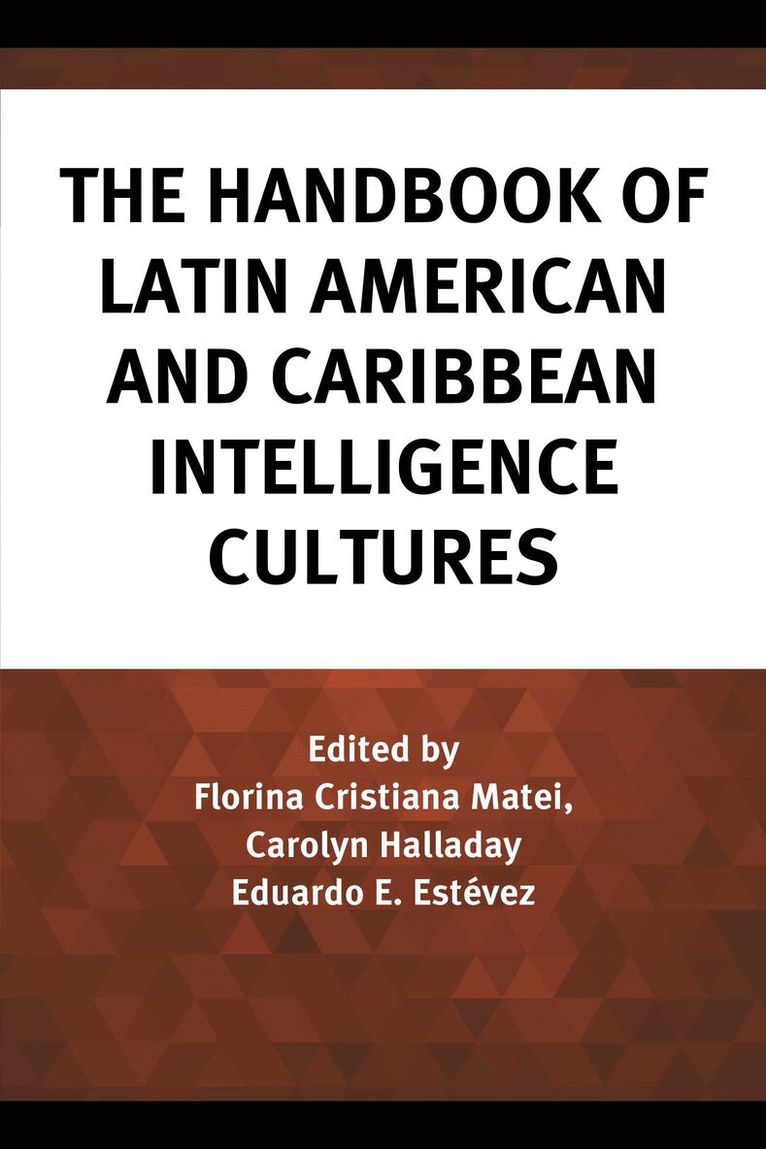
    Handbook of Latin American and Caribbean Intelligence Cultures

    AvFlorina Cristiana Matei,Carolyn Halladay

    Inbunden, Engelska, 2022

    Del i serien Security and Professional Intelligence Education Series

    1 672 kr

    Beställningsvara. Skickas inom 10-15 vardagar. Fri frakt över 249 kr.

    Beskrivning

    The Handbook of Latin American and Caribbean Intelligence Cultures explores the contemporary efforts of Latin American and Caribbean nations to develop an intelligence culture. Specifically, it analyzes these countries’ efforts to democratize their intelligence agencies (i.e. to develop intelligence services that are both transparent and effective) to convert the former military regimes’ repressive security apparatuses into democratic intelligence communities—a rather paradoxical task, considering that democracy calls for political neutrality, transparency, and accountability, while effective intelligence services must operate in secrecy. Indeed, even the most successful democracies face this conundrum of democracy and intelligence; Latin America and the Caribbean region is not alone in facing this challenge. The legacy of the repressive military regimes or brutal civil wars—which have inspired in the public a general disdain toward intelligence services due to the grave human rights abuses—coupled with politicians’ persistent lack of interest or expertise in intelligence matters complicate the region’s quest for a proper balance between the competing demands of democracy and intelligence. This volume details the attempts of the region’s countries to overcome these obstacles and pursue democratic intelligence institution building—transforming the legal basis for intelligence; establishing democratic control and oversight mechanisms; and fostering intelligence openness, transparency, and outreach.

    Produktinformation

    • Utgivningsdatum:2022-07-28
    • Mått:158 x 229 x 37 mm
    • Vikt:794 g
    • Format:Inbunden
    • Språk:Engelska
    • Serie:Security and Professional Intelligence Education Series
    • Antal sidor:414
    • Förlag:Bloomsbury Publishing Plc
    • ISBN:9781538160817

    Utforska kategorier

    • Krig och försvar inom Samhälle och politik
    • Politik och statsskick inom Samhälle och politik
    • Internationella relationer inom Samhälle och politik

    Mer om författaren

    Florina Cristiana Matei is a lecturer at the Center for Homeland Defense and Security at the United States Naval Postgraduate School (NPS), Monterey, California. She also lectures for NPS’s National Security Affairs Department and conducts Security Assistance programs for military officers and civilian counterparts around the world. She currently serves as Vice Chair of the Intelligence Studies Section of the International Studies Association, and Associate Editor of the International Journal of Intelligence and CounterIntelligence. Eduardo E. Estévez is an independent consultant/researcher specialized in intelligence and security, police reforms and citizen security. He is Adjunct Professor at the Instituto Universitario de la Policía Federal Argentina (IUPFA), Buenos Aires, Argentina. He served as Secretary of Analysis and Articulation of Processes, Ministry of Security of the Province of Santa Fe (2015- 2019); held key positions in Argentina’s Ministry of Interior, and the Ministry of Security of the Province of Buenos Aires (2000-2015); and served as Parliamentary Advisor to the National Congress (1990s). Carolyn Halladay is senior lecturer in the National Security Affairs Department at the Naval Postgraduate School (NPS). She also lectures at the NPS Center for Homeland Defense and Security. An historian and a lawyer, Dr. Halladay’s academic focus is in contemporary Central Europe, but she has participated in Security Assistance programs for military officers and civilian counterparts around the world.

    Innehållsförteckning

    • Preface - Peter GillAcknowledgementsIntroduction - Florina Cristiana Matei, Eduardo Estévez, Carolyn Halladay, with Richard ElmorePart I: Established democraciesChapter 1: Colombia - Jason BlazakisChapter 2: Mexico - Marcos Pablo MoloeznikPart II: New democraciesChapter 3: Argentina - Alejandra Otamendi, Germán Gallino & Eduardo EstévezChapter 4: Bolivia - Eduardo EstévezChapter 5: Brazil - Marco CepikChapter 6: Chile - Clay Oeffinger, Shane Moran & Florina Cristiana MateiChapter 7: Ecuador - Fredy Rivera Vélez & Renato Rivera RhonChapter 8: Peru - Victor RayChapter 9: Uruguay - Nicolás AlvarezChapter 10: Costa Rica - Gerardo Hernández Naranjo, Marco Vinicio Méndez Coto & Carlos Humberto Cascante-SeguraChapter 11: Guatemala - Eduardo EstévezChapter 12: Bahamas-Trinidad Tobago-Jamaica - Kevin PetersChapter 13: Paraguay - Eduardo Estévez &Florina Cristiana MateiChapter 14: El Salvador - Eduardo EstévezPart III: Non-Democratic RegimesChapter 15: Venezuela - Jacques (Jake) Suyderhoud & Florina Cristiana MateiChapter 16: Cuba - Brendan de BrunConclusion - Thomas C. BruneauBibliographyAbout the Authors