• Fri frakt över 249 kr
  • •
  • Snabba leveranser
  • •
  • Billiga böcker
Kundservice

Du är på sajten för privatpersoner.

Företag, bibliotek eller offentlig verksamhet?

Du handlar på classic.bokus.com, där alla dina funktioner finns intakta.
Till classic.bokus.com
Bokus logotyp. Gå till startsidan.
  • Erbjudanden
  • Nyheter
  • Student
  • Topplistor
  • Barn & ungdom
  • Bokus Play
  • E-böcker
  • Pocketböcker
  • Spel & pussel

10% rabatt på allt med kod NYSTART10 →

Sidfot

Mina sidor

    Hjälp

    • Kundservice
    • Vanliga frågor och svar
    • Frakt och leverans
    • Retur vid ångerrätt
    • Reklamera vara
    • Betalning
    • Köpvillkor
    • Allmänna villkor
    • Information om webbplatsens tillgänglighet

    Om Bokus

    • Om oss
    • Pressrum
    • För studenter
    • För företag
    • För bibliotek och offentlig verksamhet
    • För leverantörer
    • Hållbarhet

    Populärt

    • Aktuella erbjudanden
    • Presentkort
    • Studentlitteratur
    • Nya böcker
    • Topplistor
    • Signerade böcker
    • Engelska böcker

    Inspiration

    • Boktips
    • BookTok
    • Populära bokserier
    • Barnbokskaraktärer
    • Populära författare
    Logotyp för Bokus
    Följ oss på Facebook (extern länk)Följ oss på Instagram (extern länk)Följ oss på YouTube (extern länk)Följ oss på TikTok (extern länk)
    bokus @ CookiesAnpassa cookiesIntegritetspolicyKöpvillkor
    Till Citymail hemsida (extern länk)Till Budbee hemsida (extern länk)Till Postnord hemsida (extern länk)Till Schenker hemsida (extern länk)Till Early Bird hemsida (extern länk)Till Walleys hemsida (extern länk)
    1. Samhälle och politik
    2. Samhälle och kultur
    3. Kultur och medier
    4. Referensverk och tvärvetenskap

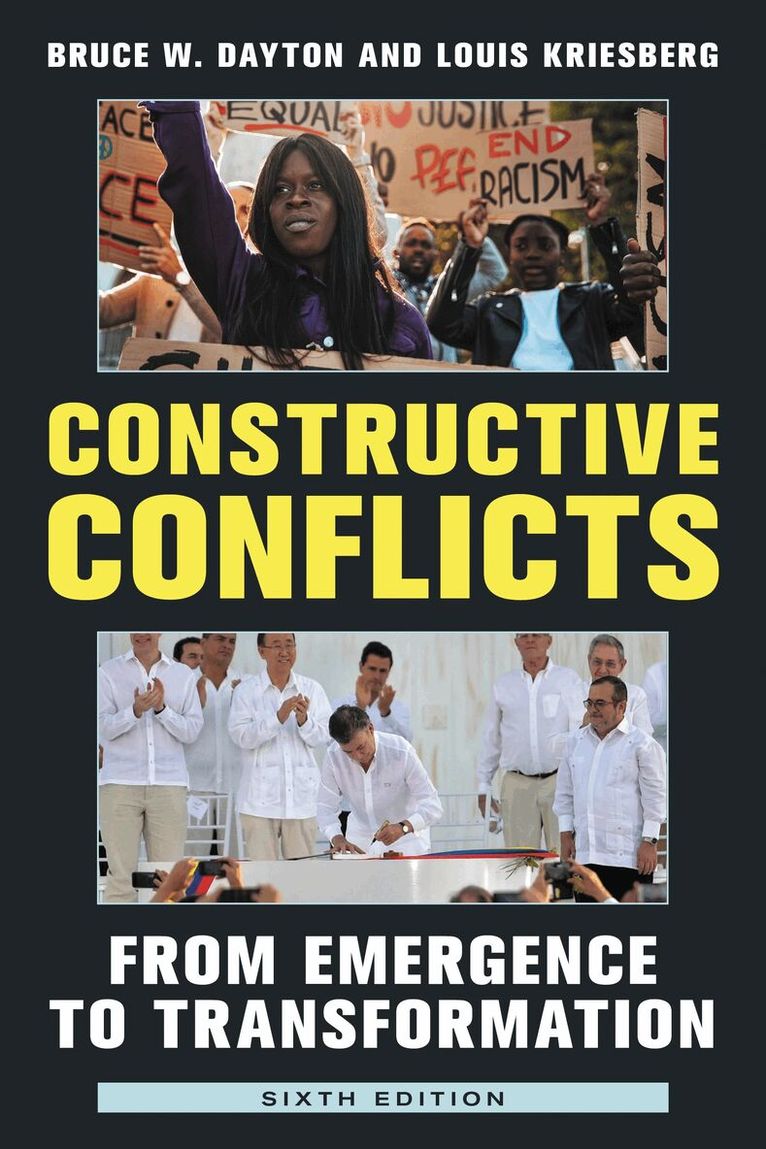
    Constructive Conflicts

    From Emergence to Transformation

    AvBruce W. Dayton,Louis Kriesberg

    Häftad, Engelska, 2022

    701 kr

    Beställningsvara. Skickas inom 10-15 vardagar. Fri frakt över 249 kr.

    Fler format och utgåvor

    Inbunden

    1 396 kr

    Beskrivning

    Substantially revised for the sixth edition, Constructive Conflicts explains how large-scale political and social conflicts can be waged more constructively, with more positive consequences and fewer destructive consequences for those involved. Drawing on research from political science, sociology, social-psychology, neuroscience, cultural studies, and other disciplines, Dayton and Kriesberg follow the lifecycle of social and political conflicts as they emerge, escalate, de-escalate, become settled, and often emerge again in new forms. The sixth edition presents numerous new examples and cases of conflict episodes that have avoided extreme coercion or violence and which have resulted in the advancement of the interests of most parties involved. The book gives policymakers, concerned citizens, and students a powerful analytical framework, supported by data, for understanding and constructively intervening in conflicts of different type and scale, offering a way out of the destructive cycles of conflict management which have come to characterize contemporary social and political relations.Key revisions and features include: Increased attention to changes in the social and political landscape including the rise of nationalism, the erosion of liberal internationalism, conflicts related to COVID response, political polarization, and the Black Lives Matter movementThoroughly revised cases and examples throughoutKey content revisions such as the growth of bottom-up strategies for peace and conflict management, the rise of misinformation in a ‘post-truth’ era, and insights from neuroscience Table of contents now organized around three distinct book sections and chapter titles revised to reflect new contentNumerous new figures and tables in every chapterEnd-of-chapter summaries, discussion questions, and activitiesNew ancillary teaching materials, including experiential exercises, simulations, and lecture outlines with teaching tips

    Produktinformation

    • Utgivningsdatum:2022-07-22
    • Mått:153 x 230 x 21 mm
    • Vikt:494 g
    • Format:Häftad
    • Språk:Engelska
    • Antal sidor:378
    • Upplaga:6
    • Förlag:Bloomsbury Publishing Plc
    • ISBN:9781538161005

    Utforska kategorier

    • Referensverk och tvärvetenskap inom Samhälle och politik
    • Krig och försvar inom Samhälle och politik
    • Sociologi inom Samhälle och politik

    Mer om författaren

    Bruce W. Dayton (Ph.D., Syracuse University) serves as associate professor and chair of the Master of Peace and Justice Leadership, the Master of Diplomacy and International Relations, and Director of the CONTACT Peacebuilding Institute at the School for International Training in Brattleboro, Vermont, USA. Professor Dayton has been active in peacebuilding and conflict transformation work for over twenty years as a practitioner, a researcher, and an educator. His other books include Perspectives in Waging Conflicts Constructively and Peacebuilding and Conflict Transformation, each co-authored with Louis Kriesberg. Bruce also served for six years as Executive Director of the International Society for Political Psychology and as Associate at the Center for Policy Negotiation in Boston, Massachusetts where he ran policy-dialogues on pressing public policy controversies. Louis Kriesberg (Ph.D., University of Chicago) is professor emeritus of Sociology, Maxwell Professor Emeritus of Social Conflict Studies, and founding director of the Program on the Analysis and Resolution of Conflicts (1986–1994), all at Syracuse University. In addition to over 160 book chapters and articles, he is the author or editor of numerous books on conflict studies. He was President of the Society for the Study of Social Problems (1983–1984), and he lectures, consults, and provides training regarding conflict resolution, security issues, and peace studies.

    Recensioner i media

    As with previous editions, the sixth edition of Constructive Conflicts provides a framework for understanding social conflict as a potential support for productive social change. With Dayton replacing Kriesberg as first author, the structure of the book has now been helpfully organized into four parts. Substantively, this new edition now marks the beginning of conflict at emergence rather than escalation, highlighting the potential for resolving conflicts before they grow violent. Additionally, it extends the end of conflict from resolution to transformation, emphasizing the potential of constructive conflict to transform societies when former opponents cooperate productively. Recommended. Graduate students, faculty, and professionals.

    Innehållsförteckning

    • List of Figures and TablesPrefacePART ONE: CONFLICT ANALYSIS AND CONFLICT THEORYChapter 1. The Constructive Conflicts ApproachPlan for the Book and Intended AudienceConflict DefinitionsSix Foundational IdeasVarieties of ConflictsCombinations Constituting Destructiveness and ConstructivenessSummary and Discussion QuestionsChapter 2. Preconditions: Three Perspectives on the Origin of ConflictsHuman NatureSociocultural RelationsSystem AttributesSynthesisSummary and Discussion QuestionsPART TWO: CONFLICT EMERGENCE AND CONFLICT STRATEGIESChapter 3. EmergenceIdentityGrievance Forming Contentious GoalsBelieving Redress is PossibleSummary and Discussion QuestionsChapter 4. Alternative Conflict Strategies: Coercion, Reward, and PersuasionChoosing StrategiesCoercion, Reward, and PersuasionStrategies and Modes of StruggleIllustrative StrategiesSummary and Discussion QuestionsChapter 5. Adopting Conflict StrategiesConflict StylePartisan Goals Partisan CharacteristicsRelations between AdversariesSocial ContextSummary and Discussion Questions PART THREE: CONFLICT ESCALATION AND DE-ESCALATIONChapter 6. EscalationProcesses of EscalationSummary and Discussion QuestionsChapter 7. De-EscalationSocial-Psychological Dynamics Organizational and Tactical DynamicsSystemic and Structural DynamicsDe-Escalation StrategiesSummary and Discussion QuestionsPART FOUR: MEDIATION, NEGOTIATION, AND POST-CONFLICT OUTCOMESChapter 8. MediationDefinitions, Applications, and BenefitsSocial RolesShapers of Mediator RolesAssessing Mediator ContributionsSummary and Discussion QuestionsChapter 9. Negotiated and Non-Negotiated SettlementsNon-Negotiated SettlementsNegotiated Settlements Forms and Stages of NegotiationSummary and Discussion QuestionsChapter 10. Post-Settlement OutcomesVariations in Post-Settlement OutcomesConstructive TransformationsSummary and Discussion QuestionsChapter 11. Toward Constructive Conflict TransformationAppendix A: Selected Organizations in the Field of Constructive Conflicts