• Fri frakt över 249 kr
  • •
  • Snabba leveranser
  • •
  • Billiga böcker
Kundservice

Du är på sajten för privatpersoner.

Företag, bibliotek eller offentlig verksamhet?

Du handlar på classic.bokus.com, där alla dina funktioner finns intakta.
Till classic.bokus.com
Bokus logotyp. Gå till startsidan.
  • Erbjudanden
  • Nyheter
  • Student
  • Topplistor
  • Barn & ungdom
  • Bokus Play
  • E-böcker
  • Pocketböcker
  • Spel & pussel

10% rabatt på allt med kod NYSTART10 →

Sidfot

Mina sidor

    Hjälp

    • Kundservice
    • Vanliga frågor och svar
    • Frakt och leverans
    • Retur vid ångerrätt
    • Reklamera vara
    • Betalning
    • Köpvillkor
    • Allmänna villkor
    • Information om webbplatsens tillgänglighet

    Om Bokus

    • Om oss
    • Pressrum
    • För studenter
    • För företag
    • För bibliotek och offentlig verksamhet
    • För leverantörer
    • Hållbarhet

    Populärt

    • Aktuella erbjudanden
    • Presentkort
    • Studentlitteratur
    • Nya böcker
    • Topplistor
    • Signerade böcker
    • Engelska böcker

    Inspiration

    • Boktips
    • BookTok
    • Populära bokserier
    • Barnbokskaraktärer
    • Populära författare
    Logotyp för Bokus
    Följ oss på Facebook (extern länk)Följ oss på Instagram (extern länk)Följ oss på YouTube (extern länk)Följ oss på TikTok (extern länk)
    bokus @ CookiesAnpassa cookiesIntegritetspolicyKöpvillkor
    Till Citymail hemsida (extern länk)Till Budbee hemsida (extern länk)Till Postnord hemsida (extern länk)Till Schenker hemsida (extern länk)Till Early Bird hemsida (extern länk)Till Walleys hemsida (extern länk)
    1. Samhälle och politik
    2. Politik och statsskick
    3. Centralt styre och förvaltning

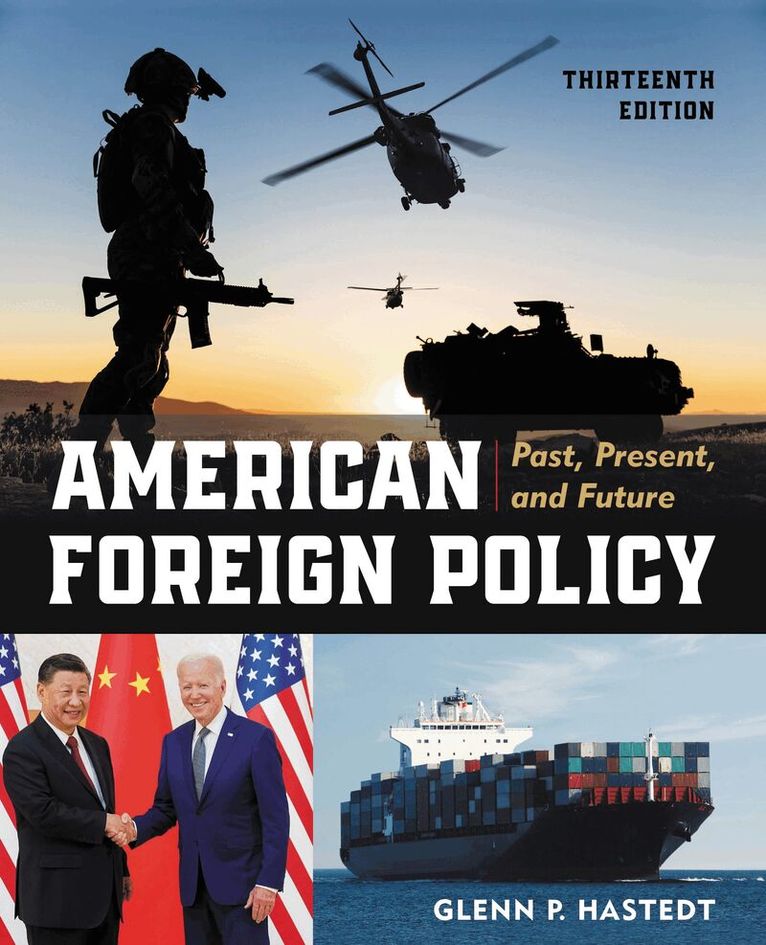
    American Foreign Policy

    Past, Present, and Future

    AvGlenn P. Hastedt

    Häftad, Engelska, 2023

    896 kr

    Beställningsvara. Skickas inom 10-15 vardagar. Fri frakt över 249 kr.

    Beskrivning

    World affairs are constantly in flux, so students need to be prepared not just to know what’s happening in the headlines but how to make sense of those events. Hastedt’s American Foreign Policy helps students develop the critical thinking skills needed to participate in debates about foreign relations—today and throughout their lives. Rather than focus on normative questions about what direction the country should take on the world stage, this text is designed to provide the historical and institutional context for the foreign policy process, from the governmental and civil society actors involved to the issues that comprise the conduct and content of American foreign policy. This thirteenth edition comes at a time when Biden’s presidency is facing some of the most important foreign policy questions in a generation, from the US withdrawal from Afghanistan to what we should do about the Russian invasion of Ukraine. These issues have emerged as many of the traditional foundations in American foreign policy have been disrupted during the Trump administration, pleasing some and angering others but almost uniformly raising political tensions at home and abroad. The revision includes up-to-date coverage of the war in Ukraine, the US exit from Afghanistan, health diplomacy and the response to COVID, the resurgence of great power politics, and other features of the Biden administration’s foreign policy. This fully revised thirteenth edition features:• Updated coverage on the Biden presidency, including the US withdrawal from Afghanistan, the Russian invasion of Ukraine, health diplomacy, and the resurgence of great-power politics• NEW! Learning Objectives to frame the expected student outcomes for each chapter• Updated On the Agenda (formerly “Dateline”) features that open each chapter to set the stage and tie a current policy issue to the chapter content• Expanded Critical Thinking Questions at the end of each chapter to engage students in higher-order thinking beyond rote memorization• An expanded art program, including additional tables to engage diverse learning styles

    Produktinformation

    • Utgivningsdatum:2023-02-06
    • Mått:191 x 228 x 20 mm
    • Vikt:676 g
    • Format:Häftad
    • Språk:Engelska
    • Antal sidor:384
    • Upplaga:13
    • Förlag:Bloomsbury Publishing Plc
    • ISBN:9781538173756

    Utforska kategorier

    • Centralt styre och förvaltning inom Samhälle och politik
    • Krig och försvar inom Samhälle och politik
    • Internationella relationer inom Samhälle och politik

    Mer om författaren

    Glenn P. Hastedt is professor emeritus at James Madison University where he was chair of the Justice Studies Department and prior to that chair of the Political Science Department. He is co-author of Introduction to International Politics: Global Challenges and Policy Responses. He has been teaching American foreign policy and international relations for over thirty years.

    Recensioner i media

    Hastedt allows teachers to cover a wide range of key topics and makes it easy for first-time students to gain basic and applied knowledge about how policy is made. A must-have for an introductory course in US foreign policy.

    Innehållsförteckning

    • Preface 1. DEFINING AMERICAN FOREIGN POLICY PROBLEMSOn the Agenda: Leaving AfghanistanThinking about Foreign Policy ProblemsChoicesWhat Do Americans Want in Foreign Policy?The National InterestCostsBuilding ConsensusSelecting a Policy InstrumentHard Power and Soft PowerUnilateral or Multilateral ActionHistorical Lesson: Into AfghanistanPresidential Foreign Policy DoctrinesThe Truman DoctrineThe Nixon DoctrineThe Carter DoctrineThe Reagan DoctrineThe Bush DoctrineIn Search of the Trump DoctrineIs There a Trump Foreign Policy Legacy?Assessing Foreign Policy ResultsIntellectual CoherenceThe Dominance of Domestic PoliticsConsistency of ApplicationOver the Horizon: The Future of Grand Strategy2. THE GLOBAL CONTEXTOn the Agenda: The Ukraine WarThinking about the WorldRealismNeoliberalismConstructivismInternational System: Structural ConstantsDecentralizationSelf-Help SystemA Stratified SystemInternational System: Evolutionary TrendsDiffusion of PowerIssue ProliferationActor ProliferationHistorical Lesson: NATORegional DiversityDominant Features TodayTerrorismGlobalizationAmerican HegemonyAmerica and the World: Attitudes and PerceptionsOver the Horizon: 20403. THE AMERICAN NATIONAL STYLEOn the Agenda: The Mexican BorderThe Importance of IdeasIsolationism versus InternationalismHistorical Sources of the American National StylePatternsUnilateralismMoral PragmatismLegalismConsequences of the American National StyleHistorical Lesson: The Bracero ProgramVoices from the PastOver the Horizon: A Millennial Foreign Policy?4. LEARNING FROM THE PASTOn the Agenda: Covid-19How Do Policy Makers Learn from the Past?Events From Which Policy Makers LearnTypes of Calculations MadeLessons LearnedHistorical Lesson: EbolaCase StudiesThe Vietnam WarThe Iraq WarOver the Horizon: Searching for Lessons from Afghanistan5. SOCIETYOn the Agenda: Quincy Institute for Responsible StatecraftPublic Awareness of Foreign Policy IssuesPublic OpinionTrends and ContentPublic Opinion and the Use of ForceImpact of Public OpinionElectionsVoting and Foreign PolicyImpact of ElectionsInterest GroupsHistorical Lesson: America First Committee, 1940Types of Interest GroupsImpact of Interest GroupsPolitical ProtestThe Media and American Foreign PolicyNewspapers and TelevisionThe New Media and American Foreign PolicyShaping the Public’s ViewStates and Cities: The New Foreign Policy BattlegroundPolicy Makers’ ResponsesOver the Horizon: An Intelligence-Industrial Complex?6. CONGRESSOn the Agenda: Aid for UkraineConstitutional PowersTreaty-Making PowerAppointment PowersWar PowersHistorical Lesson: War Powers ActCommerce PowersCongressional Structure and Foreign PolicyBlunt Foreign Policy ToolsThe Absence of a Single VoicePolicy EntrepreneurshipStaff AidesInfluence of Party and RegionOutsourcing Foreign PolicyCongress and the President: The Changing RelationshipOver the Horizon: A New War Powers Act?7. PRESIDENCYOn the Agenda: Biden’s First 100 DaysHistorical Lesson: John F. Kennedy’s First 100 DaysWeak President or Strong PresidentPresidential Power and Supreme Court DecisionsThe President and the Foreign Affairs ConstitutionExecutive AgreementsSigning StatementsExecutive Orders, Spending, and Administrative PowersInformal AmbassadorsUndeclared WarsWhen Does the President Matter?Presidential PersonalityPresidential Managerial StyleThe National Security CouncilOther White House VoicesThe Vice PresidentThe U.S. Trade RepresentativeThe White House Chief of StaffThe First LadyOver the Horizon: Improving Presidential Transitions8. BUREAUCRACYOn the Agenda: Fixing the State DepartmentPresidents and the BureaucracyThe State DepartmentStructure and Growth of the State DepartmentThe State Department’s Value SystemImpact of the State Department on Foreign PolicyThe Department of DefenseStructure and Growth of the Department of DefenseHistorical Lesson: Integrating the MilitaryThe Value System of the Department of DefenseImpact of the Defense Department on Foreign PolicyThe CIA and the Intelligence CommunityStructure and Growth of the CIA and the Intelligence CommunityThe Intelligence Community’s Value SystemImpact of the CIA and the Intelligence Community on Foreign PolicyThe Domestic BureaucraciesTreasury, Commerce, and AgricultureHomeland SecurityPolicy Makers’ Response to BureaucracyOver the Horizon: U.S. Space Command9. POLICY-MAKING MODELSOn the Agenda: Ukraine War Decision MakingForeign Policy Decisions and ModelsThe Rational Actor ModelThe Bureaucratic Politics ModelThe Small-Group Decision-Making ModelElite Theory and PluralismHistorical Lesson: The War to End All WarsIntegrating ModelsThe Cuban Missile CrisisThe Crisis: An OverviewApplying the Rational Actor Model to the CrisisApplying the Bureaucratic Politics Model to the CrisisApplying the Small-Group Decision-Making Model to the CrisisModels: A Policy Maker CritiqueOver the Horizon: Individual-Centered Models10. DIPLOMACYOn the Agenda: The Paris AgreementDiplomacy: Choices and DilemmasThe Diplomatic Tool KitBilateralism versus MultilateralismProcess versus ProductIncentives versus SanctionsBilateral Diplomacy: Allies, Friends, AdversariesShuttle DiplomacySummit DiplomacyEconomic SummitsEast-West Superpower SummitsConference DiplomacyThe General Agreement on Tariffs and Trade (GATT) and the World Trade Organization (WTO)Historical Lesson: The Kyoto Protocol and Copenhagen AccordEnvironmental ConferencesHuman Rights ConferencesGlobal Heath ConferencesUN DiplomacyPublic Diplomacy and Digital DiplomacyThe Political Use of ForceCoercive DiplomacyNuclear DiplomacyArms TransfersOver the Horizon: Coalitions of the Willing11. ECONOMIC INSTRUMENTSOn the Agenda: United States-Mexico-Canada Agreement (USMCA)Economic StatecraftInventory of OptionsStrategic OutlooksFree TradeStrategic TradeMonetary StrategiesVarieties of Trade AgreementsBilateral Trade AgreementsRegional Trade AgreementsGlobal Trade AgreementsThe China Trade WarEconomic SanctionsUsing SanctionsSanctions in Action: Iran, Cuba, RussiaForeign AidTypes of Foreign AidCold War Foreign AidPost–Cold War Foreign AidHistorical Lesson: NAFTAPost–9/11 Foreign AidContemporary Foreign AidOver the Horizon: How Trade Wars End12. MILITARY INSTRUMENTS: BIG WARSOn the Agenda: North Korean DenuclearizationCold War Nuclear ThinkingThe U.S. Cold War Strategic ArsenalU.S. Cold War Nuclear StrategyHistorical Lesson: The Baruch PlanPost–Cold War Nuclear ThinkingThe U.S. Post–Cold War Strategic Nuclear ArsenalU.S. Post–Cold War Nuclear Strategy: ContentBridging the Nuclear-Conventional DivideDeterrencePreemptionUsing Large-Scale Conventional Military ForceReducing the Danger of War: Arms Control and DisarmamentThe Cold War RecordThe Post–Cold War RecordDefenseThe Strategic Defense InitiativeNational Missile Defense SystemsOver the Horizon: A New Age of Nuclear Proliferation 13. MILITARY INSTRUMENTS: SMALL WARSOn the Agenda: Cyber WarfareSeparating Big Wars from Small WarsExiting Small WarsTypes of Small WarsHybrid WarfareCounterinsurgencyCounterterrorismThe Return of Small Wars?Small Wars by Other MeansCold War Covert ActionPost–Cold War Covert ActionThe Covert War against Osama bin LadenCyber WarfareSmall Wars for PeaceHumanitarian/Peacekeeping OperationsHistorical Lesson: The Path to MogadishuStability OperationsConventional, Cyberspace, and WMD Arms ControlChemical and Biological WeaponsRecovering Loose WMD MaterialCyberspaceConventional WeaponsCounterproliferationOver the Horizon: Drone Wars14. ALTERNATIVE FUTURESOn the Agenda: The South China SeaForeign Policy VisionsThe United States as an Ordinary StateReformed AmericaPragmatic AmericaAmerican CrusaderAmerica the BalancerDisengaged AmericaHistorical Lesson: The First Asian Pivot: Commodore Perry’s Opening of JapanOver the Horizon: A New Cold War?GlossaryNotesAbout the Author Index