• Fri frakt över 249 kr
  • •
  • Snabba leveranser
  • •
  • Billiga böcker
Kundservice

Du är på sajten för privatpersoner.

Företag, bibliotek eller offentlig verksamhet?

Du handlar på classic.bokus.com, där alla dina funktioner finns intakta.
Till classic.bokus.com
Bokus logotyp. Gå till startsidan.
  • Erbjudanden
  • Nyheter
  • Student
  • Topplistor
  • Barn & ungdom
  • Bokus Play
  • E-böcker
  • Pocketböcker
  • Spel & pussel

10% rabatt på allt med kod NYSTART10 →

Sidfot

Mina sidor

    Hjälp

    • Kundservice
    • Vanliga frågor och svar
    • Frakt och leverans
    • Retur vid ångerrätt
    • Reklamera vara
    • Betalning
    • Köpvillkor
    • Allmänna villkor
    • Information om webbplatsens tillgänglighet

    Om Bokus

    • Om oss
    • Pressrum
    • För studenter
    • För företag
    • För bibliotek och offentlig verksamhet
    • För leverantörer
    • Hållbarhet

    Populärt

    • Aktuella erbjudanden
    • Presentkort
    • Studentlitteratur
    • Nya böcker
    • Topplistor
    • Signerade böcker
    • Engelska böcker

    Inspiration

    • Boktips
    • BookTok
    • Populära bokserier
    • Barnbokskaraktärer
    • Populära författare
    Logotyp för Bokus
    Följ oss på Facebook (extern länk)Följ oss på Instagram (extern länk)Följ oss på YouTube (extern länk)Följ oss på TikTok (extern länk)
    bokus @ CookiesAnpassa cookiesIntegritetspolicyKöpvillkor
    Till Citymail hemsida (extern länk)Till Budbee hemsida (extern länk)Till Postnord hemsida (extern länk)Till Schenker hemsida (extern länk)Till Early Bird hemsida (extern länk)Till Walleys hemsida (extern länk)
    1. Samhälle och politik
    2. Samhälle och kultur
    3. Kultur och medier
    4. Referensverk och tvärvetenskap

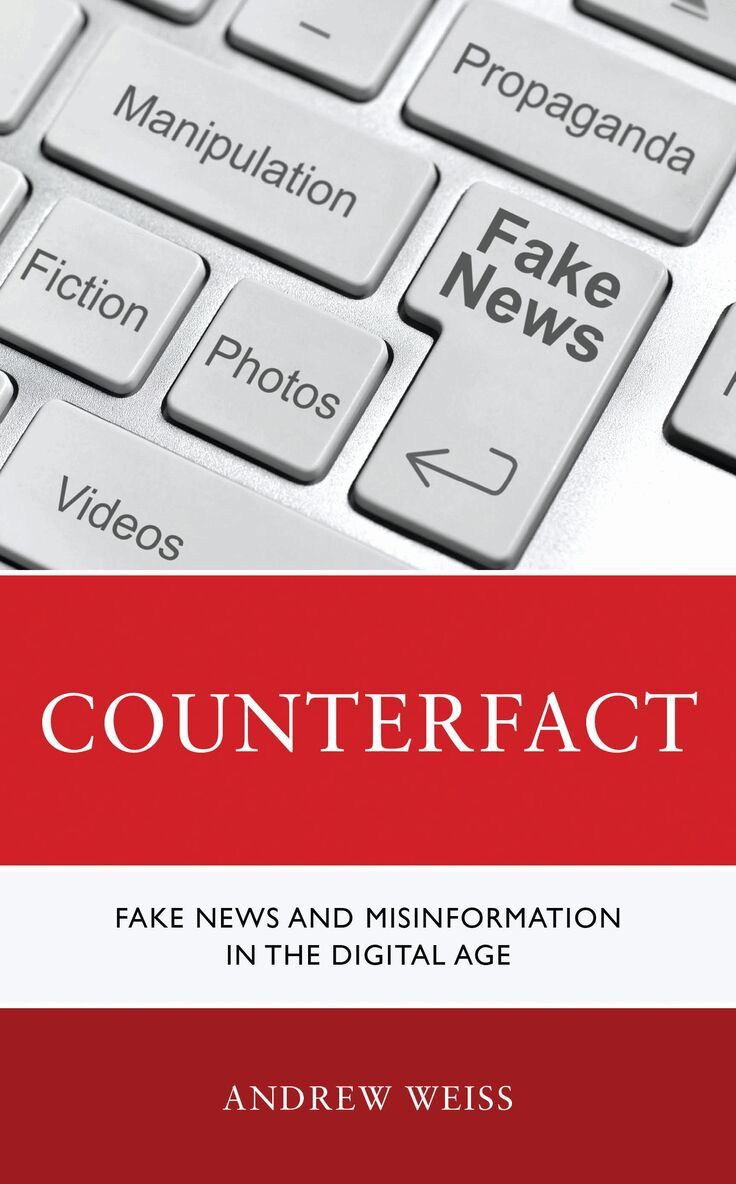
    Counterfact

    Fake News and Misinformation in the Digital Information Age

    AvAndrew Weiss

    Inbunden, Engelska, 2024

    1 239 kr

    Beställningsvara. Skickas inom 10-15 vardagar. Fri frakt över 249 kr.

    Fler format och utgåvor

    Häftad

    445 kr

    E-bok

    484 kr

    Beskrivning

    For as long as there has been a press, fake news has played a role in the disruption of how factual information is shared among people. Misinformation goes back even further, spreading through the use of lies and rumors, spoken or written, for various political and social purposes. In this book, we will trace a brief history of fake news, examine its antecedents and precursors, before looking at the way it is currently employed using digital information technologies. The current consensus on what comprises fake news is somewhat contested; as such, a more detailed look at the phenomenon is in order. Not only does fake news include false news stories spread with the intent to deceive, its purpose can be instructive and parodic, providing the very tools needed to puncture misinformation bubbles. This book will examine in detail a comprehensive model for fake news that might be used to help predict and neutralize its negative effects, as well as examine the traits that contribute to a person’s susceptibility to falling for false stories, conspiracies, and other misinformation.In this regard, the book is unique in its approach to fake news, seeing it as situated within a matrix of behaviors, conditions, and contexts that must be accounted for before its effects can be completely neutralized. The context also explores the relationship of the creator and the user of fake news, speculating on the intertwined actions and motives of both. It is hypothesized that specific conditions exploited by ‘bad actors’ would contribute to the spread of fake news and that low levels or lack of certain identifiable characteristics in users (i.e. ability to scaffold, conduct parallel thinking, be aware of one’s ignorance, know one’s strengths and weaknesses) would also make it more likely to be consumed and shared. This book also examines the wider impacts of fake news on societies, especially in the areas of education, politics, and public policy. This book makes the case for developing strategies that rely not merely upon information literacy to help individuals deal with fake news, but also on wider national and international policies that specifically aid users of information and address human behavioral characteristics. As in information behavior research, the scale and scope of examining fake news requires both a local focus and a large-scale inquiry into societal and cultural norms

    Produktinformation

    • Utgivningsdatum:2024-02-01
    • Mått:157 x 238 x 24 mm
    • Vikt:567 g
    • Format:Inbunden
    • Språk:Engelska
    • Antal sidor:300
    • Förlag:Bloomsbury Publishing Plc
    • ISBN:9781538177372

    Utforska kategorier

    • Referensverk och tvärvetenskap inom Samhälle och politik

    Mer om författaren

    Andrew Weiss is a digital services librarian at California State University, Northridge, with over fifteen years of experience working in academic libraries. He focuses primarily on scholarly communication issues, especially open access, copyright policy in academia, institutional repositories, and developing better strategies for data curation. He is currently a PhD student with Manchester Metropolitan University in the San Jose State University Gateway program. His current and prior research examines fake news and disinformation; the impact of massive digital libraries such as Google Books, the HathiTrust, and the Internet Archive; the future developments of open access publishing; the impact of ‘Big Data;’ and, last but not least, information ethics. He lives in Los Angeles with his family.

    Recensioner i media

    Counterfact is a well-informed description of fake news and false information that offers recommendations about how to mitigate these in a clearly written practical manner. This will be of great use to librarians and scholars who study the nature and use of information.