• Fri frakt över 249 kr
  • •
  • Snabba leveranser
  • •
  • Billiga böcker
Kundservice

Du är på sajten för privatpersoner.

Företag, bibliotek eller offentlig verksamhet?

Du handlar på classic.bokus.com, där alla dina funktioner finns intakta.
Till classic.bokus.com
Bokus logotyp. Gå till startsidan.
  • Erbjudanden
  • Nyheter
  • Student
  • Topplistor
  • Barn & ungdom
  • Bokus Play
  • E-böcker
  • Pocketböcker
  • Spel & pussel

10% rabatt på allt med kod: NYSTART10 →

Sidfot

Mina sidor

    Hjälp

    • Kundservice
    • Vanliga frågor och svar
    • Frakt och leverans
    • Retur vid ångerrätt
    • Reklamera vara
    • Betalning
    • Köpvillkor
    • Allmänna villkor
    • Information om webbplatsens tillgänglighet

    Om Bokus

    • Om oss
    • Pressrum
    • För studenter
    • För företag
    • För bibliotek och offentlig verksamhet
    • För leverantörer
    • Hållbarhet

    Populärt

    • Aktuella erbjudanden
    • Presentkort
    • Studentlitteratur
    • Nya böcker
    • Topplistor
    • Signerade böcker
    • Engelska böcker

    Inspiration

    • Boktips
    • BookTok
    • Populära bokserier
    • Barnbokskaraktärer
    • Populära författare
    Logotyp för Bokus
    Följ oss på Facebook (extern länk)Följ oss på Instagram (extern länk)Följ oss på YouTube (extern länk)Följ oss på TikTok (extern länk)
    bokus @ CookiesAnpassa cookiesIntegritetspolicyKöpvillkor
    Till Citymail hemsida (extern länk)Till Budbee hemsida (extern länk)Till Postnord hemsida (extern länk)Till Schenker hemsida (extern länk)Till Early Bird hemsida (extern länk)Till Walleys hemsida (extern länk)
    1. Psykologi och pedagogik
    2. Psykologi

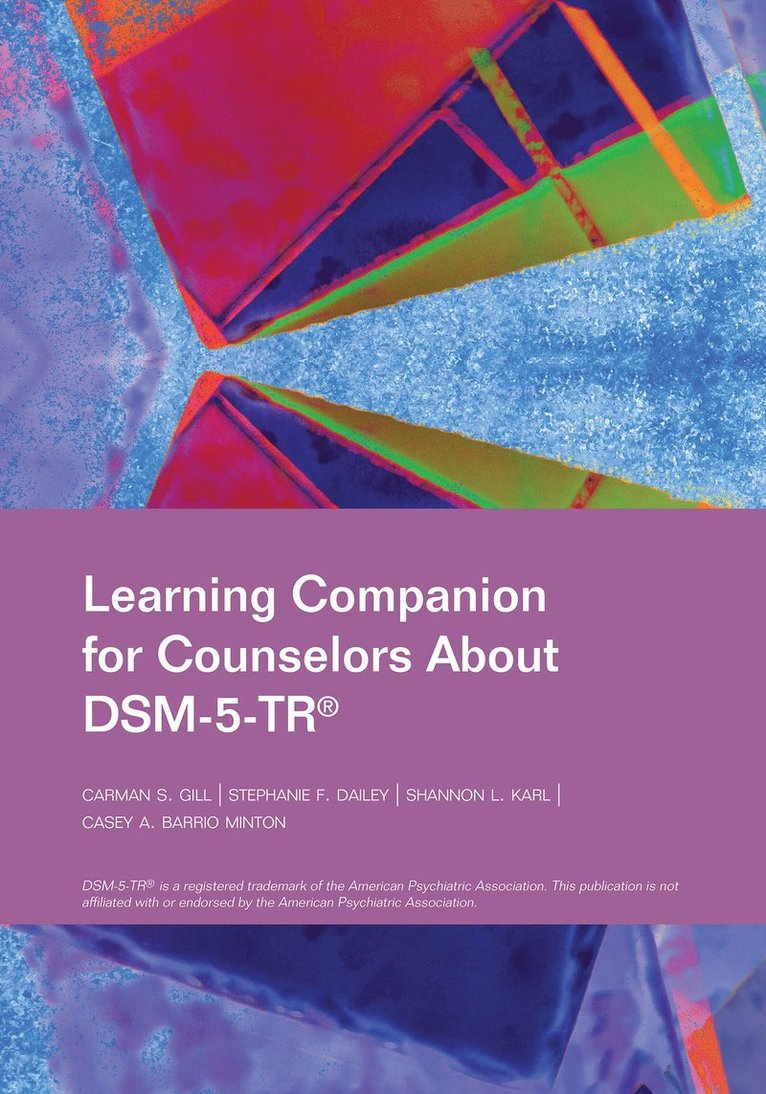
    Learning Companion for Counselors About DSM-5-TR®

    AvCarman S. Gill,Stephanie F. Dailey

    Häftad, Engelska, 2025

    675 kr

    Beställningsvara. Skickas inom 5-8 vardagar. Fri frakt över 249 kr.

    Beskrivning

    This updated learning companion is designed to assist professional counselors with a smooth transition from the DSM-5 to the DSM-5-TR. The text highlights diagnostic changes and new developments within the DSM-5-TR. Each chapter features updated research with implications for evidence-based practice alongside practical strategies for holistic, culturally-responsive, and wellness-based counseling. As with the original DSM-5 Learning Companion for Counselors, this revision is intended for counselors, counseling students, counselor educators, and mental health professionals who engage in mental health diagnosis and evidenced-based services. The DSM-5-TR includes some important changes of which counselors must be aware, and this updated learning companion will help them incorporate these changes into practice. This new edition addresses these noteworthy changes specifically, delineating the differences and guidance, as well as case examples.DSM-5-TR is a registered trademark of the American Psychiatric Association. This book is neither endorsed by nor a product of the American Psychiatric Association.

    Produktinformation

    • Utgivningsdatum:2025-08-14
    • Mått:177 x 254 x 25 mm
    • Vikt:748 g
    • Format:Häftad
    • Språk:Engelska
    • Antal sidor:432
    • Förlag:American Counseling Association
    • ISBN:9781556200267

    Utforska kategorier

    • Psykologi inom Psykologi och pedagogik
    • Psykologisk metod inom Psykologi och pedagogik
    • Psykoterapi som behandlingsmetod inom Medicin

    Mer om författaren

    Carman S. Gill, PhD, LPC, NCC, ACS, is a professor and department chair at Florida Atlantic University. She has worked with client populations including individuals who are dually diagnosed, individuals with chronic mental illness, children, and individuals experiencing acute mental health crises. Her research focus includes wellness and women’s issues, as well as spirituality and religion in counseling. Dr. Gill is a past-president of ASERVIC and has served that organization as conference cochair twice, as well as newsletter editor, member of the board of directors, and secretary. Dr. Gill has coauthored multiple peer-reviewed journal articles on spiritual topics. She has coedited a book on spirituality and religion in counseling, in addition to the previous version of this Learning Companion. Stephanie F. Dailey, EdD, LPC, NCC, is a licensed professional counselor and assistant professor of counseling at George Mason University. Dr. Dailey’s research and clinical work is directed at better understanding trauma-informed response protocols for mass casualty events, increasing resilience in first responders, and working with individuals diagnosed with severe mental illness and complex trauma. Her work at the federal level has included trauma-informed mitigation protocols for public schools during active shooter events, officer wellness programs aimed at improving use-of-force decision-making, and stress inoculation training to increase resilience in military medical providers. Dr. Dailey also co-leads a national school-based program to address current K–12 school shooter vulnerabilities. She has published and presented extensively on the Diagnostic and Statistical Manual of Mental Disorders, counseling assessment, and case conceptualization. Dr. Dailey is a former co-chair of the American Counseling Association Ethics Committee (2013–2015); a past-president of the Association for Spiritual, Ethical, and Religious Values in Counseling (ASERVIC, 2016–2017); and former chair of the American Counseling Association Foundation (2020–2023). Shannon L. Karl, PhD, LMHC, NCC, CCMHC, ACS, is a professor in the College of Psychology at Nova Southeastern University. She has extensive clinical mental health experience and is a licensed mental health counselor and qualified clinical supervisor in the state of Florida. Dr. Karl has published in the areas of eating disorders, domestic violence, counseling student performance, spirituality, addictions, and the Diagnostic and Statistical Manual of Mental Disorders. She is a past-president of ASERVIC and past-secretary of the Association for Counselor Education and Supervision. She frequently presents at regional, national, and international conferences and serves as a longtime team lead at the Council for Accreditation of Counseling and Related Educational Programs. Casey A. Barrio Minton, PhD, NCC, is a professor of counselor education and interim head of the Department of Educational Psychology and Counseling at the University of Tennessee, Knoxville. Her scholarly work focuses on crisis intervention, clinical mental health issues, and professionalization through teaching and leadership. Founding editor of the Journal of Counselor Leadership and Advocacy, Dr. Barrio Minton is a past-president of Chi Sigma Iota International, the Association for Assessment and Research in Counseling, the Southern Association for Counselor Education and Supervision, and the Association for Counselor Education and Supervision. She continues to actively serve these organizations through their mentorship programs and committees. She is a fellow of the American Counseling Association.

    Innehållsförteckning

    • Chapter 1 : Introduction and OverviewChapter 2 : Structural and Philosophical Changes to the DSM : A Historical OverviewIntroduction to Diagnostic ChangesPart One to Part Four OverviewPart One : Clinical Utility and Practice Implications for CounselorsPart One : IntroductionChapter 3 : Sociocultural Issues in Diagnosis in the DSM-5-TRChapter 4 : Culturally Responsive Case Conceptualization and Treatment Planning : Cultural FormulationChapter 5 : Practice Implications for CounselorsPart Two : Changes and Implications Involving Mood, Anxiety, and Stressor-Related ConcernsPart Two : IntroductionChapter 6 : Depressive DisordersChapter 7 : Bipolar and Related DisordersChapter 8 : Anxiety Disorders 1Chapter 9 : Obsessive-Compulsive and Related DisordersChapter 10 : Trauma- and Stressor-Related DisordersChapter 11 : Gender Dysphoria in Children, Adolescents, and AdultsPart Three : Changes and Implications Involving Addictive, Impulse-Control, and Specific Behavior-Related ConcernsPart Three : IntroductionChapter 12 : Substance-Related and Addictive DisordersChapter 13 : Disruptive, Impulse-Control, and Conduct DisordersChapter 14 : Personality DisordersChapter 15 : Specific Behavioral DisruptionsPart Four : Changes and Implications Involving Diagnoses Commonly Made by Other ProfessionalsPart Four : IntroductionChapter 16 : Neurodevelopmental and Neurocognitive DisordersChapter 17 : Schizophrenia Spectrum and Other Psychotic DisordersChapter 18 : Dissociative DisordersChapter 19 : Somatic Symptom and Related Disorders