• Fri frakt över 249 kr
  • •
  • Snabba leveranser
  • •
  • Billiga böcker
Kundservice

Du är på sajten för privatpersoner.

Företag, bibliotek eller offentlig verksamhet?

Du handlar på classic.bokus.com, där alla dina funktioner finns intakta.
Till classic.bokus.com
Bokus logotyp. Gå till startsidan.
  • Erbjudanden
  • Nyheter
  • Student
  • Topplistor
  • Barn & ungdom
  • Bokus Play
  • E-böcker
  • Pocketböcker
  • Spel & pussel

10% rabatt på allt med kod: NYSTART10 →

Sidfot

Mina sidor

    Hjälp

    • Kundservice
    • Vanliga frågor och svar
    • Frakt och leverans
    • Retur vid ångerrätt
    • Reklamera vara
    • Betalning
    • Köpvillkor
    • Allmänna villkor
    • Information om webbplatsens tillgänglighet

    Om Bokus

    • Om oss
    • Pressrum
    • För studenter
    • För företag
    • För bibliotek och offentlig verksamhet
    • För leverantörer
    • Hållbarhet

    Populärt

    • Aktuella erbjudanden
    • Presentkort
    • Studentlitteratur
    • Nya böcker
    • Topplistor
    • Signerade böcker
    • Engelska böcker

    Inspiration

    • Boktips
    • BookTok
    • Populära bokserier
    • Barnbokskaraktärer
    • Populära författare
    Logotyp för Bokus
    Följ oss på Facebook (extern länk)Följ oss på Instagram (extern länk)Följ oss på YouTube (extern länk)Följ oss på TikTok (extern länk)
    bokus @ CookiesAnpassa cookiesIntegritetspolicyKöpvillkor
    Till Citymail hemsida (extern länk)Till Budbee hemsida (extern länk)Till Postnord hemsida (extern länk)Till Schenker hemsida (extern länk)Till Early Bird hemsida (extern länk)Till Walleys hemsida (extern länk)
    1. Psykologi och pedagogik
    2. Pedagogik
    3. Pedagogisk teori och filosofi

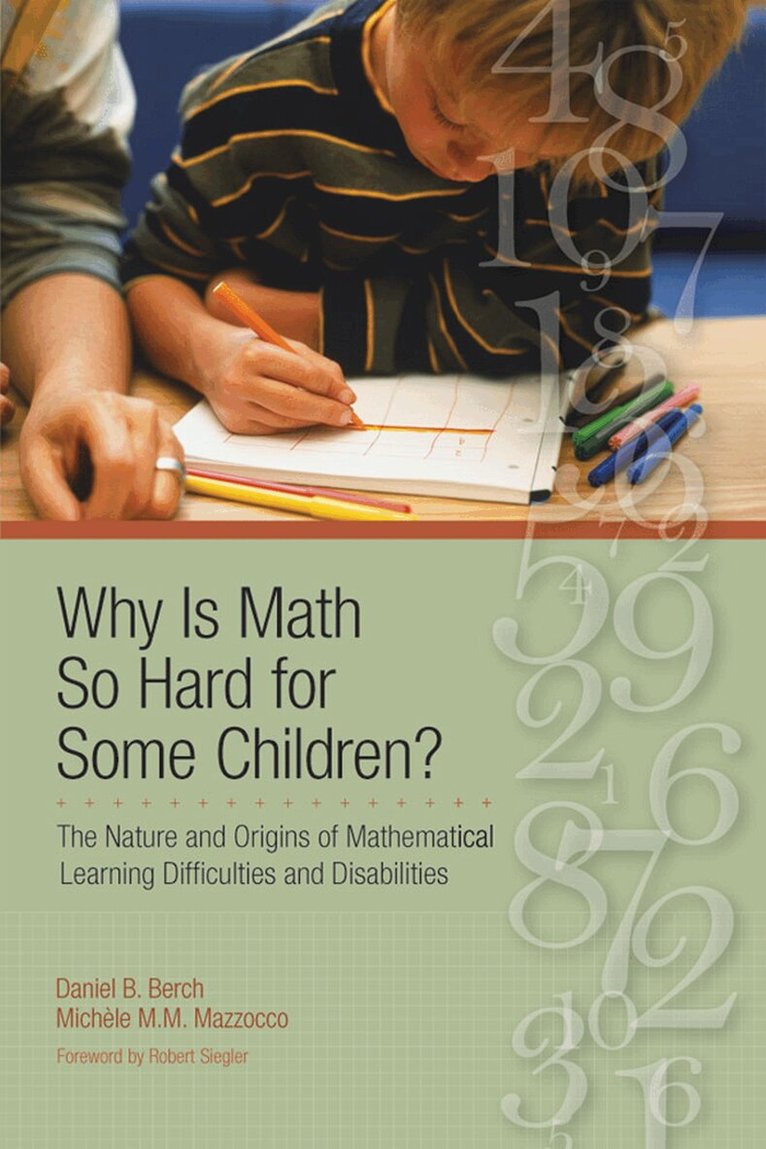
    Why Is Math So Hard for Some Children?

    The Nature and Origins of Mathematical Learning Difficulties and Disabilities

    AvDaniel B. Berch,Michele M.M. Mazzocco

    Inbunden, Engelska, 2007

    645 kr

    Beställningsvara. Skickas inom 5-8 vardagar. Fri frakt över 249 kr.

    Beskrivning

    This book will comprise a comprehensive and multidisciplinary treatment of current research on mathematical learning disabilities. Empirical, theoretical, methodological, and pedagogical perspectives on this rapidly evolving area will be discussed, drawing on a wide range of fields including cognitive and developmental psychology, educational psychology, neuropsychology, cognitive neuroscience, behavior genetics, and special education. Topics to be discussed include: issues of clarification and definition; the prevalence of mathematical learning disabilities; the role of language in mathematical learning; math anxiety; motivation; gender; cultural influences; effective instructional interventions; and much more.

    Produktinformation

    • Utgivningsdatum:2007-03-30
    • Mått:160 x 230 x 30 mm
    • Vikt:720 g
    • Format:Inbunden
    • Språk:Engelska
    • Antal sidor:488
    • Förlag:Brookes Publishing Co
    • ISBN:9781557668646

    Utforska kategorier

    • Pedagogisk teori och filosofi inom Psykologi och pedagogik
    • Pedagogisk psykologi inom Psykologi och pedagogik

    Mer om författaren

    Daniel B. Berch is Associate Chief, Child Development and Behavior Branch, National Institute of Child Health and Human Development, National Institutes of Health, in Bethesda, Maryland. Michele M.M. Mazzocco is Associate Professor of Psychiatry, Johns Hopkins School of Medicine; Associate Professor of Population and Family Health Sciences, Johns Hopkins Bloomberg School of Public Health; and Director, Math Skills Development Project, Kennedy Krieger West Campus, in Baltimore, Maryland.

    Innehållsförteckning

    • Characterizing Learning Disabilities in Mathematics; Historical Overview of the Field; Classification and Definitional Issues; Prevalence of Developmental Discalculia; Cognitive and Information Processing Features; Fundemental Information-Processing Deficits; Strategy Use, Long-Term Memory, and Working Memory Capacity; Do Words Count? Connections between Mathematics and Reading Difficulties; Fraction Skills and Proportional Reasoning; Neuropsychological Factors; Specific Language Impairment and Mathematical Disabilities; Neurodevelopmental Disorders (Turner, Fragile X, Williams); Mathematical Disabilities in Congenital and Acquired Neurodevelopmental Disorders; Neuropsychological Case Studies on Arithmetic Processing; Neurobiological and Genetic Substrates; Neuroanatomical Features of Mathematical Processing; Quantitative Genetics and Mathematical Abilities/Disabilities; Additional Influences on Math Disability; Is Math Anxiety a Mathematics Learning Disability?; Influences of Gender, Ethnicity, and Motivation on Mathematics Performance; Instructional Interventions; Early Intervention for Children at Risk of Developing Math Disabilities; Mathematical Problem Solving: Instructional Intervention; Quantitative Literacy and Developmental Dyscalculia.