• Fri frakt över 249 kr
  • •
  • Snabba leveranser
  • •
  • Billiga böcker
Kundservice

Du är på sajten för privatpersoner.

Företag, bibliotek eller offentlig verksamhet?

Du handlar på classic.bokus.com, där alla dina funktioner finns intakta.
Till classic.bokus.com
Bokus logotyp. Gå till startsidan.
  • Erbjudanden
  • Nyheter
  • Student
  • Topplistor
  • Barn & ungdom
  • Bokus Play
  • E-böcker
  • Pocketböcker
  • Spel & pussel

Må bättre, för mindre! Upp till 50% rabatt på hälsoböcker

Sidfot

Mina sidor

    Hjälp

    • Kundservice
    • Vanliga frågor och svar
    • Frakt och leverans
    • Retur vid ångerrätt
    • Reklamera vara
    • Betalning
    • Köpvillkor
    • Allmänna villkor
    • Information om webbplatsens tillgänglighet

    Om Bokus

    • Om oss
    • Pressrum
    • För studenter
    • För företag
    • För bibliotek och offentlig verksamhet
    • För leverantörer
    • Hållbarhet

    Populärt

    • Aktuella erbjudanden
    • Presentkort
    • Studentlitteratur
    • Nya böcker
    • Topplistor
    • Signerade böcker
    • Engelska böcker

    Inspiration

    • Boktips
    • BookTok
    • Populära bokserier
    • Barnbokskaraktärer
    • Populära författare
    Logotyp för Bokus
    Följ oss på Facebook (extern länk)Följ oss på Instagram (extern länk)Följ oss på YouTube (extern länk)Följ oss på TikTok (extern länk)
    bokus @ CookiesAnpassa cookiesIntegritetspolicyKöpvillkor
    Till Citymail hemsida (extern länk)Till Budbee hemsida (extern länk)Till Postnord hemsida (extern länk)Till Schenker hemsida (extern länk)Till Early Bird hemsida (extern länk)Till Walleys hemsida (extern länk)
    1. Ekonomi och Ledarskap
    2. Nationalekonomi

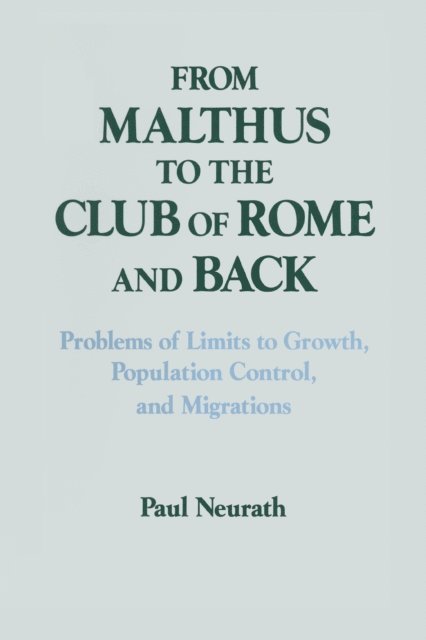
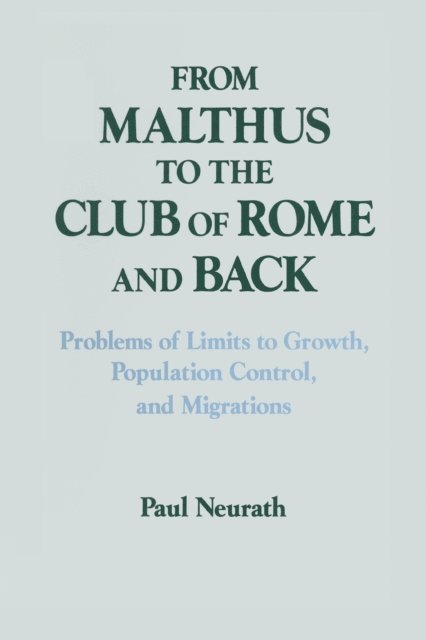
    From Malthus to the Club of Rome and Back

    Problems of Limits to Growth, Population Control and Migrations

    AvPaul Neurath

    Häftad, Engelska, 1994

    723 kr

    Beställningsvara. Skickas inom 10-15 vardagar. Fri frakt över 249 kr.

    Fler format och utgåvor

    E-bok

    855 kr

    E-bok

    881 kr

    Beskrivning

    This collection of articles on population growth spans 20 years of the author's thinking and research on a wide range of issues. The book opens with a presentation of the early history of demography before Thomas Malthus wrote his essay on the principles of population (1798) that marked the beginnings of modern demography as a science. The author follows up with a chapter on the estimates made at various times in the past hundred years about the maximum number of people who could live on earth. Four papers deal with the debates about global models of population growth and the limits to growth. Sharp swings in population policy in China from the Communist Revolution under Mao in 1949 to the one child-per-family rule in 1979 are also considered. Another chapter compares population policy in Japan, China and India. A chapter is devoted to the role of oil and the soaring price of this basic input into agriculture as a constraint on food production and, as a result, on population growth. A closing chapter considers the great migrations of the 19th and 20th centuries, including the transatlantic and transpacific movements, the mass migrations after World Wars I and II, and those of recent decades. This book will interest scholars and students in economics and other social sciences dealing with the issues of demography, population growth, and economic development.

    Produktinformation

    • Utgivningsdatum:1994-10-31
    • Mått:152 x 229 x 21 mm
    • Vikt:566 g
    • Format:Häftad
    • Språk:Engelska
    • Antal sidor:216
    • Förlag:Taylor & Francis Inc
    • ISBN:9781563244087

    Utforska kategorier

    • Nationalekonomi inom Ekonomi och Ledarskap
    • Migration inom Samhälle och politik
    • Politiskt förtryck inom Samhälle och politik

    Innehållsförteckning

    • An anthropological study of a major national political party - one which dominated Israeli politics for nearly five decades and was returned to office in summer 1992. The analysis focuses on the relationship between culture and politics to explain the crucial role the Labour Party has played.