• Fri frakt över 249 kr
  • •
  • Snabba leveranser
  • •
  • Billiga böcker
Kundservice

Du är på sajten för privatpersoner.

Företag, bibliotek eller offentlig verksamhet?

Du handlar på classic.bokus.com, där alla dina funktioner finns intakta.
Till classic.bokus.com
Bokus logotyp. Gå till startsidan.
  • Erbjudanden
  • Nyheter
  • Student
  • Topplistor
  • Barn & ungdom
  • Bokus Play
  • E-böcker
  • Pocketböcker
  • Spel & pussel

10% rabatt på allt med kod: NYSTART10 →

Sidfot

Mina sidor

    Hjälp

    • Kundservice
    • Vanliga frågor och svar
    • Frakt och leverans
    • Retur vid ångerrätt
    • Reklamera vara
    • Betalning
    • Köpvillkor
    • Allmänna villkor
    • Information om webbplatsens tillgänglighet

    Om Bokus

    • Om oss
    • Pressrum
    • För studenter
    • För företag
    • För bibliotek och offentlig verksamhet
    • För leverantörer
    • Hållbarhet

    Populärt

    • Aktuella erbjudanden
    • Presentkort
    • Studentlitteratur
    • Nya böcker
    • Topplistor
    • Signerade böcker
    • Engelska böcker

    Inspiration

    • Boktips
    • BookTok
    • Populära bokserier
    • Barnbokskaraktärer
    • Populära författare
    Logotyp för Bokus
    Följ oss på Facebook (extern länk)Följ oss på Instagram (extern länk)Följ oss på YouTube (extern länk)Följ oss på TikTok (extern länk)
    bokus @ CookiesAnpassa cookiesIntegritetspolicyKöpvillkor
    Till Citymail hemsida (extern länk)Till Budbee hemsida (extern länk)Till Postnord hemsida (extern länk)Till Schenker hemsida (extern länk)Till Early Bird hemsida (extern länk)Till Walleys hemsida (extern länk)
    1. Ekonomi och Ledarskap
    2. Företagsekonomi
    3. Organisationsteori

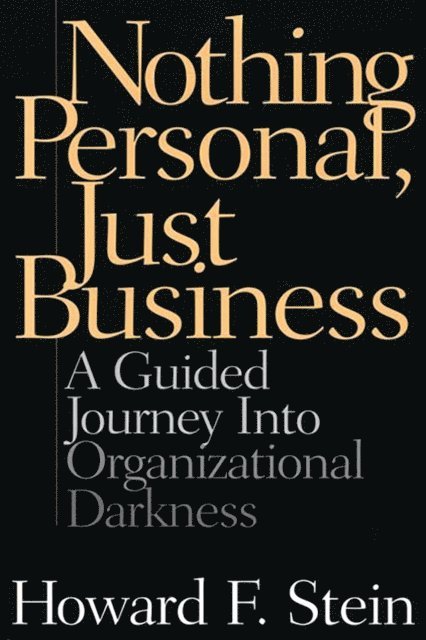
    Nothing Personal, Just Business

    A Guided Journey into Organizational Darkness

    AvHoward F. Stein

    Inbunden, Engelska, 2001

    1 018 kr

    Beställningsvara. Skickas inom 10-15 vardagar. Fri frakt över 249 kr.

    Fler format och utgåvor

    E-bok

    1 100 kr

    Beskrivning

    Throughout the United States and indeed the world, organizations have become places of darkness, where emotional savagery and brutality are now commonplace and where psychological forms of violence--intimidation, degradation, dehumanization--are the norm. Stein succeeds in portraying this dramatically in his evocative, lucid new book, and in doing so he counters official pronouncements that simply because unemployment is low and productivity high, all is well. Through the use of symbolism and metaphor he gives us access to the interior experience of organizational life today. He employs a form of disciplined subjectivity, based on Freud's concept of counter-transference, and other methods to help us comprehend what such dominating notions as managed social change really mean. Downsizing, reengineering, managed care, endless organizational restructuring--all are presented as just business but in reality, says Stein, they are devastatingly personal in their effects. With numerous vignettes and anecdotes drawn from his formal and informal research, Dr. Stein shows us in often horrifying detail what work has come to be in so many of these dark places--but also what must happen, and can happen, to lift them into the light.Through consultations, observation, and personal experience, Stein documents the ordinary assaults on the human spirit, a form of violence in the workplace that usually escapes common classification. By that he means culturally sanctioned violence, such as everyday forms of intimidation, ridicule, goading, and doubling of workloads--all in an asserted effort to make the workplace more productive, more competitive. His examples, metaphors, symbols, images come from the Holocaust and the Vietnam War, and refer back to other horrors in other times, the Crusades and the Spanish Inquisition among them. His book demonstrates precisely how brutal so many of our rational business practices have become, and how disposable all of us ultimately are, at all levels, in all organizations. Stein draws upon a variety of research techniques, including a form of counter-transference based on Freud's concept, to understand the inner meanings and feelings contained in workplace metaphors and symbols. An incisive foreword by Dr. David B. Friedman, Associate Clinical Professor of Psychiatry at the New York University School of Medicine, comments on this, puts the book in perspective and offers additional insights into Stein's themes and how brilliantly he develops them.

    Produktinformation

    • Utgivningsdatum:2001-06-30
    • Mått:156 x 235 x 15 mm
    • Vikt:454 g
    • Format:Inbunden
    • Språk:Engelska
    • Antal sidor:192
    • Förlag:Bloomsbury Publishing Plc
    • ISBN:9781567204421
    • Utmärkelser:Commended for Oklahoma Book Award (Nonfiction) 2002

    Utforska kategorier

    • Organisationsteori inom Ekonomi och Ledarskap
    • Arbetspsykologi inom Psykologi och pedagogik

    Mer om författaren

    HOWARD F. STEIN is a professor in the Department of Family and Preventive Medicine, University of Oklahoma Health Sciences Center, Oklahoma City. A medical and psychoanalytic anthropologist, organizational consultant, political psychologist and psychohistorian, Dr. Stein specializes in teaching clinical behavioral science to residents and graduate students in Family Medicine and in Occupational Medicine. He is a former editor of The Journal of Psychoanalytic Anthropology, has published more than 200 articles and chapters in books, and has written and edited more than 20 of his own books, most recently Euphemism, Spin, and the Crisis in Organizational Life (Quorum, 1998).

    Innehållsförteckning

    • Foreword by David B. Friedman, M.D.PrefaceIntroduction: Don't Take It Personally, It's Just BusinessCountertransference as a Tool in Organizational Theory: The "Use" of Self to Understand Workplace ViolenceDownsizing, Managed Care, and the Potlatching of Workplace: A Study in Cultural Brutality and Its MystificationThe Holocaust as Trope for Managed Social ChangeOrdinary Brutality at Work"How Long Can We Circle the Wagons?" A Study in the Sense of Doom at WorkRupture and Reconciliation: A Case StudyConclusionsIndex