• Fri frakt över 249 kr
  • •
  • Snabba leveranser
  • •
  • Billiga böcker
Kundservice

Du är på sajten för privatpersoner.

Företag, bibliotek eller offentlig verksamhet?

Du handlar på classic.bokus.com, där alla dina funktioner finns intakta.
Till classic.bokus.com
Bokus logotyp. Gå till startsidan.
  • Erbjudanden
  • Nyheter
  • Student
  • Topplistor
  • Barn & ungdom
  • Bokus Play
  • E-böcker
  • Pocketböcker
  • Spel & pussel

10% studentrabatt med kod TERM26

Sidfot

Mina sidor

    Hjälp

    • Kundservice
    • Vanliga frågor och svar
    • Frakt och leverans
    • Retur vid ångerrätt
    • Reklamera vara
    • Betalning
    • Köpvillkor
    • Allmänna villkor
    • Information om webbplatsens tillgänglighet

    Om Bokus

    • Om oss
    • Pressrum
    • För studenter
    • För företag
    • För bibliotek och offentlig verksamhet
    • För leverantörer
    • Hållbarhet

    Populärt

    • Aktuella erbjudanden
    • Presentkort
    • Studentlitteratur
    • Nya böcker
    • Topplistor
    • Signerade böcker
    • Engelska böcker

    Inspiration

    • Boktips
    • BookTok
    • Populära bokserier
    • Barnbokskaraktärer
    • Populära författare
    Logotyp för Bokus
    Följ oss på Facebook (extern länk)Följ oss på Instagram (extern länk)Följ oss på YouTube (extern länk)Följ oss på TikTok (extern länk)
    bokus @ CookiesAnpassa cookiesIntegritetspolicyKöpvillkor
    Till Citymail hemsida (extern länk)Till Budbee hemsida (extern länk)Till Postnord hemsida (extern länk)Till Schenker hemsida (extern länk)Till Early Bird hemsida (extern länk)Till Walleys hemsida (extern länk)
    1. Naturvetenskap och teknik
    2. Teknik och industri
    3. Maskinteknik och material

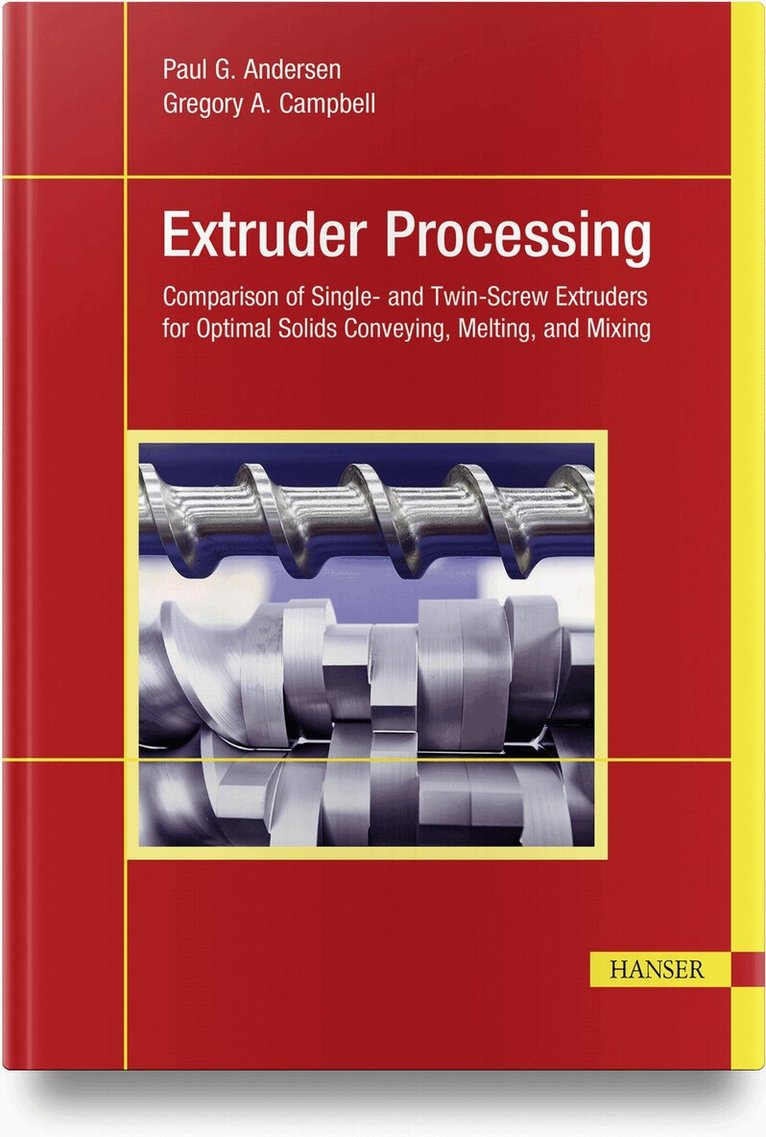
    Extruder Processing

    Comparison of Single- and Twin-Screw Extruders for Optimal Solids Conveying, Melting, and Mixing

    AvPaul G. Andersen,Gregory A. Campbell

    Inbunden, Engelska, 2022

    1 186 kr

    Beställningsvara. Skickas inom 3-6 vardagar. Fri frakt över 249 kr.

    Beskrivning

    Single-screw or twin-screw extruder? When the need to produce a homogeneous polymer melt occurs in the industrial environment, both product attributes and equipment cost must be evaluated. For many applications both the single and twin-screw extruder will produce the desired homogeneous melt needed to form the product through an extrusion die. Some applications such as dispersive mixing of solids in a polymer matrix are best accomplished in a twin-screw extruder. On the other hand, applications involving chemical reactions, color concentrate distributive mixing, and in line polymer-polymer distributive mixing can be accomplished with either device.However, for the same production rate, twin-screw extruders are generally more expensive than single-screw extruders with a diameter less than 200 mm. Therefore, a thorough understanding is needed for the concepts of solids conveying, melting, and mixing for the two types of extruders to make appropriate process acquisition decisions. This book covers engineering and technology concepts that should aid the practitioner in comparing these two types of extrusion equipment relative to process requirements.The handbook is intended for newcomers interested in the theoretical and regulatory aspects of validation and for thermal analysis practitioners who have to validate their equipment and methods.

    Produktinformation

    • Utgivningsdatum:2022-09-30
    • Mått:172 x 243 x 20 mm
    • Vikt:363 g
    • Format:Inbunden
    • Språk:Engelska
    • Antal sidor:220
    • Förlag:Hanser Publications
    • ISBN:9781569908631

    Utforska kategorier

    • Maskinteknik och material inom Naturvetenskap och teknik
    • Tillverkningsteknik inom Naturvetenskap och teknik

    Mer om författaren

    Paul G. Andersen, Ph.D., is Process Technology Consultant at Coperion Corporation, Ramsey, NJ, USA. He was previously Director, Process Technology at Coperion, a position he held until 2016. In 2009/2010, he was President of the Society of Plastics Engineers (SPE).Professor Gregory A. Campbell is Professor Emeritus at Clarkson University, Potsdam, NY, USA. He formerly directed a research group at GM Research and managed polymer fabrication at Mobil Chemical Research.

    Innehållsförteckning

    • Part 1: Validation of Computerized SystemsRecent Changes in Regulations and Regulatory GuidanceInstrument Qualification, Computerized System Validation and Method ValidationRegulatory Requirements for Computerized System ValidationComputerized System ValidationWriting the User Requirements Specification (URS)Auditing the System SupplierInstallation Qualification and Operational Qualification (IQ and OQ)Performance Qualification (PQ) or End User TestingPart 2: Method ValidationMeasurement Errors and Uncertainty of MeasurementValidation of Analytical Procedures and MethodsInterlaboratory Studies in Thermal AnalysisMethod Development Through to SOPPractical ExamplesAppendix 1: 21 CFR Part 11 and EU GMP Annex 11Appendix 2: Basic StatisticsAppendix 3: Standard Test Methods for Thermal Analysis