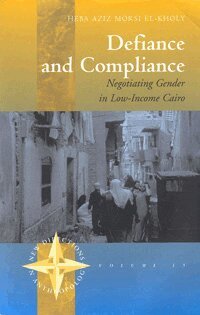
Defiance and Compliance
Negotiating Gender in Low-Income Cairo
1 880 kr
Beställningsvara. Skickas inom 5-8 vardagar. Fri frakt över 249 kr.
Du är på sajten för privatpersoner.
1 880 kr
Beställningsvara. Skickas inom 5-8 vardagar. Fri frakt över 249 kr.
Heba El-Kholy is a development professional and social anthropologist. An Egyptian, she was born and raised in Cairo, Egypt. She holds a PhD. in Anthropology and Sociology from the School of Oriental and African Studies (SOAS), University of London and a Masters degree in development Sociology from Cornell University. Over the past 18 years, she has worked in the Arab world as a development practitioner, activist, researcher and programme advisor with a number of regional and international organizations, including the Ford Foundation, the Canadian International Devplopment Agency (CIDA), and International Quality International. She has published numerous articles related to development and poverty and is a founder and board member of the Association for the Development and Enhancement of Women, (ADEW), in Egypt. Dr. El-Kholy currently lives and works in New York where she is Policy Advisor at the United Nations Development Program (UNDP).
“[This book] is commended as being a thoughtful and thought-provoking survey which offers much-needed insights on economic ramifications and their lasting effects.” · Midwest Book Review"The 13th volume in the outstanding 'New Directions in Anthropology' series…is a collection of insightful observations and cogent interviews … and commended as being a thoughtful and thought-provoking survey which offers much-needed insights on economic ramifications and their lasting effects." · The Bookwatch"Dr.El-Kholy's powerful study of labouring women in four Cairo neighbourhoods shows them vigorously confronting gender inequalities. Mindful of their sexual reputations, they see marriage less as oppression, more as a risky entry into the 'real' world of womanhood. These women can be strong in negotiations over marriage contracts, and wage-rates. Crystal-clear analysis, persuasive writing, and contextualised ethnography combine to make this book an intellectual and political challenge." · Peter Loizos, London School of Economics
Du är på sajten för privatpersoner.
1 880 kr
Beställningsvara. Skickas inom 5-8 vardagar. Fri frakt över 249 kr.
Heba El-Kholy is a development professional and social anthropologist. An Egyptian, she was born and raised in Cairo, Egypt. She holds a PhD. in Anthropology and Sociology from the School of Oriental and African Studies (SOAS), University of London and a Masters degree in development Sociology from Cornell University. Over the past 18 years, she has worked in the Arab world as a development practitioner, activist, researcher and programme advisor with a number of regional and international organizations, including the Ford Foundation, the Canadian International Devplopment Agency (CIDA), and International Quality International. She has published numerous articles related to development and poverty and is a founder and board member of the Association for the Development and Enhancement of Women, (ADEW), in Egypt. Dr. El-Kholy currently lives and works in New York where she is Policy Advisor at the United Nations Development Program (UNDP).
“[This book] is commended as being a thoughtful and thought-provoking survey which offers much-needed insights on economic ramifications and their lasting effects.” · Midwest Book Review"The 13th volume in the outstanding 'New Directions in Anthropology' series…is a collection of insightful observations and cogent interviews … and commended as being a thoughtful and thought-provoking survey which offers much-needed insights on economic ramifications and their lasting effects." · The Bookwatch"Dr.El-Kholy's powerful study of labouring women in four Cairo neighbourhoods shows them vigorously confronting gender inequalities. Mindful of their sexual reputations, they see marriage less as oppression, more as a risky entry into the 'real' world of womanhood. These women can be strong in negotiations over marriage contracts, and wage-rates. Crystal-clear analysis, persuasive writing, and contextualised ethnography combine to make this book an intellectual and political challenge." · Peter Loizos, London School of Economics