• Fri frakt över 249 kr
  • •
  • Snabba leveranser
  • •
  • Billiga böcker
Kundservice

Du är på sajten för privatpersoner.

Företag, bibliotek eller offentlig verksamhet?

Du handlar på classic.bokus.com, där alla dina funktioner finns intakta.
Till classic.bokus.com
Bokus logotyp. Gå till startsidan.
  • Erbjudanden
  • Nyheter
  • Student
  • Topplistor
  • Barn & ungdom
  • Bokus Play
  • E-böcker
  • Pocketböcker
  • Spel & pussel

10% rabatt på allt med kod: NYSTART10 →

Sidfot

Mina sidor

    Hjälp

    • Kundservice
    • Vanliga frågor och svar
    • Frakt och leverans
    • Retur vid ångerrätt
    • Reklamera vara
    • Betalning
    • Köpvillkor
    • Allmänna villkor
    • Information om webbplatsens tillgänglighet

    Om Bokus

    • Om oss
    • Pressrum
    • För studenter
    • För företag
    • För bibliotek och offentlig verksamhet
    • För leverantörer
    • Hållbarhet

    Populärt

    • Aktuella erbjudanden
    • Presentkort
    • Studentlitteratur
    • Nya böcker
    • Topplistor
    • Signerade böcker
    • Engelska böcker

    Inspiration

    • Boktips
    • BookTok
    • Populära bokserier
    • Barnbokskaraktärer
    • Populära författare
    Logotyp för Bokus
    Följ oss på Facebook (extern länk)Följ oss på Instagram (extern länk)Följ oss på YouTube (extern länk)Följ oss på TikTok (extern länk)
    bokus @ CookiesAnpassa cookiesIntegritetspolicyKöpvillkor
    Till Citymail hemsida (extern länk)Till Budbee hemsida (extern länk)Till Postnord hemsida (extern länk)Till Schenker hemsida (extern länk)Till Early Bird hemsida (extern länk)Till Walleys hemsida (extern länk)
    1. Filosofi och religion
    2. Religion och tro
    3. Kristendom
    4. Biblar

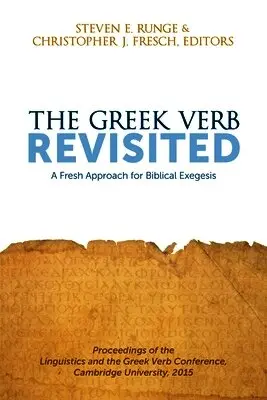
    Fresh Approach for Biblical Exegesis

    AvRunge,Steven E. Runge

    Häftad, Engelska, 2016

    516 kr

    Beställningsvara. Skickas inom 5-8 vardagar. Fri frakt över 249 kr.

    Beskrivning

    New Testament studies have debated the Koine Greek verb for 25 years--reaching an impasse when it came to both tense and aspect.Now, a group of scholars offer a new take on this debate. Originally presented as part of a conference on the Greek verb at Tyndale House, Cambridge, the chapters in The Greek Verb Revisited represent scholarly collaboration from the fields of linguistics, classics, and New Testament studies--resulting in a new perspective that allows the reader to approach the Greek verb in a fresh way.The Greek Verb Revisited not only offers a rare glimpse into the background of the debate over the Greek verb, but also explains the significance of this discussion and provides a linguistically-sound way forward.Contributors include:--Rutger J. Allan (Vrije Universiteit, Amsterdam)--Michael Aubrey (Faithlife Corporation)--Rachel Aubrey (Canada Institute of Linguistics, Trinity Western University)--Randall Buth (Biblical Language Center)--Robert Crellin (Faculty of Classics, Cambridge)--Nicholas J. Ellis (BibleMesh)--Buist Fanning (Dallas Theological Seminary)--Christopher J. Fresch (Bible College of South Australia)--Peter J. Gentry (Southern Baptist Theological Seminary)--Geoffrey Horrocks (Faculty of Classics, Cambridge)--Patrick James (The Greek Lexicon Project; Faculty of Classics, Cambridge)--Stephen H. Levinsohn (SIL International)--Amalia Moser (National and Kapodistrian University of Athens)--Christopher J. Thomson (University of Edinburgh)--Elizabeth Robar (Tyndale House, Cambridge)--Steven E. Runge (Lexham Research Institute; Stellenbosch University)

    Produktinformation

    • Utgivningsdatum:2016-11-02
    • Mått:151 x 224 x 39 mm
    • Vikt:942 g
    • Format:Häftad
    • Språk:Engelska
    • Antal sidor:688
    • Förlag:Faithlife Corporation
    • ISBN:9781577996361

    Utforska kategorier

    • Biblar inom Filosofi och religion
    • Religion: allmänt inom Filosofi och religion

    Mer om författaren

    Steven E. Runge (LittD, University of Stellenbosch, South Africa) serves as a research associate in the Department of Ancient Studies at the University of Stellenbosch, as director of the Lexham Research Institute, and as scholar-in-residence at Faithlife Corporation.Christopher J. Fresch (PhD, University of Cambridge) teaches biblical languages and Old Testament at Bible College of South Australia, an affiliated college of the Australian College of Theology. His research focuses on Greek and Hebrew languages, linguistics, and the Septuagint.

    Recensioner i media

    The Greek verb is the engine of the language, driving the direction in which clauses, sentences, paragraphs and whole works go. The editors of this fine book have brought together an impressive international group of scholars to assess and expand the state of our knowledge of the Greek verb in antiquity. This is no mere "academic" (read, irrelevant) enquiry: they do this in order to illuminate reading of key Greek texts, especially the New Testament and the Greek Old Testament, and achieve that aim very well with lots of examples and ideas to use. Scholars and students of the New Testament and the Greek Old Testament will find their reading of these important texts deepened, strengthened and (in places) corrected by this fine book. These scholars bring together expertise in classics, linguistics and New Testament studies in highly fruitful cross-disciplinary interaction and together move this conversation about the Greek verb forward much more quickly than might have happened through each working alone. I hope it receives the wide use it deserves as the conversation continues.--Steve Walton, professorial research fellow in New Testament, St Mary's University, Twickenham (London), UKA collection of essays from the 2015 Cambridge Verb Conference, The Greek Verb Revisited is the most significant book on the Koine Greek verb to be published in over a quarter century. The essays in this volume are well-informed by up-to-date research in linguistics and present a good mix of theoretical and practical treatments of the Greek verb. Comprehensive, correct, and current, this book ought to be mandatory reading for anyone serious about the grammar of the verb in the Greek New Testament, for both students and seasoned scholars alike.--Stephen C. Carlson, post-doctoral research fellow, Institute for Religion & Critical Inquiry, Faculty of Theology and Philosophy, Australian Catholic UniversitySteve Runge and Chris Fresch are to be congratulated for bringing together such important contributions to our understanding of the verb in Koine Greek. This volume reflects the cutting edge of the ongoing discussion. It should now be the starting point for students and scholars, as most previous discussions must now be considered outdated. Contributors do not agree on all the details, but we can see a clear consensus forming and these very capable scholars have left us all in their debt. This will certainly be required reading for my course on advanced Greek as I cannot recommend it highly enough!--Roy E. Ciampa, PhD, Nida Institute for Biblical Scholarship, Gordon-Conwell Theological SeminaryThis inter-disciplinary collection of studies will now provide a basis for any further work on the Greek verb, and it is clear that refining our understanding of Greek verbs is crucial for an accurate grasp of any Greek sentence.--Larry Hurtado, emeritus professor of New Testament language, literature & theology, School of Divinity, University of EdinburghThe Greek Verb Revisited (ed. Runge and Fresch) is an exceptional and ground-breaking volume which opens new vistas of interpretation for our understanding of the diachronic development of ancient Greek and its interpretation.--Michael P. Theophilos, senior lecturer, Biblical Studies and Ancient Languages, Australian Catholic UniversityThe Greek Verb Revisited: A Fresh Approach for Biblical Exegesis offers a coherent and compelling account of the Greek verb through the combined efforts of a diverse, multidisciplinary team of linguists and scholars. Crucially, this notable volume also demonstrates the incomparable fruitfulness of long-term multidisciplinary collaborative scholarship. It is hoped that this exemplary collegial collaboration will help inspire a new wave of similar projects in biblical studies to move the discussion forward on any and all issues of consequence.--Randall K. J. Tan, PhD, vice president, biblical research, Global Bible InitiativeThis book is fascinating and hard to put down despite some of the technicality of the treatments. I particularly appreciated the multidisciplinary representation (classical, biblical, linguistic) and diachronic perspective from Homer to modern Greek. Helpful frameworks are provided to understand the Greek verb such as semantics, pragmatics, and discourse information structure. Through all of this, particular conclusions continue to reverberate in my thinking: Certainly, the augment in the indicative marks past time (allowing for pragmatic uses); most likely the Greek verb system is primarily aspectual (as opposed to tense-based); and clearly the choice of verbal aspect is exegetically significant (amplifying our need to properly understand it). I am already incorporating insights gleaned from The Greek Verb Revisited in my pedagogy and research.--Fredrick J. Long, professor of New Testament and director of Greek instruction, Asbury Theological Seminary; international coordinator of ΓΡΚ Greek Honor Society, GlossaHouseThis is an important volume that deserves careful consideration. It will no doubt occupy a significant position within modern discussions of the Greek verbal system, and rightly so.--Constantine R. Campbell, PhD, associate professor of New Testament, Trinity Evangelical Divinity School