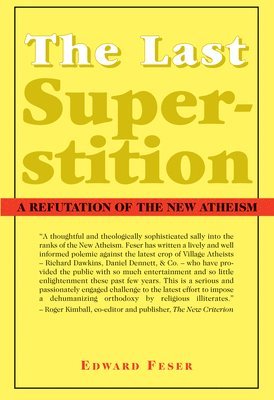
Häftad, Engelska, 2010
Last Superstition – A Refutation of the New Atheism
Av Edward Feser
288 kr
Beställningsvara. Skickas inom 5-8 vardagar. Fri frakt över 249 kr.
Beskrivning
The central contention of the “New Atheism” of Richard Dawkins, Daniel Dennett, Sam Harris, and Christopher Hitchens is that there has for several centuries been a war between science and religion, that religion has been steadily losing that war, and that at this point in human history a completely secular scientific account of the world has been worked out in such thorough and convincing detail that there is no longer any reason why a rational and educated person should find the claims of any religion the least bit worthy of attention.But as Edward Feser argues inThe Last Superstition, in fact there is not, and never has been, any war between science and religion at all. There has instead been a conflict between two entirely philosophical conceptions of the natural order: on the one hand, the classical “teleological” vision of Plato, Aristotle, Augustine, and Aquinas, on which purpose or goal-directedness is as inherent a feature of the physical world as mass or electric charge; and the modern “mechanical” vision of Descartes, Hobbes, Locke, and Hume, according to which the physical world is comprised of nothing more than purposeless, meaningless particles in motion. As it happens, on the classical teleological picture, the existence of God, the immortality of the soul, and the natural-law conception of morality are rationally unavoidable. Modern atheism and secularism have thus always crucially depended for their rational credentials on the insinuation that the modern, mechanical picture of the world has somehow been established by science. Yet this modern “mechanical” picture has never been established by science, and cannot be, for it is not a scientific theory in the first place but merely a philosophical interpretation of science. Moreover, as Feser shows, the philosophical arguments in its favor given by the early modern philosophers were notable only for being surprisingly weak. The true reasons for its popularity were then, and are now, primarily political: It was a tool by which the intellectual foundations of ecclesiastical authority could be undermined and the way opened toward a new secular and liberal social order oriented toward commerce and technology. So as to further these political ends, it was simply stipulated, by fiat as it were, that no theory inconsistent with the mechanical picture of the world would be allowed to count as “scientific.” As the centuries have worn on and historical memory has dimmed, this act of dogmatic stipulation has falsely come to be remembered as a “discovery.”However, not only is this modern philosophical picture rationally unfounded, it is demonstrably false. For the “mechanical” conception of the natural world, when worked out consistently, absurdly entails that rationality, and indeed the human mind itself, are illusory. The so-called “scientific worldview” championed by the New Atheists thus inevitably undermines its own rational foundations; and into the bargain (and contrary to the moralistic posturing of the New Atheists) it undermines the foundations of any possible morality as well. By contrast, and as The Last Superstition demonstrates, the classical teleological picture of nature can be seen to find powerful confirmation in developments from contemporary philosophy, biology, and physics; moreover, morality and reason itself cannot possibly be made sense of apart from it. The teleological vision of the ancients and medievals is thereby rationally vindicated – and with it the religious worldview they based upon it.
Produktinformation
- Utgivningsdatum: 2010-12-10
- Mått: 152 x 229 x 23 mm
- Vikt: 454 g
- Format: Häftad
- Språk: Engelska
- Antal sidor: 312
- Förlag: St Augustine's Press
- ISBN: 9781587314520
Utforska kategorier
Betyg & recensioner
0 recensioner
Inga recensioner tillgängliga.