• Fri frakt över 249 kr
  • •
  • Snabba leveranser
  • •
  • Billiga böcker
Kundservice

Du är på sajten för privatpersoner.

Företag, bibliotek eller offentlig verksamhet?

Du handlar på classic.bokus.com, där alla dina funktioner finns intakta.
Till classic.bokus.com
Bokus logotyp. Gå till startsidan.
  • Erbjudanden
  • Nyheter
  • Student
  • Topplistor
  • Barn & ungdom
  • Bokus Play
  • E-böcker
  • Pocketböcker
  • Spel & pussel

10% rabatt på allt med kod: NYSTART10 →

Sidfot

Mina sidor

    Hjälp

    • Kundservice
    • Vanliga frågor och svar
    • Frakt och leverans
    • Retur vid ångerrätt
    • Reklamera vara
    • Betalning
    • Köpvillkor
    • Allmänna villkor
    • Information om webbplatsens tillgänglighet

    Om Bokus

    • Om oss
    • Pressrum
    • För studenter
    • För företag
    • För bibliotek och offentlig verksamhet
    • För leverantörer
    • Hållbarhet

    Populärt

    • Aktuella erbjudanden
    • Presentkort
    • Studentlitteratur
    • Nya böcker
    • Topplistor
    • Signerade böcker
    • Engelska böcker

    Inspiration

    • Boktips
    • BookTok
    • Populära bokserier
    • Barnbokskaraktärer
    • Populära författare
    Logotyp för Bokus
    Följ oss på Facebook (extern länk)Följ oss på Instagram (extern länk)Följ oss på YouTube (extern länk)Följ oss på TikTok (extern länk)
    bokus @ CookiesAnpassa cookiesIntegritetspolicyKöpvillkor
    Till Citymail hemsida (extern länk)Till Budbee hemsida (extern länk)Till Postnord hemsida (extern länk)Till Schenker hemsida (extern länk)Till Early Bird hemsida (extern länk)Till Walleys hemsida (extern länk)
    1. Samhälle och politik
    2. Samhälle och kultur
    3. Kultur och medier
    4. Referensverk och tvärvetenskap

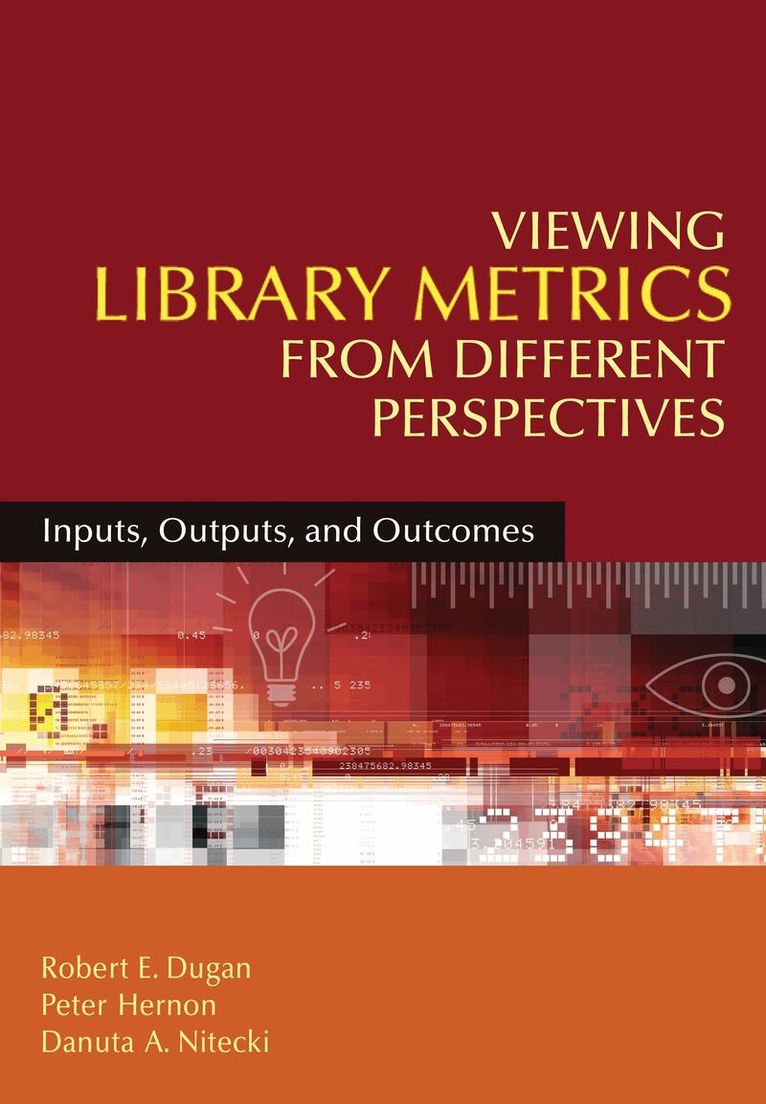
    Viewing Library Metrics from Different Perspectives

    Inputs, Outputs, and Outcomes

    AvRobert E. Dugan,Peter Hernon

    Häftad, Engelska, 2009

    759 kr

    Beställningsvara. Skickas inom 10-15 vardagar. Fri frakt över 249 kr.

    Beskrivning

    This guidebook shows academic libraries how to use innovative new performance metrics to achieve greater accountability and higher levels of service.Viewing Library Metrics from Different Perspectives: Inputs, Outputs, and Outcomes helps academic librarians go well beyond the basic guideposts of inputs and outputs to explore a wide range of metrics for measuring their effectiveness and improving performance. Based on their groundbreaking article, "Outcomes Assessment: Not Synonymous with Inputs and Outputs," Robert Dugan and Peter Hernon, along with coauthor Danuta Nitecki, give libraries the tools they need to see beyond their own walls and interpret both outcome and impact metrics from the perspective of the parent institution, the customer, and the stakeholder, as well as the library itself.Viewing Library Metrics from Different Perspectives makes a convincing argument for targeting the right audience with the right metric. The first three chapters introduce key concepts and the relevant literature, and helps libraries make the crucial distinction between assessment and evaluation. Chapters four through nine examine the four perspectives and their attendant metrics. The final chapters discuss how best to present and interpret the results.

    Produktinformation

    • Utgivningsdatum:2009-08-27
    • Mått:178 x 254 x 23 mm
    • Vikt:482 g
    • Format:Häftad
    • Språk:Engelska
    • Antal sidor:364
    • Förlag:Bloomsbury Publishing Plc
    • ISBN:9781591586654
    • Utmärkelser:Winner of The Greenwood Publishing Group Award for the Best Book in Library Literature 2010

    Utforska kategorier

    • Referensverk och tvärvetenskap inom Samhälle och politik

    Mer om författaren

    Robert E. Dugan is director of Sawyer Library at Suffolk University, Boston, MA.Peter Hernon is professor at the Graduate School of Library and Information Science at Simmons College, Boston, MA.Danuta A. Nitecki is dean of libraries and professor at College of Information Science & Technology at Drexel University, Philadelphia, PA.

    Recensioner i media

    Dugan (Sawyer Library, Suffolk U., Ashburton, Massachusetts), Hernon (library and information science, Simmons College, Boston, Massachusetts), and Nitecki's (Sterling Memorial Library, Yale U., Connecticut) text offers academic librarians a wide range of metrics for measuring library effectiveness and improving performance. Coverage includes key concepts and the relevant supporting literature; differentiating between assessment and evaluation; the perspectives of the library itself and of the parent institution, the customer, and the stakeholder; benchmarking and best practices; metrics for marketing and public relations; management information systems; and presenting, interpreting, and displaying metrics. Multiple appendices summarize the text and illustrate numerous metrics applicable to libraries. For academic and public library managers, graduate students in library and information science, the stakeholders served by libraries, and vendors supplying use data to libraries and consortia.

    Innehållsförteckning

    • IllustrationsPrefaceAcknowledgments1 IntroductionInformation NeedsTransparencyApplying MetricsAcademic LibrariesConclusionNotes2 Related LiteratureUse of the Word MetricHistorical ContextRelevant Guides, Manuals, and Other Major WorksOther Lists of MetricsScholarly WritingsSome Relevant Web Sites and SoftwareConclusionNotes3 Assessment and EvaluationThe InstitutionAcademic LibrariesMoving toward Standardized Statistical GatheringConclusionNotes4 The Library PerspectiveTraditional Inputs and OutputsE-metricsDevelopment of Metrics Based on PerceptionsStrategies for Using Library MetricsProfessional Development Is NeededConclusionNotes5 The Customer PerspectiveTypes of CustomersExcellence in Customer ServiceTypes of Questions Relevant to MeasurementCustomer ExpectationsReliability as a Customer ExpectationMethods of Data CollectionConclusionNotes6 The Institutional PerspectiveInstitutional Metrics (in General)Institutional Metrics to Which Libraries Can ContributeConclusionNotes7 The Stakeholder PerspectiveAccountabilityAffordabilityTransparency and Comparative MetricsAdvocacyConclusionNotes8 Benchmarking and Best PracticesDifferentiating More between Benchmarking and Best PracticesBest PracticesConvergenceQuantitative MetricsQualitative MetricsPlanning for the FutureConclusionNotes9 Metrics for Marketing and Public RelationsTypes of MetricsMethods of EvaluationStrategies for Using MetricsAn Agenda for Conducting Further ResearchConclusionNotes10 Management Information SystemsCharacteristics of MetricsMIS ActivitiesThe Sawyer LibraryOther ApplicationsSupplementing the MISConclusionNotes11 Utilizing Metrics: Interpretation, Synthesis, and PresentationInterpretationSynthesisPresentationConclusionNotes12 The Joy of MetricsGrounding of PurposeSatisfaction of Improvement and Knowledge of ExcellenceImportance of SharingReward of ImpactChallenges of EngagementConclusionNotesAppendix: Metrics AnalysisAbout the AppendicesA. Inputs: Library Perspective (reported as numbers)B. Inputs: Library Perspective (reported as ratios/percentages)C. Outputs: Library Perspective (reported as numbers)D. Outputs: Library Perspective (reported as ratios/percentages)E. Selected Examples of Process MetricsF. Selected Examples of Trend MetricsG. Examples of Qualitative MetricsH. Customer PerspectiveI. Institutional PerspectiveTable I-1: Librarians Should Be Aware of These Institutional Metrics and Their Implications Concerning the LibraryTable I-2: Measures of, or from, the Library about Value to the InstitutionJ. Stakeholder Perspectives (Examples)Table J-1: Stakeholders Directly/Indirectly Benefiting from the LibraryTable J-1a: Library Infrastructure and CapacityTable J-1b: Library Contribution to OutcomesTable J-1c: Library Contribution to SatisfactionTable J-2: Stakeholders with Oversight Interest in the LibraryK. Selected Metrics Used by Libraries for Benchmarking and Best PracticesL. Marketing and Public RelationsM. Selected Metrics from Library ReportsN. Some Metrics Related to Scholarly CommunicationO. COUNTER Code of Practice, Release 3 (August 2008)BibliographyIndex