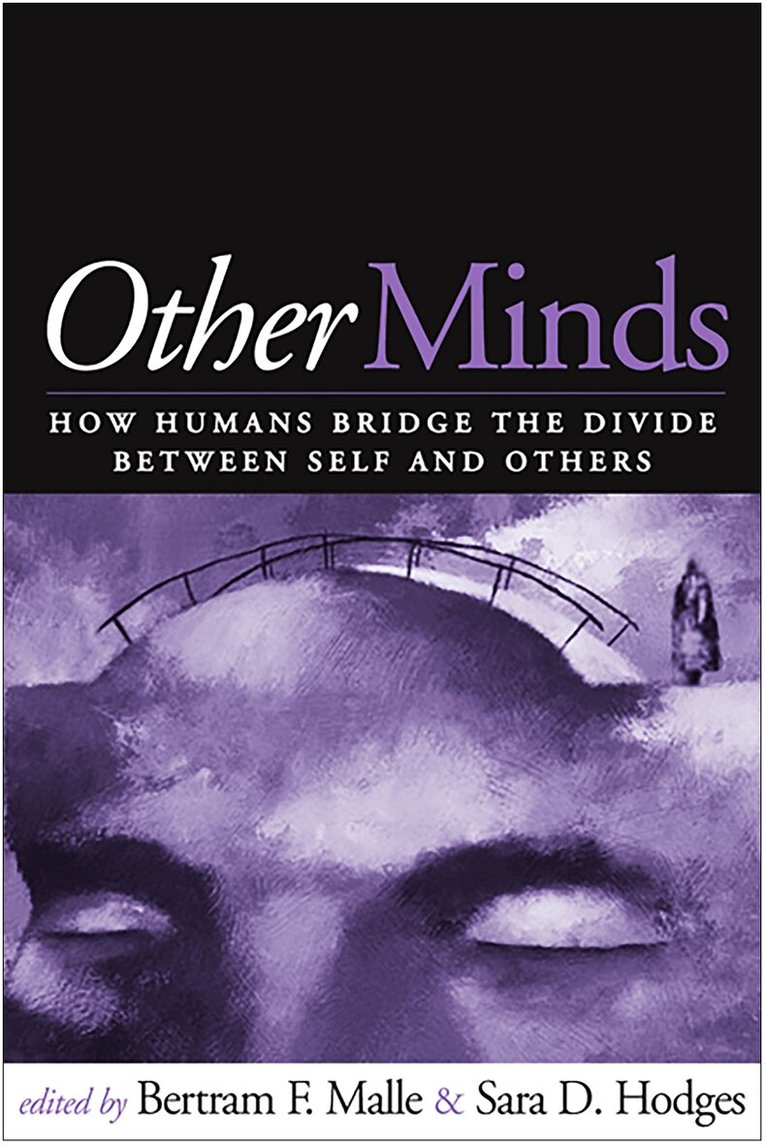
Other Minds
How Humans Bridge the Divide between Self and Others
AvBertram F. Malle,Sara D. Hodges
380 kr
Tillfälligt slut
Beskrivning
Produktinformation
- Utgivningsdatum:2007-03-08
- Mått:152 x 229 x 21 mm
- Vikt:500 g
- Format:Häftad
- Språk:Engelska
- Antal sidor:354
- Förlag:Guilford Publications
- ISBN:9781593854683
Utforska kategorier
Mer om författaren
Bertram F. Malle, PhD, is Associate Professor of Psychology at the University of Oregon and the recipient of a Society of Experimental Social Psychology Dissertation Award and a National Science Foundation Career Award. His research examines the cognitive tools that humans bring to social interaction, such as the folk concept of intentionality, inferences of mental states, and explanations of behavior. Dr. Malle is coeditor of two other volumes, Intentions and Intentionality and The Evolution of Language Out of Pre-Language, and the author of How the Mind Explains Behavior.Sara D. Hodges, PhD, is Associate Professor of Psychology at the University of Oregon. Her research, which has been published in scholarly journals and edited volumes, explores the role of the self in people's perceptions of others, with a particular emphasis on empathy, projection, and social comparison. Dr. Hodges also studies how people construct evaluations and preferences in social contexts. Her research has received funding from the National Science Foundation, and she has been the recipient of two Rippey Innovative Teaching Awards at the University of Oregon.
Recensioner i media
In the age of neo-behaviorism and social neuroscience, this volume shows that mind still matters. Malle and Hodges have brought together a stellar group of investigators to probe the ways in which people perceive and think about 'other minds.' Like Fritz Heider before them, Malle, Hodges, and colleagues know that the study of folk psychology offers unique scientific opportunities. The advances in theory of mind, simulation theory, and empathy research, to name a few, reassure us that the day for the total reduction of psychology has not yet come.--Joachim I. Krueger, PhD, Department of Psychology, Brown UniversityOnce upon a time in psychology, other minds were a taboo topic. That's over now, and instead the hot new topic is how people manage the trick of perceiving other minds--as well as understanding their own minds. This book brings together exciting current views of the process of mind perception from laboratories studying social, cognitive, developmental, and neuroscientific psychology.--Daniel M. Wegner, PhD, Department of Psychology, Harvard UniversityA great many scholars have noted the inherent difficulty of trying to discern the contents of other minds--a difficulty, it is now clear, we all try to overcome by employing a variety of inferential tools. Fittingly, this excellent and timely volume likewise displays a variety of perspectives on how people approach the 'problem of other minds,' both when mindreading is successfully accomplished and when efforts to do so fall short. Anyone who wants to better understand this subject would be well advised to read this book.--Thomas D. Gilovich, PhD, Department of Psychology, Cornell UniversityIn recent years, the study of 'other minds' has promised the possibility of a rapprochement among various branches of the psychological sciences. This volume achieves this reconciliation as developmental, social, and abnormal psychologies are brought together with linguistic and communication sciences and the burgeoning area of social cognitive neuroscience. Encyclopedic in its range, it will serve as a handbook for all those committed to explaining the human capacity for social understanding.--Chris Moore, PhD, Department of Human Development and Applied Psychology, Ontario Institute for Studies in Education, University of Toronto, Canada - The material in this volume should be a considerable interest to clinicians interested in matters pertaining to empathy, mentalization, projective identification, and countertransference effects. --Bulletin of the Menninger Clinic, 1/10/2007Æ’Æ’ Stimulating and provocative and points to future developments. --The Journal of Nervous and Mental Disease, 1/10/2007
Innehållsförteckning
- I. Questions about the Phenomenon1. Executive Functioning and Children's Theories of Mind, Louis J. Moses 2. Three Puzzles of Mindreading, Bertram F. Malle 3. A Constituent Approach to the Study of Perspective Taking: What Are Its Fundamental Elements?, Mark H. Davis4. Starting without Theory: Confronting the Paradox of Conceptual Development, Daniel D. Hutto II. Reading Behavior, Reading Minds 5. Is There a Social Brain?: Lessons from Eye-Gaze Following, Joint Attention, and Autism, Diego Fernandez-Duque and Jodie A. Baird6. Visual Cues as Evidence of Others' Minds in Collaborative Physical Tasks, Susan R. Fussell, Robert E. Kraut, Darren Gergle, and Leslie D. Setlock7. Attributing Motives to Other People, Glenn D. Reeder and David Trafimow8. Explanatory Coherence and Goal-Based Knowledge Structures in Making Dispositional Inferences, Stephen J. Read and Lynn C. Miller III. Reading One's Own Mind, Reading Other Minds 9. Perspective Taking as the Royal Avenue to Empathy, Jean Decety10. Everyday Solutions to the Problem of Other Minds: Which Tools Are Used When?, Daniel R. Ames 11. Mental Simulation: Royal Road to Other Minds?, Josef Perner and Anton Kühberger12. Why Self-Ascriptions Are Difficult and Develop Late, Radu J. BogdanIV. Language and Other Minds 13. Language as the Route into Other Minds, Janet Wilde Astington and Eva Filippova14. Representation of the Interlocutor's Mind during Conversation, Marjorie Barker and T. Givón15. Conceptual Alignment in Conversation, Michael F. Schober16. On the Inherent Ambiguity of Traits and Other Mental Concepts, James S. Uleman V. Limits of Mindreading17. Mindreading in an Exotic Case: The Normal Adult Human, Dale J. Barr and Boaz Keysar 18. Empathy Gaps in Emotional Perspective Taking, Leaf Van Boven and George Loewenstein19. Is How Much You Understand Me in Your Head or Mine?, Sara D. Hodges 20. Empathic Accuracy and Inaccuracy in Close Relationships, William Ickes, Jeffry A. Simpson, and Minda Oriña21. Theory of Mind in Schizophrenia, Robyn Langdon
Du kanske också är intresserad av
- Nyhet
Ät för din ålder : Kokbok och guide för dig i klimakteriet
Caroline Wilbois, Johanna Andersson
279 kr
- -30%
- -21%
Hjärnans akilleshälar : hur din hjärna lurar dig, och vad du kan göra åt det
Anders Hansen
229 kr289 kr
- -30%
- Signerad!
- -22%