• Fri frakt över 249 kr
  • •
  • Snabba leveranser
  • •
  • Billiga böcker
Kundservice

Du är på sajten för privatpersoner.

Företag, bibliotek eller offentlig verksamhet?

Du handlar på classic.bokus.com, där alla dina funktioner finns intakta.
Till classic.bokus.com
Bokus logotyp. Gå till startsidan.
  • Erbjudanden
  • Nyheter
  • Student
  • Topplistor
  • Barn & ungdom
  • Bokus Play
  • E-böcker
  • Pocketböcker
  • Spel & pussel

10% rabatt på allt med kod: NYSTART10 →

Sidfot

Mina sidor

    Hjälp

    • Kundservice
    • Vanliga frågor och svar
    • Frakt och leverans
    • Retur vid ångerrätt
    • Reklamera vara
    • Betalning
    • Köpvillkor
    • Allmänna villkor
    • Information om webbplatsens tillgänglighet

    Om Bokus

    • Om oss
    • Pressrum
    • För studenter
    • För företag
    • För bibliotek och offentlig verksamhet
    • För leverantörer
    • Hållbarhet

    Populärt

    • Aktuella erbjudanden
    • Presentkort
    • Studentlitteratur
    • Nya böcker
    • Topplistor
    • Signerade böcker
    • Engelska böcker

    Inspiration

    • Boktips
    • BookTok
    • Populära bokserier
    • Barnbokskaraktärer
    • Populära författare
    Logotyp för Bokus
    Följ oss på Facebook (extern länk)Följ oss på Instagram (extern länk)Följ oss på YouTube (extern länk)Följ oss på TikTok (extern länk)
    bokus @ CookiesAnpassa cookiesIntegritetspolicyKöpvillkor
    Till Citymail hemsida (extern länk)Till Budbee hemsida (extern länk)Till Postnord hemsida (extern länk)Till Schenker hemsida (extern länk)Till Early Bird hemsida (extern länk)Till Walleys hemsida (extern länk)
    1. Naturvetenskap och teknik
    2. Teknik och industri
    3. Agronomi och lantbruk
    4. Lantbruksteknik

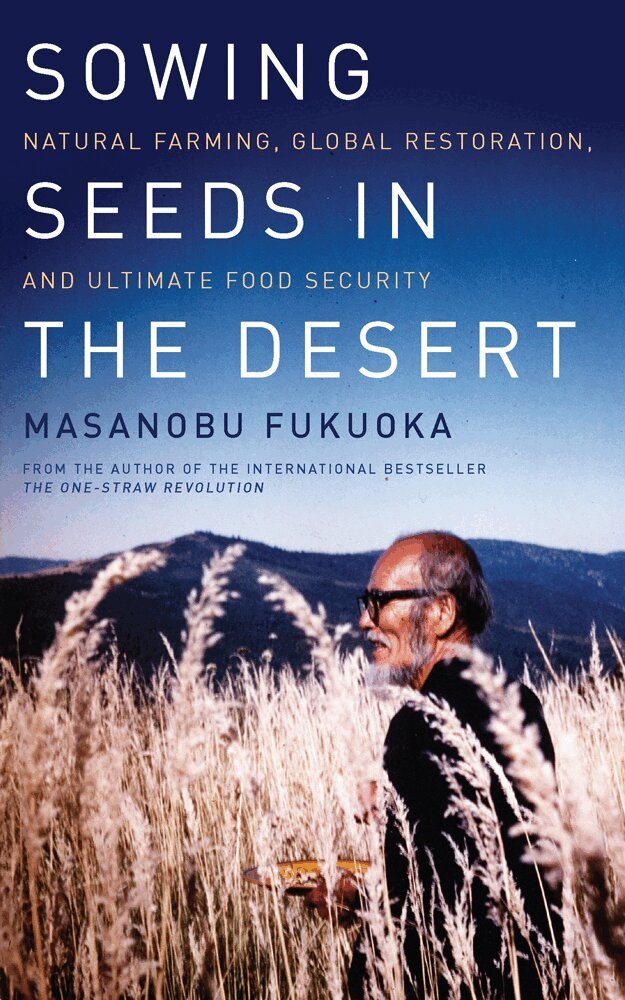
    Sowing Seeds in the Desert

    Natural Farming, Global Restoration, and Ultimate Food Security

    AvMasanobu Fukuoka,Larry Korn

    Häftad, Engelska, 2013

    Del i serien Chelsea Green Publishing Co

    228 kr

    Skickas . Fri frakt över 249 kr.

    Fler format och utgåvor

    E-bok

    172 kr

    Beskrivning

    The earth is in great peril, due to the corporatization of agriculture, the rising climate crisis, and the ever-increasing levels of global poverty, starvation, and desertification on a massive scale. This present condition of global trauma is not "natural," but a result of humanity's destructive actions. And, according to Masanobu Fukuoka, it is reversible. We need to change not only our methods of earth stewardship, but also the very way we think about the relationship between human beings and nature.Fukuoka grew up on a farm on the island of Shikoku in Japan. As a young man he worked as a customs inspector for plants going into and out of the country. This was in the 1930s when science seemed poised to create a new world of abundance and leisure, when people fully believed they could improve upon nature by applying scientific methods and thereby reap untold rewards. While working there, Fukuoka had an insight that changed his life forever. He returned to his home village and applied this insight to developing a revolutionary new way of farming that he believed would be of great benefit to society. This method, which he called "natural farming," involved working with, not in opposition to, nature.Fukuoka's inspiring and internationally best-selling book, The One-Straw Revolution was first published in English in 1978. In this book, Fukuoka described his philosophy of natural farming and why he came to farm the way he did. One-Straw was a huge success in the West, and spoke directly to the growing movement of organic farmers and activists seeking a new way of life. For years after its publication, Fukuoka traveled around the world spreading his teachings and developing a devoted following of farmers seeking to get closer to the truth of nature.Sowing Seeds in the Desert, a summation of those years of travel and research, is Fukuoka's last major work-and perhaps his most important. Fukuoka spent years working with people and organizations in Africa, India, Southeast Asia, Europe, and the United States, to prove that you could, indeed, grow food and regenerate forests with very little irrigation in the most desolate of places. Only by greening the desert, he said, would the world ever achieve true food security.This revolutionary book presents Fukuoka's plan to rehabilitate the deserts of the world using natural farming, including practical solutions for feeding a growing human population, rehabilitating damaged landscapes, reversing the spread of desertification, and providing a deep understanding of the relationship between human beings and nature. Fukuoka's message comes right at the time when people around the world seem to have lost their frame of reference, and offers us a way forward.

    Produktinformation

    • Utgivningsdatum:2013-07-22
    • Mått:128 x 203 x 16 mm
    • Vikt:272 g
    • Format:Häftad
    • Språk:Engelska
    • Serie:Chelsea Green Publishing Co
    • Antal sidor:216
    • Förlag:Chelsea Green Publishing Co
    • ISBN:9781603585224

    Utforska kategorier

    • Lantbruksteknik inom Naturvetenskap och teknik
    • Miljövetenskap och miljöpolitik inom Naturvetenskap och teknik

    Mer om författaren

    Masanobu Fukuoka (1913-2008) was a farmer and philosopher who was born and raised on the Japanese island of Shikoku. He studied plant pathology and spent several years working as a customs inspector in Yokohama. While working there, at the age of 25, he had an inspiration that changed his life. He decided to quit his job, return to his home village, and put his ideas into practice by applying them to agriculture.Over the next sixty-five years he worked to develop a system of natural farming that demonstrated the insight he was given as a young man, believing that it could be of great benefit to the world. He did not plow his fields, used no agricultural chemicals or prepared fertilizers, and did not flood his rice fields as farmers have done in Asia for centuries, and yet his yields equaled or surpassed the most productive farms in Japan.In 1975 he wrote The One-Straw Revolution, a best-selling book that described his life’s journey, his philosophy, and farming techniques. This book has been translated into more than twenty-five languages and has helped make Mr. Fukuoka a leader in the worldwide sustainable agriculture movement. He continued farming until shortly before his death in 2008, at the age of ninety-five.After The One-Straw Revolution was published in English, Mr. Fukuoka traveled to Africa, India, Southeast Asia, Europe, and the United States. His interest turned to rehabilitating the deserts of the world using his natural farming techniques. Mr. Fukuoka is also the author of The Natural Way of Farming and The Road Back to Nature. In 1988 he received the Magsaysay Award, often referred to as the “Nobel of Asia,” for Public Service.Larry Korn was an American who lived and worked on the farm of Masanobu Fukuoka for more than two years in the early 1970s. He was translator and editor of the English-language edition of Mr. Fukuoka’s The One-Straw Revolution and editor of his later book, Sowing Seeds in the Desert. Korn accompanied Mr. Fukuoka on his visits to the United States in 1979 and 1986. He studied Asian history, soil science, and plant nutrition at the University of California, Berkeley, and worked in wholesale and retail plant nurseries, as a soil scientist for the California Department of Forestry, and as a residential landscape contractor in the San Francisco Bay Area. Throughout his life, Korn taught many courses and workshops about natural farming, permaculture, and local food production throughout the United States.

    Recensioner i media

    Kirkus Reviews-From the late author of bestseller The One Straw Revolution (1978) comes a similar book about a philosophical approach to natural farming."The fundamental concept of a natural farm," writes Fukuoka (The Natural Way of Farming, 1985, etc.), "begins with intuitively grasping nature's original form, where many varieties of plants and animals live together as a harmonious whole, joyfully and in mutual benefit." In this English translation of the author's last work (first published in Japan in 1996), he decries the "indiscriminate deforestation and large-scale agriculture carried out in order to support the materialistic cultures of the developed countries." This process has created a condition called "desertification," the inability of the soil to grow anything. Because humans have lost their connection with nature, Fukuoka advocates foregoing harmful modern methods of farming in favor of a simpler approach. Based primarily on the success of his farm in Japan, the author believes the solution lies in aerial distribution of a large variety of plants via clay seed pellets, the use of cover crops, and a no-tilling approach to the soil. By seeding a wide variety of species in the desert, nature will select those plants best suited for a particular location. These plants will flourish, drawing water from deep within the earth and thereby allowing other plants and trees to prosper. Taking his philosophy to Africa, India and the United States, among other places, Fukuoka demonstrated that, given sufficient time, seeding fallow earth with vegetables, plants and trees created a lush setting. More a spiritual analysis of farming methods than a hands-on approach, the book still provides viable and simple solutions to the world's increased need for productive land. An enlightened method for reclaiming the barren soils of the world.

    Innehållsförteckning

    • 1. The call to natural farming2. Reconsidering human knowledge3. Healing a world in crisis4. Global desertification5. Revegetating the earth through natural methods6. Travels on the west coast of the United States