• Fri frakt över 249 kr
  • •
  • Snabba leveranser
  • •
  • Billiga böcker
Kundservice

Du är på sajten för privatpersoner.

Företag, bibliotek eller offentlig verksamhet?

Du handlar på classic.bokus.com, där alla dina funktioner finns intakta.
Till classic.bokus.com
Bokus logotyp. Gå till startsidan.
  • Erbjudanden
  • Nyheter
  • Student
  • Topplistor
  • Barn & ungdom
  • Bokus Play
  • E-böcker
  • Pocketböcker
  • Spel & pussel

10% rabatt på allt med kod: NYSTART10 →

Sidfot

Mina sidor

    Hjälp

    • Kundservice
    • Vanliga frågor och svar
    • Frakt och leverans
    • Retur vid ångerrätt
    • Reklamera vara
    • Betalning
    • Köpvillkor
    • Allmänna villkor
    • Information om webbplatsens tillgänglighet

    Om Bokus

    • Om oss
    • Pressrum
    • För studenter
    • För företag
    • För bibliotek och offentlig verksamhet
    • För leverantörer
    • Hållbarhet

    Populärt

    • Aktuella erbjudanden
    • Presentkort
    • Studentlitteratur
    • Nya böcker
    • Topplistor
    • Signerade böcker
    • Engelska böcker

    Inspiration

    • Boktips
    • BookTok
    • Populära bokserier
    • Barnbokskaraktärer
    • Populära författare
    Logotyp för Bokus
    Följ oss på Facebook (extern länk)Följ oss på Instagram (extern länk)Följ oss på YouTube (extern länk)Följ oss på TikTok (extern länk)
    bokus @ CookiesAnpassa cookiesIntegritetspolicyKöpvillkor
    Till Citymail hemsida (extern länk)Till Budbee hemsida (extern länk)Till Postnord hemsida (extern länk)Till Schenker hemsida (extern länk)Till Early Bird hemsida (extern länk)Till Walleys hemsida (extern länk)
    1. Psykologi och pedagogik
    2. Psykologi
    3. Barnpsykologi och utvecklingspsykologi

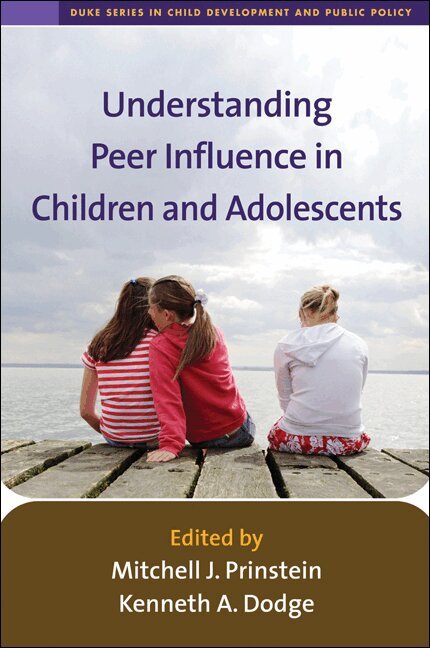
    Understanding Peer Influence in Children and Adolescents

    AvMitchell J. Prinstein,Kenneth A. Dodge

    Häftad, Engelska, 2010

    Del i serien Duke Series in Child Development and Public Policy

    498 kr

    Beställningsvara. Skickas inom 5-8 vardagar. Fri frakt över 249 kr.

    Beskrivning

    Scientists, educators, and parents of teens have long recognized the potency of peer influences on children and youth, but until recently, questions of how and why adolescents emulate their peers were largely overlooked. This book presents a comprehensive framework for understanding the processes by which peers shape each other's attitudes and behavior, and explores implications for intervention and prevention. Leading authorities share compelling findings on such topics as how drug use, risky sexual behavior, and other deviant behaviors catch on among certain peer groups or cliques; the social, cognitive, developmental, and contextual factors that strengthen or weaken the power of peer influence; and the nature of positive peer influences and how to support them.

    Produktinformation

    • Utgivningsdatum:2010-04-20
    • Mått:152 x 229 x 20 mm
    • Vikt:380 g
    • Format:Häftad
    • Språk:Engelska
    • Serie:Duke Series in Child Development and Public Policy
    • Antal sidor:255
    • Förlag:Guilford Publications
    • ISBN:9781606236475

    Utforska kategorier

    • Barnpsykologi och utvecklingspsykologi inom Psykologi och pedagogik
    • Socialpsykologi och gruppsykologi inom Psykologi och pedagogik

    Mer om författaren

    Mitchell J. Prinstein, PhD, ABPP, is the John Van Seters Professor of Psychology and Neuroscience and Director of Clinical Psychology at the University of North Carolina at Chapel Hill. His research examines interpersonal models of internalizing symptoms and health-risk behaviors among adolescents, with a focus on the unique role of peer relationships in the developmental psychopathology of depression, self-injury, and suicidality. Dr. Prinstein is a past editor of the Journal of Clinical Child and Adolescent Psychology and a past president of the Society for a Science of Clinical Psychology and the Society for Clinical Child and Adolescent Psychology. He is a recipient of awards including the Theodore Blau Early Career Award from the Society of Clinical Psychology of the American Psychological Association (APA), the Brickell Memorial Award for research on suicidality from Columbia University, the Mentor Award from the Association for Behavioral and Cognitive Therapies, the Beverly Thorn Award for Outstanding Service from the Council of University Directors of Clinical Psychology, and the Raymond D. Fowler Award for Outstanding Contribution to the Professional Development of Graduate Students from the American Psychological Association of Graduate Students.Kenneth A. Dodge, PhD, is the Pritzker Professor of Public Policy and Psychology and Neuroscience at Duke University. He is Founding and Emeritus Director of the Duke Center for Child and Family Policy. A clinical and developmental psychologist, Dr. Dodge studies early childhood development, prevention of violent behavior in the family, and public policy to improve population outcomes for communities. He is the developer of Family Connects, a population approach to improve children’s outcomes in the first year of life. The author of more than 500 highly cited scientific articles, which have been cited more than 100,000 times, Dr. Dodge has been elected into the National Academy of Medicine and is the 2019–2021 President of the Society for Research in Child Development.

    Recensioner i media

    The topic of peer influences has long been important to the field. This remarkable volume from distinguished editors and contributors proposes original and compelling conceptual models that will elucidate peer influence processes for researchers and students alike. In addition, many of the authors discuss general and specific implications of their work for prevention and intervention programs. This book would be an excellent text for advanced undergraduates, master's students, and beginning doctoral students in developmental, educational, school, and clinical psychology.--W. Andrew Collins, PhD, Morse-Alumni Distinguished Teaching Professor, Institute of Child Development, University of MinnesotaThis volume brings together leading researchers to piece together the puzzle of peer influences, highlighting their mechanisms, moderators, contexts, and the potential for interventions that capitalize on positive peer processes. With this understanding, we can begin to consider the developmental supports that children and youth require individually and collectively to promote social adaptation. The picture of peer processes emerging from this volume is critical to informing the strategies and policies of a broad range of professionals responsible for children and youth.--Debra Pepler, PhD, LaMarsh Centre for Research on Violence and Conflict Resolution, York UniversityWhile it has long been known that adolescents influence one another, insufficient attention has been given to how, where, and when these influences occur. This first-rate volume considers the mechanisms and processes involved in peer influence from a variety of conceptual and theoretical viewpoints and presents a fascinating sampling of new research.--Willard W. Hartup, EdD, Regents' Professor Emeritus, Institute of Child Development, University of Minnesota- Each chapter stands alone and provides unique insights....Useful and informative for anyone interested in working with children and adolescents....Use this book as a resource. Look up a topic in the index, or read one chapter at a time, with sticky notes ready to flag and comment on the themes that resonate with you and your work. It is worth it. --Prevention Researcher, 3/5/2010ƒƒ Prinstein and Dodge are to be  commended  for bringing together chapters that jointly provide, in one  short and  very readable volume, an accessible overview that delivers  what is  promised: an understanding of how peers influence children and   adolescents. --Canadian Paychology, 2/3/2010

    Innehållsförteckning

    • I. Introduction1. Current Issues in Peer Influence Research, Mitchell J. Prinstein and Kenneth A. DodgeII. Peer Influence Mechanisms2. A Comprehensive Conceptualization of the Peer Influence Process in Adolescence, B. Bradford Brown, Jeremy P. Bakken, Suzanne W. Ameringer, and Shelly D. Mahon3. Cognitive Social Influence: Moderation, Mediation, Modification, and...the Media, Frederick X. Gibbons, Elizabeth A. Pomery, and Meg Gerrard4. Dynamics and Ecology of Adolescent Peer Influence, Thomas J. Dishion, Timothy F. Piehler, and Michael W. Myers5. Deviance Regulation Theory: Applications to Adolescent Social Influence, Hart Blanton and Melissa BurkleyIII. Altering Peer Influence Effects: Moderators and Interventions6. Variation in Patterns of Peer Influence: Considerations of Self and Other, William M. Bukowski, Ana Maria Velasquez, and Mara Brendgen7. Adolescent Peer Influences: Beyond the Dark Side, Joseph P. Allen and Jill Antonishak8. Mobilizing and Weakening Peer Influence as Mechanisms for Changing Behavior: Implications for Alcohol Intervention Programs, Deborah A. Prentice9. Identity Signaling, Social Influence, and Social Contagion, Jonah BergerIV. Underexplored Contexts for Potential Peer Influence Effects10. Homophily in Adolescent Romantic Relationships, Wyndol Furman and Valerie A. Simon11. Peer Influence in Involuntary Social Groups: Lessons from Research on Bullying, Jaana Juvonen and Adriana Galván