• Fri frakt över 249 kr
  • •
  • Snabba leveranser
  • •
  • Billiga böcker
Kundservice

Du är på sajten för privatpersoner.

Företag, bibliotek eller offentlig verksamhet?

Du handlar på classic.bokus.com, där alla dina funktioner finns intakta.
Till classic.bokus.com
Bokus logotyp. Gå till startsidan.
  • Erbjudanden
  • Nyheter
  • Student
  • Topplistor
  • Barn & ungdom
  • Bokus Play
  • E-böcker
  • Pocketböcker
  • Spel & pussel

10% rabatt på allt med kod: NYSTART10 →

Sidfot

Mina sidor

    Hjälp

    • Kundservice
    • Vanliga frågor och svar
    • Frakt och leverans
    • Retur vid ångerrätt
    • Reklamera vara
    • Betalning
    • Köpvillkor
    • Allmänna villkor
    • Information om webbplatsens tillgänglighet

    Om Bokus

    • Om oss
    • Pressrum
    • För studenter
    • För företag
    • För bibliotek och offentlig verksamhet
    • För leverantörer
    • Hållbarhet

    Populärt

    • Aktuella erbjudanden
    • Presentkort
    • Studentlitteratur
    • Nya böcker
    • Topplistor
    • Signerade böcker
    • Engelska böcker

    Inspiration

    • Boktips
    • BookTok
    • Populära bokserier
    • Barnbokskaraktärer
    • Populära författare
    Logotyp för Bokus
    Följ oss på Facebook (extern länk)Följ oss på Instagram (extern länk)Följ oss på YouTube (extern länk)Följ oss på TikTok (extern länk)
    bokus @ CookiesAnpassa cookiesIntegritetspolicyKöpvillkor
    Till Citymail hemsida (extern länk)Till Budbee hemsida (extern länk)Till Postnord hemsida (extern länk)Till Schenker hemsida (extern länk)Till Early Bird hemsida (extern länk)Till Walleys hemsida (extern länk)
    1. Psykologi och pedagogik
    2. Pedagogik
    3. Material och digital teknik i undervisningen

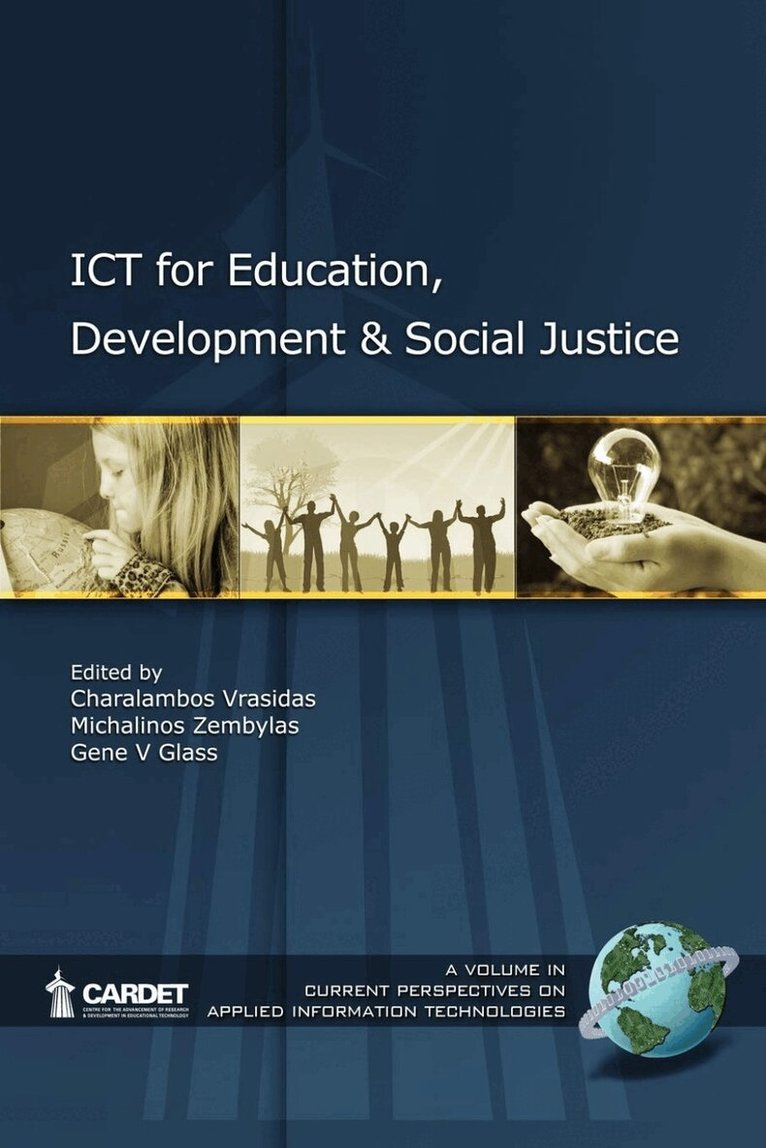
    ICT for Education, Development, and Social Justice

    AvCharalambos Vrasidas,Michalinos Zembylas

    Inbunden, Engelska, 2009

    Del i serien Current Perspectives on Applied Information Technologies

    1 070 kr

    Beställningsvara. Skickas inom 5-8 vardagar. Fri frakt över 249 kr.

    Beskrivning

    This volume provides examples of current developments on the role of ICT for education, development, and social justice within an international context. Chapters draw on advanced contemporary thinking from scholars and practitioners in the field to present case studies of how ICT can be used to promote sustainable development and social justice. Social justice is understood in a wide sense as the pursuit of democracy, justice and development in the struggle against any form of oppression; it is within this context that ICT is explored as a tool for social change.The objectives of this book are:- To analyze the philosophical, historical, political, and cultural backgrounds and contexts that are constitutive of contemporary challenges and tensionsin the role of ICT for education, development, and social justice around the world;- To appreciate the contextual and international dimensions of the tensions and challenges faced by educators around the world and contribute to ongoingefforts to sketch a vision for addressing their needs;- To explore ways in which ICT in education can promote social justice and contribute toward sustaining communities around the world

    Produktinformation

    • Utgivningsdatum:2009-02-17
    • Mått:156 x 234 x 17 mm
    • Vikt:571 g
    • Format:Inbunden
    • Språk:Engelska
    • Serie:Current Perspectives on Applied Information Technologies
    • Antal sidor:280
    • Förlag:Emerald Publishing Inc
    • ISBN:9781607520221

    Utforska kategorier

    • Material och digital teknik i undervisningen inom Psykologi och pedagogik
    • Diskriminering och rättvisa inom Samhälle och politik

    Innehållsförteckning

    • Part I. Overview.Chapter 1. ICT for Development: Challenges and Possibilities; Charalambos Vrasidas, Michalinos Zembylas, and Gene V. Glass.Chapter 2. ICT for Education, Development, and Social Justice: Some Theoretical Issues; Michalinos Zembylas.Part II. ICT for Development.Chapter 3. E-Hopes and Public Education in Latin America; Gustavo E. Fischman and José Luis Ramírez Romero.Chapter 4. The Expansion of Higher Education in the Developing World: The Contribution of Distance Education; Sir John Daniel.Chapter 5. Role of ICT in Bridging the Digital Divide in a High-Poverty School District; Amy S. C. Leh, Lee Grafton, and Sylvester Robertson.Chapter 6. Is There a Role for Information and Communications Technologies in the Education and Development of Disadvantaged Rural Communities? Tom Power, Kimberley Porteus, Brian Ramadiro, Nomakholwa Tshume, Shumi Makalema, and Rhodri Thomas.Chapter 7. Open Resources for Sustainable Education; Marina Stock McIsaac and António Moreira.Part III. ICT for Inclusion.Chapter 8. Mobile Technologies: Current Practices, Future Possibilities; Tom Power and James Sankale.Chapter 9. The Digital Divide in Disability and Education; Jason Brent Ellis, Carla Abreu-Ellis, and Amber Ricker.Chapter 10. School–Community ICT-Mediated Linkages: The Southeast Asian Experience; Cher Ping Lim and John Hedberg.Part IV. ICT for Cultural Understandings.Chapter 11. Online Gaming: Building Bridges that Enhance Cultural Understandings; Mary A. Kayler, Debra Sprague, and Chris Dede.Chapter 12. Computer-Supported Collaborative Intercultural Education: Creating Bridges for Palestinians and Jews in Conflict; Zvi Bekerman and Gabriel Horenczyk.Chapter 13. ICT for Peace and Reconciliation: Constraints and Possibilities in Cambodia and Tibet; Edward J. Brantmeier and Jayson W. Richardson.Chapter 14. Social Networking Applications, Social Justice, and Multicultural Understanding; Carrie O'Connor and Rebecca Skulnick.