• Fri frakt över 249 kr
  • •
  • Snabba leveranser
  • •
  • Billiga böcker
Kundservice

Du är på sajten för privatpersoner.

Företag, bibliotek eller offentlig verksamhet?

Du handlar på classic.bokus.com, där alla dina funktioner finns intakta.
Till classic.bokus.com
Bokus logotyp. Gå till startsidan.
  • Erbjudanden
  • Nyheter
  • Student
  • Topplistor
  • Barn & ungdom
  • Bokus Play
  • E-böcker
  • Pocketböcker
  • Spel & pussel

10% rabatt på allt med kod NYSTART10 →

Sidfot

Mina sidor

    Hjälp

    • Kundservice
    • Vanliga frågor och svar
    • Frakt och leverans
    • Retur vid ångerrätt
    • Reklamera vara
    • Betalning
    • Köpvillkor
    • Allmänna villkor
    • Information om webbplatsens tillgänglighet

    Om Bokus

    • Om oss
    • Pressrum
    • För studenter
    • För företag
    • För bibliotek och offentlig verksamhet
    • För leverantörer
    • Hållbarhet

    Populärt

    • Aktuella erbjudanden
    • Presentkort
    • Studentlitteratur
    • Nya böcker
    • Topplistor
    • Signerade böcker
    • Engelska böcker

    Inspiration

    • Boktips
    • BookTok
    • Populära bokserier
    • Barnbokskaraktärer
    • Populära författare
    Logotyp för Bokus
    Följ oss på Facebook (extern länk)Följ oss på Instagram (extern länk)Följ oss på YouTube (extern länk)Följ oss på TikTok (extern länk)
    bokus @ CookiesAnpassa cookiesIntegritetspolicyKöpvillkor
    Till Citymail hemsida (extern länk)Till Budbee hemsida (extern länk)Till Postnord hemsida (extern länk)Till Schenker hemsida (extern länk)Till Early Bird hemsida (extern länk)Till Walleys hemsida (extern länk)
    1. Psykologi och pedagogik
    2. Pedagogik
    3. Utbildningsstrategier och utbildningspolitik

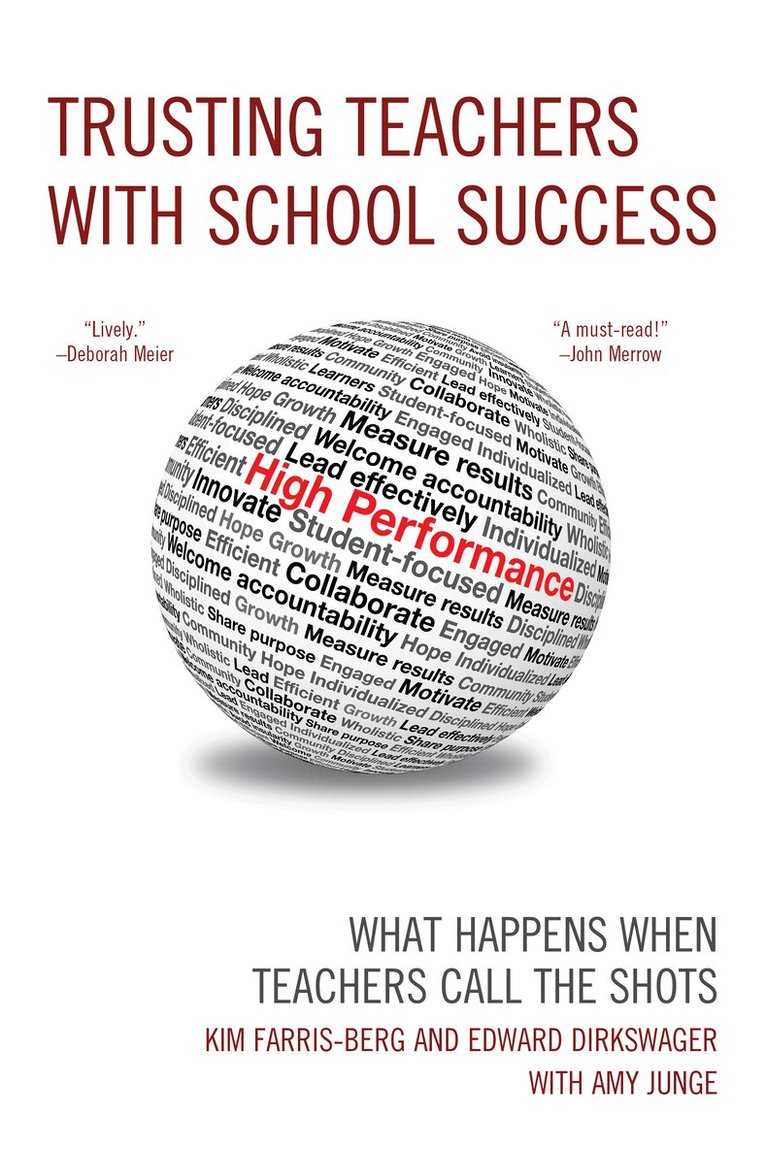
    Trusting Teachers with School Success

    What Happens When Teachers Call the Shots

    AvKim Farris-Berg,Edward J. Dirkswager

    Inbunden, Engelska, 2012

    1 222 kr

    Beställningsvara. Skickas inom 10-15 vardagar. Fri frakt över 249 kr.

    Fler format och utgåvor

    Häftad

    335 kr

    E-bok

    572 kr

    Beskrivning

    Lately, our nation’s strategy for improving our schools is mostly limited to “getting tough” with teachers. Blaming teachers for poor outcomes, we spend almost all of our energy trying to control teachers’ behavior and school operations. But what if all of this is exactly the opposite of what is needed? What if teachers are the answer and not the problem? What if trusting teachers, and not controlling them, is the key to school success?Examining the experiences of teachers who are already trusted to call the shots, this book answers: What would teachers do if they had the autonomy not just to make classroom decisions, but to collectively—with their colleagues—make the decisions influencing whole school success? Decisions such as school curriculum, how to allocate the school budget, and whom to hire.Teachers with decision-making authority create the schools that many of us profess to want. They individualize learning. Their students are active (not passive) learners who gain academic and life skills. The teachers create school cultures that are the same as those in high-performing organizations. They accept accountability and innovate, and make efficient use of resources. These promising results suggest: it’s time to trust teachers.

    Produktinformation

    • Utgivningsdatum:2012-10-18
    • Mått:157 x 237 x 25 mm
    • Vikt:517 g
    • Format:Inbunden
    • Språk:Engelska
    • Antal sidor:254
    • Förlag:Bloomsbury Publishing Plc
    • ISBN:9781610485098

    Utforska kategorier

    • Utbildningsstrategier och utbildningspolitik inom Psykologi och pedagogik

    Mer om författaren

    Kim Farris-Berg and Edward J. Dirkswager are fellows at the Center for Policy Studies in St. Paul, Minnesota. Amy Junge is an associate at the Center for Policy Studies in St. Paul, Minnesota.To learn more about the authors, visit their website at www.trustingteachers.org.

    Recensioner i media

    While school reform has proceeded seemingly unabated for the last 50 years, the most recent proposals have, for the most part, excluded classroom practitioners from the discussion. Farris-Berg and Dirkswager (fellows, Center for Policy Studies, St. Paul, Minnesota) examine the results at schools that trust the teachers who work there to make the important educational decisions affecting the children they serve. While exploring how best to encourage autonomous teachers, the book also reviews how much independence teachers need, how educators respond to this autonomy, and how the results of their decisions can be assessed and evaluated. A large part of the work looks at eight practices that autonomous teachers embrace and that the authors suggest are necessary for a high-performing organization. These practices are explained through the use of vignettes, examples, photographs, and graphics that deepen understanding of the concepts undergirding each practice. Each of these chapters examining effective practices concludes with a series of questions and challenges related to implementation as identified by teachers assuming increased responsibility in school governance. These questions and challenges would provide ideal starting places for discussions related to these issues. Summing Up: Highly recommended. General readers; upper-division undergraduate students and above.

    Innehållsförteckning

    • ContentsAcknowledgementsPrefacePART ONE: What would happen if we trusted teachers with school success?Introduction. To get high performing schools, maybe it’s time to trust teachers.Chapter 2. Teacher Autonomy: what it is, who has it, and how it’s securedChapter 3. When granted autonomy, teachers choose to operate in ways that emulate the cultural characteristics of high-performing organizations.PART TWO: Eight practices autonomous teachers embrace whichare indicative of the cultural characteristics of high-performing organizationsChapter 4. Practice #1: Share purpose, which always focuses on students as individuals, and use it as the basis of decisions aimed at school improvementChapter 5. Practice #2: Participate in collaboration and leadership for the good of the whole school, not just a classroom.Chapter 6. Practice #3: Encourage colleagues and students to be active, ongoing learners in an effort to everyone’s engagement and motivationChapter 7. Practice #4: Develop or adopt learning programs that individualize student learningChapter 8. Practice #5: Address social and discipline problems as part of student learningChapter 9. Practice #6: Broaden the definition and scope of student achievement and assessmentChapter 10. Practice #7: Encourage teacher improvement using 360-degree, peer- and self-evaluation methods as well as peer coaching and mentoringChapter 11. Practice #8: Make budget trade-offs to meet the needs of students they serve PART THREE:Implementation strategies for those who want to support teacher autonomyChapter 12. It’s time to trust teachers.AppendixesNotesBibliographyAbout the Authors