• Fri frakt över 249 kr
  • •
  • Snabba leveranser
  • •
  • Billiga böcker
Kundservice

Du är på sajten för privatpersoner.

Företag, bibliotek eller offentlig verksamhet?

Du handlar på classic.bokus.com, där alla dina funktioner finns intakta.
Till classic.bokus.com
Bokus logotyp. Gå till startsidan.
  • Erbjudanden
  • Nyheter
  • Student
  • Topplistor
  • Barn & ungdom
  • Bokus Play
  • E-böcker
  • Pocketböcker
  • Spel & pussel

10% rabatt på allt med kod NYSTART10 →

Sidfot

Mina sidor

    Hjälp

    • Kundservice
    • Vanliga frågor och svar
    • Frakt och leverans
    • Retur vid ångerrätt
    • Reklamera vara
    • Betalning
    • Köpvillkor
    • Allmänna villkor
    • Information om webbplatsens tillgänglighet

    Om Bokus

    • Om oss
    • Pressrum
    • För studenter
    • För företag
    • För bibliotek och offentlig verksamhet
    • För leverantörer
    • Hållbarhet

    Populärt

    • Aktuella erbjudanden
    • Presentkort
    • Studentlitteratur
    • Nya böcker
    • Topplistor
    • Signerade böcker
    • Engelska böcker

    Inspiration

    • Boktips
    • BookTok
    • Populära bokserier
    • Barnbokskaraktärer
    • Populära författare
    Logotyp för Bokus
    Följ oss på Facebook (extern länk)Följ oss på Instagram (extern länk)Följ oss på YouTube (extern länk)Följ oss på TikTok (extern länk)
    bokus @ CookiesAnpassa cookiesIntegritetspolicyKöpvillkor
    Till Citymail hemsida (extern länk)Till Budbee hemsida (extern länk)Till Postnord hemsida (extern länk)Till Schenker hemsida (extern länk)Till Early Bird hemsida (extern länk)Till Walleys hemsida (extern länk)
    1. Historia och arkeologi
    2. Historia
    3. Historia: särskilda händelser och ämnen
    4. Socialhistoria och kulturhistoria

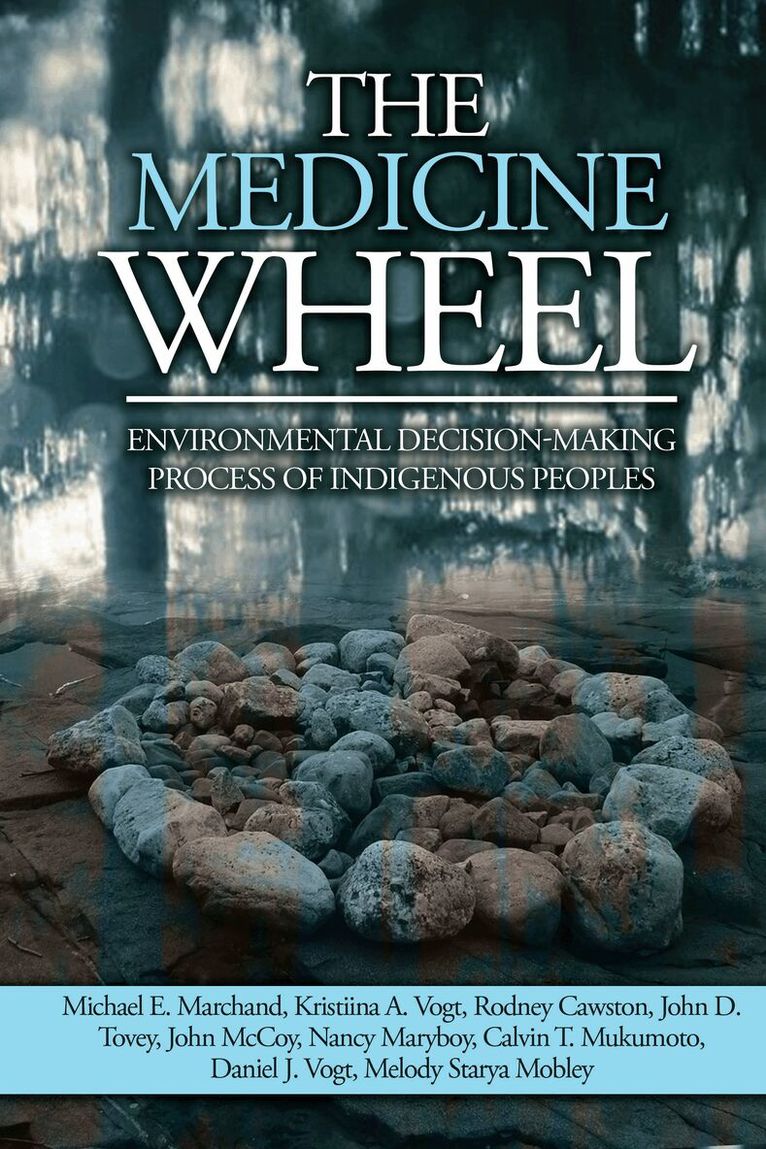
    Medicine Wheel

    Environmental Decision-Making Process of Indigenous Peoples

    AvMichael E. Marchand,Kristiina A. Vogt

    Häftad, Engelska, 2020

    1 009 kr

    Beställningsvara. Skickas inom 5-8 vardagar. Fri frakt över 249 kr.

    Beskrivning

    The Medicine Wheel built by Indigenous people acknowledges that ecosystems experience unpredictable recurring cycles and that people and the environment are interconnected. The Western science knowledge framework is incomplete unless localized intergenerational knowledge is respected and becomes part of the problem-definition and solution process. The goal of this book is to lay the context for how to connect Western science and Indigenous knowledge frameworks to form a holistic and ethical decision process for the environment. What is different about this book is that it not only describes the problems inherent to each knowledge framework but also offers new insights for how to connect culture and art to science knowledge frameworks. Read this book and learn how you can move beyond stereotypes to connect with nature.

    Produktinformation

    • Utgivningsdatum:2020-03-01
    • Mått:152 x 229 x 33 mm
    • Vikt:594 g
    • Format:Häftad
    • Språk:Engelska
    • Antal sidor:466
    • Förlag:Michigan State University Press
    • ISBN:9781611863581

    Utforska kategorier

    • Socialhistoria och kulturhistoria inom Historia och arkeologi
    • Geografi inom Naturvetenskap och teknik
    • Etnicitet inom Samhälle och politik

    Mer om författaren

    MICHAEL E. MARCHAND is former Chair and Council Member of the Confederated Tribes of the Colville Reservation and President of the Affiliated Tribes of Northwest Indians Economic Development Corporation.KRISTIINA A. VOGT is Professor of Ecosystem Management at the University of Washington.RODNEY CAWSTON is an enrolled member and Chair of the Confederated Tribes of the Colville Reservation.JOHN D. TOVEY is Director of Planning for the Confederated Tribes of the Umatilla Indian Reservation in Oregon.JOHN MCCOY is a Tulalip Tribal member and Senator for Washington’s 38th Legislative District.NANCY MARYBOY is Cherokee/Navajo, President and Founder of the Indigenous Education Institute at Friday Harbor, Washington, and Affiliate Assistant Professor at the University of Washington.CALVIN T. MUKUMOTO provides forestry/business services in Indian Country and to minority small business owners.DANIEL J. VOGT is a Soil and Ecosystem Ecologist at the University of Washington and a Cofounder of the Forest Systems and Bioenergy program in the School of Environmental and Forest Sciences.MELODY STARYA MOBLEY is Cherokee and the first Black woman hired as a wildlife biologist by the U.S. Forest Service, as well as an independent consultant and author.

    Recensioner i media

    “All of us in public natural resource management can benefit from the depth of contemporary and historical insight present in the essays collected in The Medicine Wheel. Filled with context, inspiration, and deep ways of thinking about the connections between people and the landscape, this is a volume you will want to consult time and again, and to share with your peers. Keep it close.”—DOUG DECKER, former Oregon State Forester Director, Executive Seminar in Natural Resources Leadership, Mark O. Hatfield School of Government, Portland State University

    Innehållsförteckning

    • Contents Preface Acronyms Chapter I. Indigenous Knowledge Framework and the Medicine Wheel 1.1 Bighorn Medicine Wheel Story 1.2 The Medicine Wheel: Non-linear Knowledge-forming Process Chapter II. What Is Needed to be a “Leader without Borders”? 2.1 My People’s 9,400 Year Ancestral History 2.2 Becoming a “Leader without Borders”: Interview of Dr. Mike Marchand Chapter III. How Do You Become “Cultured”? 3.1 Western European Culture: You Live it, You Wear it and You Eat it 3.2 Culture According to Indigenous People 3.3 Keeping Deep Culture in Two Worlds: Interview of Dr. Mike Tulee 3.4 Culture Defined by Nation-Level Melting Pots 3.5 Tribal Peoples’ Cultural Context: Interview of JD Tovey 3.6 Cultural Foods and Food Security 3.7 Holistic Nature Knowledge not Decoupled from Nature and Religion 3.8 Languages and Indigenous People 3.9 What Is Your Real Name? Dr. Mike's Wolverine Encounter 3.10 Sports and Games Invented by American Indians Chapter IV. Western Science ≠ Indigenous Forms of Knowledge 4.1 Knowledge-forming Processes: Western Science ≠ Indigenous Ways of Knowing 4.2 How Knowledge Frameworks Address Scarcity of Land or Lack of Knowledge 4.3 The Challenge of Culture for Western Scientists 4.4 Traditional Knowledge: Native Ways of Knowing 4.5 Juxtaposition of Western and Traditional Knowledge 4.6 Who Are Trusted for Their Science Knowledge? 4.7 Women’s Role in Passing Indigenous Knowledge Inter-Generationally: Interview of JD Tovey 4.8 Role of Environmental Economics in Environmental Justice 5.1 PNW U.S. Tribes and Leadership in Climate Change Planning 5.2 Tribes, Tribal Resources and Forest Losses 5.3 Today Better Forest Management on Tribal Lands Compared to Their Neighbors 5.4 Realities in Developing Resources on Reservations Chapter VI. Tribes, State and Federal Agencies: Leadership and Knowledge Sharing Dynamics 6.1 Tribal/Federal/State Cultural Resource Policy 6.2 Tribes and Washington State 6.3 Alaska Natives, Conservation and Policy Process 6.4 Federal Agency and Tribes: Continuing Challenges to Tribal Rights 6.5 Inter-Tribal Collaborations: Increase Tribal Role in Natural Resource Planning 6.6 Intra- and Inter-Governmental Affairs and Public Policy Process 7.1 Why We Need New Education Tool for Nature Literacy for the Masses 7.2 Massive Amounts of Fragmented Data in STEM Sciences 7.3 Critical Analysis Lacking in Environmental Education 7.4 Native People’s Storytelling Practices to Communicate Holistic Science Chapter VIII. Learning Indigenous People’s Way to Tell Circular Stories 8.1 Technology to Digitize Stories Part of Popular Culture 8.2 Digital Technologies Part of Popular Culture 8.3 Challenges in Communicating and Telling Circular Stories 8.4 Digitizing Native Stories without Pickling Culture: Interview of JD Tovey 8.5 Stories in Navajo Lands Chapter IX. Medicine Wheel: Moving beyond Nature, People and Business Stereotypes 9.1 When I Was a Young Boy 9.2 Communicating Indigenous Knowledge to the Masses 9.3 Medicine Wheel and Not Case Studies 9.4 “Fictional Tribe” as an Educational Tool to Teach How to Form Holistic Knowledge References Authors Contributing Authors Index