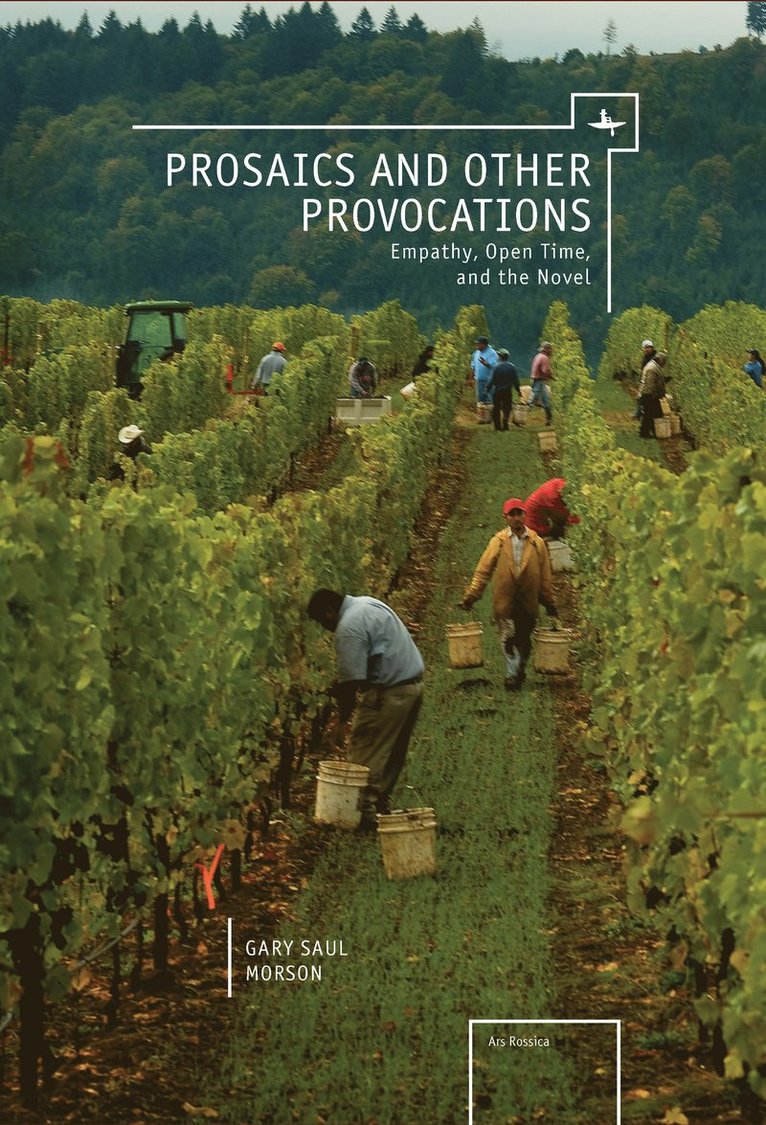
Häftad, Engelska, 2018
Prosaics and Other Provocations
Empathy, Open Time, and the Novel
Del i serien Ars Rossica
485 kr
Beställningsvara. Skickas inom 5-8 vardagar. Fri frakt över 249 kr.
Beskrivning
Produktinformation
- Utgivningsdatum: 2018-06-14
- Mått: 155 x 234 x 21 mm
- Vikt: 460 g
- Format: Häftad
- Språk: Engelska
- Serie: Ars Rossica
- Antal sidor: 300
- Förlag: Academic Studies Press
- ISBN: 9781618118097
Utforska kategorier
Mer om författaren
Gary Saul Morson (PhD Yale University) is a member of the American Academy of Arts and Sciences and Frances Hooper Professor of the Arts and Humanities at Northwestern University. His study Narrative and Freedom: The Shadows of Time (1996) won a best book award from the American Comparative Literature Association. He is also the author of Mikhail Bakhtin: Creation of a Prosaics (co-authored with Caryl Emerson, 1990), Anna Karenina in Our Time: Seeing More Wisely (2007), and The Words of Others: From Quotations to Culture (2011).
Recensioner i media
“Read this book. While it is inspired by (and offers brief but illuminating studies of) the masterworks of Tolstoy and Dostoevsky, the volume’s relevance greatly transcends Russian literature, indeed it offers a corrective to much (one is tempted to say all) thought, whether that includes technological or economic history, animal or language speciation, or deconstructing the Old Testament. . . . Readers who cherish various theories of literature or even science itself will find Morson a contentious, amusing, and always-eloquent conversationalist, who argues for a “counter-tradition,” a life affirming perspective that opposes all-encompassing laws and patterns with details, processes, and especially our consciousness of the present moment with all its innumerable potentials.”— Brett Cooke (Texas A&M University), in the The Russian Review, January 2015 (Vol. 74, No. 1)“Professors in undergraduate and especially graduate courses offered, and perhaps still offer, dire warnings against treating literary characters as though they somehow resembled real people or focusing on the writer’s intent in producing a work. Evaluation—declaring a work to be “good” or “bad”—was to be abjured. Morson cheerfully, even aggressively, violates these prohibitions. He is not afraid to single out those writers and works that he calls great, to consider the views of authors on literature, and to use novels as a means for probing ethical issues that individuals may face in real life.”— Barry P. Scherr (Dartmouth College), in the Slavic and East European Journal, 58.3 (Fall 2014)
Betyg & recensioner
0 recensioner
Inga recensioner tillgängliga.