• Fri frakt över 249 kr
  • •
  • Snabba leveranser
  • •
  • Billiga böcker
Kundservice

Du är på sajten för privatpersoner.

Företag, bibliotek eller offentlig verksamhet?

Du handlar på classic.bokus.com, där alla dina funktioner finns intakta.
Till classic.bokus.com
Bokus logotyp. Gå till startsidan.
  • Erbjudanden
  • Nyheter
  • Student
  • Topplistor
  • Barn & ungdom
  • Bokus Play
  • E-böcker
  • Pocketböcker
  • Spel & pussel

10% rabatt på allt med kod: NYSTART10 →

Sidfot

Mina sidor

    Hjälp

    • Kundservice
    • Vanliga frågor och svar
    • Frakt och leverans
    • Retur vid ångerrätt
    • Reklamera vara
    • Betalning
    • Köpvillkor
    • Allmänna villkor
    • Information om webbplatsens tillgänglighet

    Om Bokus

    • Om oss
    • Pressrum
    • För studenter
    • För företag
    • För bibliotek och offentlig verksamhet
    • För leverantörer
    • Hållbarhet

    Populärt

    • Aktuella erbjudanden
    • Presentkort
    • Studentlitteratur
    • Nya böcker
    • Topplistor
    • Signerade böcker
    • Engelska böcker

    Inspiration

    • Boktips
    • BookTok
    • Populära bokserier
    • Barnbokskaraktärer
    • Populära författare
    Logotyp för Bokus
    Följ oss på Facebook (extern länk)Följ oss på Instagram (extern länk)Följ oss på YouTube (extern länk)Följ oss på TikTok (extern länk)
    bokus @ CookiesAnpassa cookiesIntegritetspolicyKöpvillkor
    Till Citymail hemsida (extern länk)Till Budbee hemsida (extern länk)Till Postnord hemsida (extern länk)Till Schenker hemsida (extern länk)Till Early Bird hemsida (extern länk)Till Walleys hemsida (extern länk)
    1. Naturvetenskap och teknik
    2. Matematik och naturvetenskap
    3. Matematik

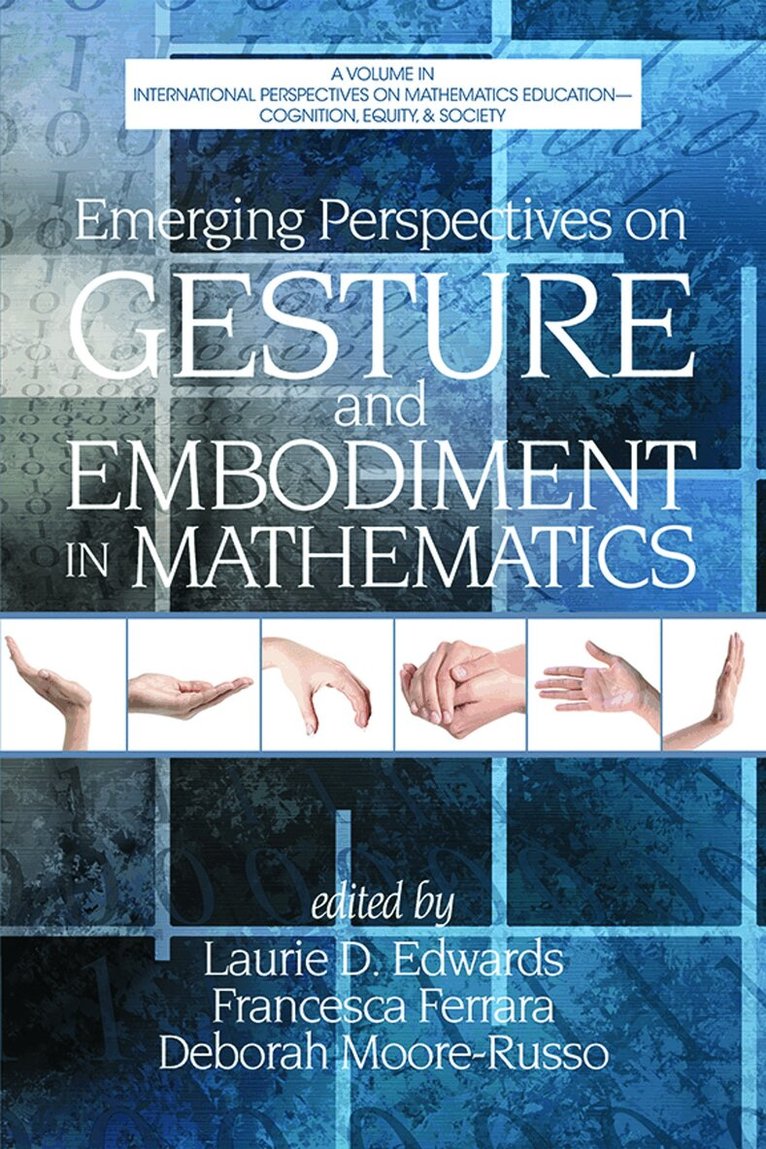
    Emerging Perspectives on Gesture and Embodiment in Mathematics

    AvLaurie D. Edwards,Francesca Ferrara

    Häftad, Engelska, 2014

    Del i serien Cognition, Equity & Society: International Perspectives

    623 kr

    Beställningsvara. Skickas inom 5-8 vardagar. Fri frakt över 249 kr.

    Beskrivning

    The purpose of the book is to establish a common language for, and understanding of, embodiment as it applies to mathematical thinking, and to link mathematics education research to recent work in gesture studies, cognitive linguistics and the theory of embodied cognition. Just as in past decades, mathematics education experienced a "turn to the social" in which socio-cultural factors were explored, in recent years there has been a nascent "turn to the body." An increasing number of researchers and theorists in mathematics education have become interested in the fact that, although mathematics may be socially constructed, this construction is not arbitrary or unconstrained, but rather is rooted in, and shaped by, the body. All those who engage with mathematics, whether at an elementary or advanced level, share the same basic biological and cognitive capabilities, as well as certain common physical experiences that come with being humans living in a material world. In addition, the doing and communicating of mathematics is never a purely intellectual activity: it involves a wide range of bodily actions, from committing inscriptions to paper or whiteboard, to speaking, listening, gesturing and gazing. This volume will present recent research on gesture and mathematics, within a framework that addresses several levels of mathematical development. The chapters will begin with contributions that examine early mathematical and proto-mathematical knowledge, for example, the conservation of volume and counting. The role of gesture in teaching and learning arithmetic procedures will be addressed. Core concepts and tools from secondary level mathematics will be investigated, including algebra, functions and graphing. And finally, research into the embodied understanding of advanced topics in geometry and calculus will be presented.The overall goal for the volume is to acknowledge the multimodal nature of mathematical knowing, and to contribute to the creation of a model of the interactions and mutual influences of bodily motion, spatial thinking, gesture, speech and external inscriptions on mathematical thinking, communication and learning. The intended audience is researchers and theorists in mathematics education as well as graduate students in the field.

    Produktinformation

    • Utgivningsdatum:2014-07-08
    • Mått:156 x 234 x 15 mm
    • Vikt:403 g
    • Format:Häftad
    • Språk:Engelska
    • Serie:Cognition, Equity & Society: International Perspectives
    • Antal sidor:284
    • Förlag:Emerald Publishing Inc
    • ISBN:9781623965532

    Utforska kategorier

    • Matematik inom Naturvetenskap och teknik
    • Undervisning i specifika ämnen inom Psykologi och pedagogik

    Mer om författaren

    Laurie Edwards, St. Mary's College of California, USAFrancesca Ferrara, University of Turin, ItalyDeborah Moore-Russo, SUNY, University at Buffalo, USA

    Innehållsförteckning

    • Introduction, Deborah Moore-Russo, Laurie D. Edwards, Francesca Ferrara.Chapter 1. Embodiment, modalities and mathematical affordances, Laurie D. Edwards & Ornella Robutti.Section I. Gestures and Embodiment in Early MathematicsChapter 2. Embodied knowledge in the development of conservation of quantity: Evidence from gesture, Martha Alibali, Breckie Church & Sotaro Kita.Chapter 3. Gesture's role in learning arithmetic, Susan Goldin-Meadow, Steven Jacobs, & Susan Levine.Section II.Chapter 4. Gestures and embodiment in school mathematics, Ferdinando Arzarello & Cristina Sabena.Chapter 5. An exploratory study of multi-modalities in the mathematics classroom: Enrica's explanation of an experience, Francesca Ferrara, Ornella Robutti & Laurie D. Edwards.Chapter 6. The gestures of blind mathematics learners, Lulu Healy & Solange Hassan Ahmad Ali Fernandes.Section III.Chapter 7. Gestures and embodiment in university mathematics, Deborah Moore-Russo & Janine Viglietti.Chapter 8. The role of conscious gesture mimicry in mathematical learning, Caroline Yoon, Michael Thomas & Tommy Dreyfus.Chapter 9. Re-conceiving modeling: An embodied cognition view of modeling, George Sweeney & Chris Rasmussen.Chapter 10. More than mere handwaving: Gesture and embodiment in expert mathematical proof, Tyler Marghetis, Laurie D. Edwards & Rafael Núñez.Chapter 11. Blending across modalities in mathematical discourse, Nathaniel Smith.