• Fri frakt över 249 kr
  • •
  • Snabba leveranser
  • •
  • Billiga böcker
Kundservice

Du är på sajten för privatpersoner.

Företag, bibliotek eller offentlig verksamhet?

Du handlar på classic.bokus.com, där alla dina funktioner finns intakta.
Till classic.bokus.com
Bokus logotyp. Gå till startsidan.
  • Erbjudanden
  • Nyheter
  • Student
  • Topplistor
  • Barn & ungdom
  • Bokus Play
  • E-böcker
  • Pocketböcker
  • Spel & pussel

10% rabatt på allt med kod: NYSTART10 →

Sidfot

Mina sidor

    Hjälp

    • Kundservice
    • Vanliga frågor och svar
    • Frakt och leverans
    • Retur vid ångerrätt
    • Reklamera vara
    • Betalning
    • Köpvillkor
    • Allmänna villkor
    • Information om webbplatsens tillgänglighet

    Om Bokus

    • Om oss
    • Pressrum
    • För studenter
    • För företag
    • För bibliotek och offentlig verksamhet
    • För leverantörer
    • Hållbarhet

    Populärt

    • Aktuella erbjudanden
    • Presentkort
    • Studentlitteratur
    • Nya böcker
    • Topplistor
    • Signerade böcker
    • Engelska böcker

    Inspiration

    • Boktips
    • BookTok
    • Populära bokserier
    • Barnbokskaraktärer
    • Populära författare
    Logotyp för Bokus
    Följ oss på Facebook (extern länk)Följ oss på Instagram (extern länk)Följ oss på YouTube (extern länk)Följ oss på TikTok (extern länk)
    bokus @ CookiesAnpassa cookiesIntegritetspolicyKöpvillkor
    Till Citymail hemsida (extern länk)Till Budbee hemsida (extern länk)Till Postnord hemsida (extern länk)Till Schenker hemsida (extern länk)Till Early Bird hemsida (extern länk)Till Walleys hemsida (extern länk)
    1. Naturvetenskap och teknik
    2. Matematik och naturvetenskap
    3. Matematik

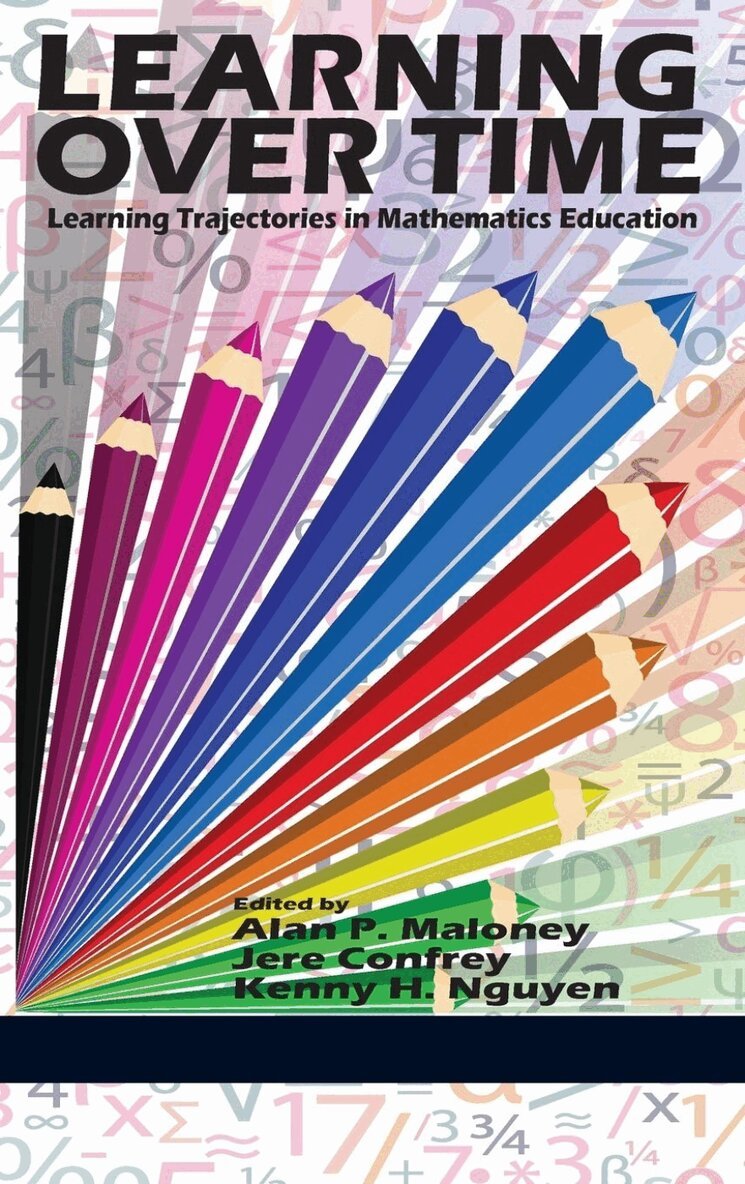
    Learning Over Time

    Learning Trajectories in Mathematics Education

    AvAlan P. Maloney,Jere Confrey

    Häftad, Engelska, 2014

    623 kr

    Beställningsvara. Skickas inom 5-8 vardagar. Fri frakt över 249 kr.

    Beskrivning

    The driving forces behind mathematics learning trajectories is the need to understand how children actually learn and make sense of mathematics—how they progress from prior knowledge, through intermediate understandings, to the mathematics target understandings—and how to use these insights to improve instruction and student learning. In this book, readers will come to understand what learning trajectories are, the research and methodology that are necessary for developing them, and gain insight into potential applications of learning trajectories.A synthesis and research outcome in their own right, learning trajectories provide detailed description of instructionally-grounded development of mathematical concepts and reasoning from the perspective of student learning, and, overall, building on decades of accumulated experience in mathematics education research. However, their greater importance may lie in their potential as frameworks that contribute an unprecedented coherence across classroom instruction, professional development, standards, and assessment, by focusing squarely on conceptual understanding and reasoning instead of assessment-driven procedural knowledge. This potential was sufficiently compelling as an organizing framework to have been cited as a basis for the Common Core mathematics standards, the new mathematics learning expectations that are now consistent across most of the United States. (Among the conference attendees were the writers of the Common Core State Standards for Mathematics, at the beginning of the Standards drafting process.)This book is an outgrowth of a conference on learning trajectories, hosted in 2009 at North Carolina State University, which examined research on learning trajectories. An overarching message of the chapters in this volume is that learning trajectories, by focusing on how children’s mathematical reasoning develops, are coming into their own as a rigorous underpinning for both instruction and accountability. Some of the learning scientists featured in this volume have played major roles learning trajectories’ evolution--from small-scale day-to-day conjectures by individual teachers, to systematic research endeavors that teachers and scientists alike can use to interpret standards, plan instruction, and formatively assess student work. The work in this volume will be of interest to mathematics educators, teachers, and professional development specialists.

    Produktinformation

    • Utgivningsdatum:2014-06-18
    • Mått:156 x 234 x 15 mm
    • Vikt:408 g
    • Format:Häftad
    • Språk:Engelska
    • Antal sidor:288
    • Förlag:Emerald Publishing Inc
    • ISBN:9781623965686

    Utforska kategorier

    • Matematik inom Naturvetenskap och teknik
    • Undervisning i specifika ämnen inom Psykologi och pedagogik

    Mer om författaren

    Alan P. Maloney, North Carolina State University, USAJere Confrey, North Carolina State University, USAKenny H. Nguyen, Catlin Gabel School, USA

    Innehållsförteckning

    • Preface, Richard A. Duschl.Introduction: Learning Trajectories in Mathematics, Jere Confrey, Alan P. Maloney, and Kenny H. Nguyen.Chapter 1. Learning Trajectories: Foundations for Effective, Research-Based Education, Douglas H. Clements and Julie Sarama.Chapter 2. Toward Establishing a Learning Progression to Support the Development of Statistical Reasoning, Richard Lehrer, Min-Joung Kim, Elizabeth Ayers, and Mark Wilson.Chapter 3. Equipartitioning, a Foundation for Rational Number Reasoning: Elucidation of a Learning Trajectory, Jere Confrey, Alan P. Maloney, Kenny H. Nguyen, and André A. Rupp.Chapter 4. Two Approaches to Describing the Development of Students' Reasoning About Length: A Case Study for Coordinating Related Trajectories, Jeffrey E. Barrett and Michael T. Battista.Chapter 5. Linking Standards and Learning Trajectories: Boundary Objects and Representations, Jere Confrey and Alan Maloney.Chapter 6. Exploring the Relationship Between Learning Trajectories and Curriculum: A Content Analysis of Rational Number Reasoning in Connected Mathematics and UCSMP Transition Mathematics, Kenny Huy Nguyen and Jere Confrey.Chapter 7. Articulated Learning Trajectories: A Framework for Mathematical Content Analyses, Travis A. Olson.Chapter 8. Learning Trajectories and Professional Development, P. Holt Wilson.Chapter 9. Conclusion: Learning Trajectories Going Forward: A Foundation for Coherence in the Instructional Core, Jere Confrey, Alan P. Maloney, and Kenny H. Nguyen.Author Biographies.