• Fri frakt över 249 kr
  • •
  • Snabba leveranser
  • •
  • Billiga böcker
Kundservice

Du är på sajten för privatpersoner.

Företag, bibliotek eller offentlig verksamhet?

Du handlar på classic.bokus.com, där alla dina funktioner finns intakta.
Till classic.bokus.com
Bokus logotyp. Gå till startsidan.
  • Erbjudanden
  • Nyheter
  • Student
  • Topplistor
  • Barn & ungdom
  • Bokus Play
  • E-böcker
  • Pocketböcker
  • Spel & pussel

10% rabatt på allt med kod: NYSTART10 →

Sidfot

Mina sidor

    Hjälp

    • Kundservice
    • Vanliga frågor och svar
    • Frakt och leverans
    • Retur vid ångerrätt
    • Reklamera vara
    • Betalning
    • Köpvillkor
    • Allmänna villkor
    • Information om webbplatsens tillgänglighet

    Om Bokus

    • Om oss
    • Pressrum
    • För studenter
    • För företag
    • För bibliotek och offentlig verksamhet
    • För leverantörer
    • Hållbarhet

    Populärt

    • Aktuella erbjudanden
    • Presentkort
    • Studentlitteratur
    • Nya böcker
    • Topplistor
    • Signerade böcker
    • Engelska böcker

    Inspiration

    • Boktips
    • BookTok
    • Populära bokserier
    • Barnbokskaraktärer
    • Populära författare
    Logotyp för Bokus
    Följ oss på Facebook (extern länk)Följ oss på Instagram (extern länk)Följ oss på YouTube (extern länk)Följ oss på TikTok (extern länk)
    bokus @ CookiesAnpassa cookiesIntegritetspolicyKöpvillkor
    Till Citymail hemsida (extern länk)Till Budbee hemsida (extern länk)Till Postnord hemsida (extern länk)Till Schenker hemsida (extern länk)Till Early Bird hemsida (extern länk)Till Walleys hemsida (extern länk)
    1. Medicin
    2. Andra medicinska specialiteter
    3. Behandling och behandlingsmetoder
    4. Tal- och språkstörningar

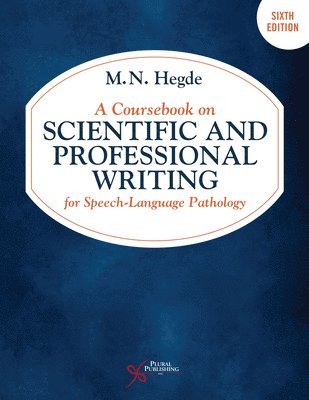
    A Coursebook on Scientific and Professional Writing for Speech-Language Pathology

    AvM.N. Hegde

    Häftad, Engelska, 2022

    2 166 kr

    Beställningsvara. Skickas inom 5-8 vardagar. Fri frakt över 249 kr.

    Beskrivning

    A Coursebook on Scientific and Professional Writing for Speech-Language Pathology, Sixth Edition is a unique interactive resource to help students develop the strong writing skills necessary for a successful clinical or academic career in speech-language pathology. The book not only describes the principles of good writing, but also contains numerous opportunities to practice writing skills replete with exemplars. The Coursebook is ideal for dedicated courses on scientific and/or professional writing, and can also be used in courses on assessment, research methods, and clinical methods and practicum.The first section of the book is a refresher on the basic rules of grammar, punctuation, and composition. The second section is focused on scientific writing and explains the different types of academic publications, offers tips on how to write without bias, and describes the typical manuscript formatting required by scientific publications. It also includes examples of the "elements of scientific style," such as capitalization and abbreviations, how to reference sources cited within the text, and how to prepare the reference list. Also covered are how to submit a manuscript to scholarly journals and best practices for proofreading and making revisions. The last section is focused on professional/clinical writing and the various written communications speech-language pathologists (SLPs) prepare as part of their jobs. These include diagnostic reports, brief and comprehensive treatment plans, and progress reports. The book ends with a section on report writing for SLPs working in public schools, including assessment reports, IEPs, and SOAP notes. A unique and student-friendly feature of the book is its practical design. The first two sections provide incorrect exemplars the user can rewrite or write correctly. In the last section, left-hand pages show specific examples of general, scientific, or professional writing, and the corresponding right-hand pages allow students to practice writing. Updates to the Scientific Writing section include:Incorporation of APA 7th edition changes to reference citations and preparation of the reference list, along with updates on how to cite electronic sources. Information on how to submit content to academic journals and conferences, preparing electronic manuscripts, and making revisions in light of the copyeditor's comments have been updated to current publishing industry standards.Updates to the Professional Writing section include:Updates to reflect current clinical terminology and practice in speech-language pathology. A new trial-by-trial treatment progress recording sheet has been added to the progress report section. An Objective, Subjective, Assessment, Plan (SOAP) progress report written for medical settings has been added, along with a new section on report writing in public schools, which includes an assessment plan that helps determine whether a student meets the school district's criteria for enrollment in clinical speech-language services.

    Produktinformation

    • Utgivningsdatum:2022-09-27
    • Mått:216 x 279 x 30 mm
    • Vikt:1 084 g
    • Format:Häftad
    • Språk:Engelska
    • Antal sidor:459
    • Upplaga:6
    • Förlag:Plural Publishing Inc
    • ISBN:9781635504019

    Utforska kategorier

    • Tal- och språkstörningar inom Medicin

    Mer om författaren

    M.N. Hegde, PhD, is Professor Emeritus of Communication Sciences and Disorders at California State University-Fresno. A specialist in fluency disorders, language disorders, research methods, and treatment procedures in communication disorders, Dr. Hegde is world renown as a researcher, presenter, contributor of original articles to leading national and international journals, and critically acclaimed author of more than two dozen highly regarded books in speech-language pathology. He has served on the editorial board of several scientific and professional journals, has been a guest editor of international journals, and continues to serve as an editorial consultant to the Journal of Fluency Disorders.

    Innehållsförteckning

    • Preface to the Sixth EditionAcknowledgementsAbout the AuthorPART AFOUNDATIONS OF SCIENTIFIC AND PROFESSIONAL WRITINGA.1. BASIC RULES OF USAGE AmpersandA.1.1. Use the Ampersand Correctly ApostropheA.1.2. Do Not Turn a Possessive Into a Plural A.1.3. Do Not Turn a Plural Into a Possessive A.1.4. Use the Correct Forms of Possessive Nouns A.1.5. Use the Possessive Forms of Pronouns Correctly A.1.6. Distinguish Contractions From PossessivesUnusual Singulars and PluralsA.1.7. Use Unusual Singulars and Plurals Correctly CommaA.1.8. Use a Serial Comma A.1.9. Do Not Use a Serial Comma When You Write Only Two Parallel Terms and Connect Them With a ConjunctionA.1.10. Use a Comma to Separate Parenthetic Expressions That Are Not in ParenthesesA.1.11. Place a Comma Before a Conjunction Introducing an Independent Clause A.1.12. Do Not Use a Comma Before a Conjunction That Is Followed by a Dependent ClauseDashA.1.13. Prefer an Em Dash to a Comma to Set Off an Abrupt BreakSemicolonA.1.14. Join Independent Clauses With a Semicolon When the Clauses Are Not Joined by a Conjunction AgreementA.1.15. Follow the Rules of Agreement ModifiersA.1.16. Use Modifiers CorrectlyPronounsA.1.17. Clarify the Referents of Pronouns A.1.18. Let the Pronoun Agree in Number With Its Antecedent A.1.19. Use the Proper Case of PronounSentence FragmentsA.1.20. Do Not Break a Single Sentence Into Two Parts A.1.21. Do Not Write Sentence Fragments as a Series of Declarative Statements A.1.22. Do Not Punctuate Appositives Nouns and AdjectivesA.1.23. Use Certain Terms Only in Their Adjectival Forms A.1.24. Do Not Turn a Noun Into a Verb Participial PhraseA.1.25. Let a Participial Phrase at the Beginning of a Sentence Refer to the Grammatical Subject A.2 BASIC RULES OF COMPOSITIONStructure of Research PapersA.2.1. Design a Broad Outline of Your Paper A.2.2. Design Headings and Subheadings of Your PaperComposing ParagraphsA.2.3. Write Paragraphs That Express Related IdeasA.2.4. Do Not Write Paragraphs That Are Too Long A.2.5. Do Not Write One-Sentence Paragraphs A.2.6. Begin and End Most Paragraphs With Transitionary SentencesConcise and Direct WritingA.2.7. Prefer the Shorter to the Longer Sentences A.2.8. Prefer the Active Voice A.2.9. Say What It Is, Instead of What It Is Not A.2.10. Avoid Too Many Qualifications A.2.11. Use Definite, Specific, and Concrete Language A.2.12. Eliminate or Replace Unnecessary PhrasesA.2.13. Avoid Redundant PhrasesA.2.14. Avoid Wordiness A.2.15. Avoid Jargon A.2.16. Avoid Euphemism A.2.17. Keep Related Words TogetherParallelismA.2.18. Write in Parallel Terms A.2.19. Maintain Parallelism in Numbered or Bulleted ListsMisplaced or Dangling ModifiersA.2.20. Avoid Dangling Modifiers A.2.21. Avoid Misplaced ModifiersShifts Within and Between SentencesA.2.22. Avoid Shifts Within and Between Sentences QuotationsA.2.23. Make Quotations Count A.2.24. Do Not Overuse QuotationsA.2.25. Do Not Include Islands of Quotations A.2.26. Do Not Begin a Sentence With a QuotationA.2.27. Use Quotation and Punctuation Marks CorrectlyA.2.28. Do Not Misuse Quotation Marks A.2.29. Give References for All Direct Quotations A.2.30. Reproduce Quotations Exactly A.2.31. Integrate Quotations of Fewer Than 40 Words With the Text A.2.32. Arrange Quotations as a Block When They Have 40 Words or More A.2.33. Show Correctly the Changes in QuotationsA.2.34. Quote Correctly the Sources on the Internet Precision in the Use of Scientific TermsA.2.35. Use the Terms Ending in -ology CorrectlyA.2.36. Use Certain Terms Ending in -ics CorrectlyUse of Fresh LanguageA.2.37. Avoid ClichesA.2.38. Avoid Colloquial or Informal ExpressionsA.3. COMMONLY MISUSED WORDS AND PHRASES A.3.1. Accept and ExceptA.3.2. Affect and Effect A.3.3. Alternate and Alternative A.3.4. Allusion and Illusion A.3.5. And/Or A.3.6. Baseline and Baserate A.3.7. Effect and Impact A.3.8. Elicit and Evoke A.3.9. Elicit and Illicit A.3.10. Farther and FurtherA.3.11. Focus and Analysis A.3.12. Incidence and Prevalence A.3.13. Inter- and Intra- A.3.14. Latter and Later A.3.15. Proof and Support A.3.16. Secondly and ThirdlyA.3.17. Since and Because A.3.18. There and TheirPART B SCIENTIFIC WRITING B.1. INTRODUCTION TO SCIENTIFIC WRITINGB.2. TERMS FOR WRITING WITHOUT BIASB.2.1. Do Not Overuse the Pronouns He and He or She B.2.2. Use the Appropriate Terms of Gender Identities B.2.3. Use the Appropriate Terms of Sexual Orientations B.2.4. Avoid Prejudicial Reference to Disabilities B.2.5. Avoid Prejudicial Reference to Ethnic or Racial IdentityB.2.6. Avoid Prejudicial Reference to AgeB.2.7. Avoid Prejudicial Comparisons of Study GroupsB.3. FORMAT OF SCIENTIFIC WRITINGMarginsB.3.1. Leave Correct Margins Title PageB.3.2. Type Correctly the Title Page of a Paper for Publication B.3.3. Type Correctly the Title Page of a Class (Term) PaperRunning HeadB.3.4. Type the Manuscript Running Head CorrectlyAbstract B.3.5. Write an Abstract on the Second Page Beginning of TextB.3.6. Begin the Text With an Untitled Introductory Section on Page ThreeHeading LevelsB.3.7. Use the Headings Within the Text ConsistentlyFont and Font SizeB.3.8. Use Acceptable Font and Size B.3.9. Use Bold Font Correctly Page NumbersB.3.10. Number the Pages Correctly B.3.11. Reprint the Corrected Pages Line Spacing and Line LengthB.3.12. Use Appropriate Line Spacing B.3.13. Align the Text to the Left Margin B.3.14. Correct the Spelling Errors B.4. ELEMENTS OF SCIENTIFIC STYLE CapitalizationB.4.1. Capitalize the First Words B.4.2. Capitalize the First and the Major Words B.4.3. Capitalize the Words Correctly in Headings B.4.4. Capitalize Proper Nouns and Trade Names B.4.5. Capitalize the Chapters and Sections the Reader Is Referred To B.4.6. Capitalize Nouns That Are Followed by a Number or Letter B.4.7. Capitalize Both Words in Otherwise Capitalized Hyphenated Compound B.4.8. Do Not Capitalize the Second Word of a Hyphenated Compound in Reference ListsItalicizationB.4.9. Use Italics Correctly Within the Body of Text B.4.10. Use Reverse Italics CorrectlyB.4.11. Use Italics Correctly in the Reference ListHyphenationB.4.12. Use the Hyphen Correctly B.4.13. Do Not Overuse or Misuse the Hyphen IndentationB.4.14. Use Correct IndentationSpace After PunctuationB.4.15. Give Correct Space or No Space After Punctuation AbbreviationsB.4.16. Write Out Abbreviations the First Time You Use the Term, and Enclose the Abbreviations in ParenthesesB.4.17. Do Not Start a Sentence With a Lowercase Abbreviation B.4.18. Use Latin Abbreviations Only in Parenthetical Constructions B.4.19. Add the Lowercase Plural Morpheme s to Plural Abbreviations Without an ApostropheB.4.20. With Abbreviations, Use the Period Correctly B.4.21. Abbreviate Units of Measurement When a Number Is SpecifiedNumbers in Words or NumeralsB.4.22. Write Out Units of Measurement When a Number Is Not Specified B.4.23. Use Roman Numerals Only When It Is an Established Practice B.4.24. Use Arabic Numerals for Numbers 10 and Above B.4.25. Use Numerals for Numbers Below 10 in Specified Contexts B.4.26. Write Out in Words Numbers Below 10 in Specified Contexts B.4.27. Write Out in Words Any Number That Begins a Sentence B.4.28. Combine Words and Numerals in Specified Contexts Reference Citations Within the TextB.4.29. Cite the Author's Last Name and Year or Years of Publication in the Text B.4.30. Cite Both Names in the Text When a Work Has Two Authors B.4.31. Cite Works With Three or More Authors With Only the First AuthorB.4.32. Distinguish Works of Multiple Authors Published in the Same Year B.4.33. Join Multiple Author Names With the Conjunction and or the Ampersand B.4.34. Distinguish the Different First Authors With the Same Surname B.4.35. Cite Multiple Works of the Same Author in a Temporally Ascending Order B.4.36. Attach Alphabetical Suffixes to the Same Author's Multiple Publications in the Same Year B.4.37. Within Parentheses, Arrange the Last Names of Multiple Authors in Alphabetical OrderB.4.38. Cite Secondary Sources Sparingly and Correctly B.4.39. Cite Correctly the Works With No Author or an Anonymous AuthorB.4.40. Cite Correctly the Year of Publication in Parenthetical Text B.4.41. Cite Correctly the Specific Parts of a Source Reference ListB.4.42. General Guidelines on Creating a Reference ListB.4.43. Begin the Reference List on a New Page With a Centered Heading B.4.44. In the Reference List, Arrange Authors in Alphabetical OrderB.4.45. Arrange Multiple Works of the Same Single Author From the Earliest to the Latest YearB.4.46. Alphabetize the Titles of Several Works of the Same Author Published in the Same YearB.4.47. Arrange the Multiple Works of the Same Author Published in a Different Years in Temporally Ascending OrderB.4.48. Alphabetize the Different Authors With the Same Last Name According to Their InitialsB.4.49. Format Each Entry in the Reference List With a Hanging Indent of Five Spaces B.4.50. Use the Specified Abbreviations in Reference Lists Selected Examples of References Printed Journal ArticlesB.4.51. Overview of Referencing Printed Journal ArticlesB.4.52. Use the Correct Format to Reference Printed Journal ArticlesB.4.53. Arrange Correctly the Articles With Multiple Authors B.4.54. Reference Correctly the Different Forms of Journal PublicationsMagazines and Newspaper ArticlesB.4.55. Reference Correctly the Publications From Magazines and Newspapers AbstractsB.4.56. Reference Correctly the Article Abstracts Used as the Primary Source Books and Book ChaptersB.4.57. Authored Books in Reference Lists B.4.58. Edited Books and Chapters in Edited Books Conference and Convention PresentationsB.4.59. Paper and Poster Presentations Unpublished Articles, Dissertations, and ThesesB.4.60. Unpublished Articles, Theses, or Dissertations B.4.61. Theses and Dissertations Published in a Database or Available Online B.4.62. Guidelines on Using Electronic Sources in Scientific WritingB.4.63. Examples of Electronic Sources in the Reference ListB.5. WRITING SECTIONS OF RESEARCH PAPERS AND PROPOSALS B.5.1. General Guidelines on Completed and Proposed Empirical Studies B.5.2. Sections of a Research Paper B.6. MANUSCRIPT SUBMISSION, REVISION, AND PROOFREADINGB.6.1. Manuscript Submission for Journal Publication B.6.2. Submission for Convention or Conference Presentations B.6.3. Book and Book Chapter PublicationsB.6.4. Copyediting and Author RevisionsB.6.5. Proofreading PART C PROFESSIONAL WRITING C.1. INTRODUCTION TO PROFESSIONAL WRITING C.2. ELEMENTS OF DIAGNOSTIC REPORTS Common Elements of a Diagnostic ReportUnique Elements Depending on the Age of the ClientC.3. DIAGNOSTIC REPORTS C.3.1. Diagnostic Report: Speech Sound Disorder C.3.2. Diagnostic Report: Voice DisorderC.3.3. Diagnostic Report: Aphasia and Apraxia of Speech C.3.4. Diagnostic Report: Stuttering C.4. PRACTICE IN DIAGNOSTIC REPORT WRITING C.4.1. Practice Writing Diagnostic Report: Speech Sound DisorderC.4.2. Practice Writing Diagnostic Report: Child Language Disorder C.4.3. Practice Writing Diagnostic Report: Stuttering C.4.4. Practice Writing Diagnostic Report: Voice DisorderC.5. COMPREHENSIVE TREATMENT PLANS C.5.1. Comprehensive Treatment Plan: Speech Sound Disorder C.6. BRIEF TREATMENT PLANS C.6.1. Brief Treatment Plan: Stuttering C.6.2. Brief Treatment Plan: Speech Sound Disorder C.6.3. Brief Treatment Plan: Child Language DisorderC.6.4. Brief Treatment Plan: Voice DisorderC.7. PRACTICE IN WRITING TREATMENT PLANS C.7.1. Practice Writing Comprehensive Treatment Plan: Child Language DisorderC.7.2. Practice Writing Brief Treatment Plan: Stuttering C.7.3. Practice Writing Brief Treatment Plan: Speech Sound DisorderC.7.4. Practice Writing Brief Treatment Plan: Child Language Disorder C.7.5. Practice Writing Brief Treatment Plan: Voice Disorder C.8. PROGRESS REPORTS C.8.1. Trial-by-Trial Data Recording Sheet for Treatment Sessions C.8.2. Progress Report: Treatment of Stuttering C.8.3. Progress Report: Treatment of Speech Sound DisorderC.8.4. Sample Progress Report: Treatment of Child Language Disorder C.8.5. Progress Report: Treatment of Voice Disorder C8.6. SOAP Progress ReportC.9. PRACTICE IN WRITING PROGRESS REPORTS C.9.1. Practice Writing Progress Report: Treatment of Stuttering C.9.2. Practice Writing Progress Report: Treatment of Speech Sound DisorderC.9.3. Practice Writing Progress Report: Treatment of Child Language DisorderC.9.4. Practice Writing Progress Report: Treatment of Voice DisorderC.10. REPORT WRITING IN PUBLIC SCHOOLSC.10.1. Assessment Report FormatC.10.2. IEP: Treatment of Child Language Disorder C.10.3. IEP: Treatment of Speech Sound Disorder C.10.4. IEP: Treatment of Voice DisorderC.10.5. IEP: Treatment of StutteringC.10.6. SOAP Note Format Selected ReferencesGlossaryIndex