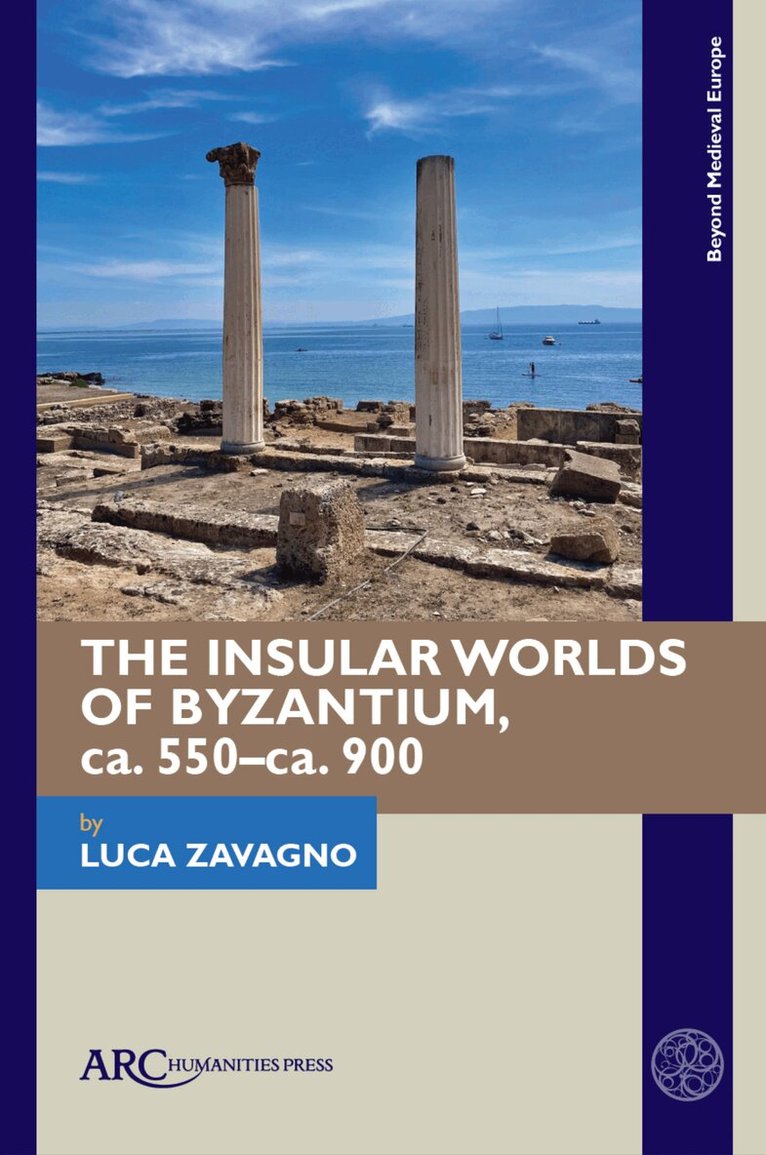
Inbunden, Engelska, 2025
Insular Worlds of Byzantium, ca. 550–ca. 900
Av Luca Zavagno
Del i serien Beyond Medieval Europe
2234 kr
Beställningsvara. Skickas inom 7-10 vardagar. Fri frakt över 249 kr.
Beskrivning
Produktinformation
- Utgivningsdatum: 2025-07-31
- Mått: 152 x 229 x undefined mm
- Vikt: 558 g
- Format: Inbunden
- Språk: Engelska
- Serie: Beyond Medieval Europe
- Antal sidor: 246
- Förlag: Arc Humanities Press
- ISBN: 9781641890489
Utforska kategorier
Mer om författaren
Luca Zavagno is Associate Professor of Byzantine History at Bilkent University, Ankara. A historian of Europe and the Mediterranean in the medieval period, he specializes in Byzantine history and archaeology.
Recensioner i media
Luca Zavagno’s The Insular Worlds of Byzantium, ca. 550–ca. 900 offers a fresh and ambitious reinterpretation of the role of islands within the Byzantine Mediterranean during the so-called “transitional period” between Late Antiquity and the early Middle Ages. It focuses on a clearly defined group of case studies in the Mediterranean—namely, the four large islands of Crete, Sicily, and Sardinia, together with the two archipelagos of Malta and the Balearics. At its core, the study seeks to challenge long-standing historiographical models that emphasize decline, rupture, and fragmentation following the Arab conquests. Instead, the author proposes an interpretation centered on continuity, transformation, and connectivity, arguing that islands were not marginal or peripheral spaces, but rather active nodes within a wider Mediterranean network.The theoretical framework of the book draws on modern approaches to Mediterranean history, such as nissology, particularly the works of Horden and Purcell. Central to Zavagno’s argument is the concept of liminality, which he uses to characterize islands as spaces “in-between” political, economic, and cultural systems. In contrast to the notion of “borderlands,” which implies fixed geopolitical divisions, liminality highlights fluidity, negotiation, and adaptability. Noteworthy is the inclusion of the western Mediterranean, which is often underrepresented in Byzantine studies, and which significantly enriches the scope of the analysis. [...][C]riticisms, however, must be considered in light of the limitations of the evidence, including the lack of systematic excavations in many sites of these islands, which the author himself acknowledges. In this sense, Zavagno’s achievement is all the more significant, as he succeeds in constructing a coherent and persuasive interpretation from fragmentary material. In any case, The Insular Worlds of Byzantium opens new directions for research and offers a compelling reinterpretation of the role of islands in Byzantine history.
Betyg & recensioner
0 recensioner
Inga recensioner tillgängliga.