• Fri frakt över 249 kr
  • •
  • Snabba leveranser
  • •
  • Billiga böcker
Kundservice

Du är på sajten för privatpersoner.

Företag, bibliotek eller offentlig verksamhet?

Du handlar på classic.bokus.com, där alla dina funktioner finns intakta.
Till classic.bokus.com
Bokus logotyp. Gå till startsidan.
  • Erbjudanden
  • Nyheter
  • Student
  • Topplistor
  • Barn & ungdom
  • Bokus Play
  • E-böcker
  • Pocketböcker
  • Spel & pussel

10% rabatt på allt med kod: NYSTART10 →

Sidfot

Mina sidor

    Hjälp

    • Kundservice
    • Vanliga frågor och svar
    • Frakt och leverans
    • Retur vid ångerrätt
    • Reklamera vara
    • Betalning
    • Köpvillkor
    • Allmänna villkor
    • Information om webbplatsens tillgänglighet

    Om Bokus

    • Om oss
    • Pressrum
    • För studenter
    • För företag
    • För bibliotek och offentlig verksamhet
    • För leverantörer
    • Hållbarhet

    Populärt

    • Aktuella erbjudanden
    • Presentkort
    • Studentlitteratur
    • Nya böcker
    • Topplistor
    • Signerade böcker
    • Engelska böcker

    Inspiration

    • Boktips
    • BookTok
    • Populära bokserier
    • Barnbokskaraktärer
    • Populära författare
    Logotyp för Bokus
    Följ oss på Facebook (extern länk)Följ oss på Instagram (extern länk)Följ oss på YouTube (extern länk)Följ oss på TikTok (extern länk)
    bokus @ CookiesAnpassa cookiesIntegritetspolicyKöpvillkor
    Till Citymail hemsida (extern länk)Till Budbee hemsida (extern länk)Till Postnord hemsida (extern länk)Till Schenker hemsida (extern länk)Till Early Bird hemsida (extern länk)Till Walleys hemsida (extern länk)
    1. Naturvetenskap och teknik
    2. Matematik och naturvetenskap
    3. Naturvetenskap:allmänt

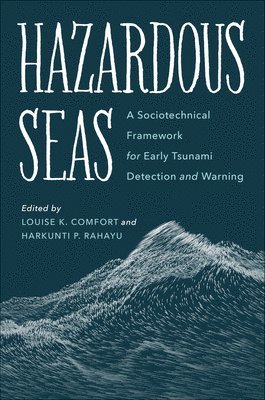
    Hazardous Seas

    A Sociotechnical Framework for Early Tsunami Detection and Warning

    AvLouise K. Comfort,Harkunti P. Rahayu

    Häftad, Engelska, 2023

    399 kr

    Beställningsvara. Skickas inom 5-8 vardagar. Fri frakt över 249 kr.

    Beskrivning

    Tsunamis are infrequent but terrifying hazards for coastal communities. Difficult to predict, they materialise with little warning, claiming thousands of lives and causing billions of dollars in damage. Recent mega-tsunamis in Japan and Indonesia claimed close to 250,000 lives, triggering wide-scale economic and social disruption. Developing countries cannot afford costly underwater cable systems, and governments and relief organisations have been forced to rely on flawed warning systems such as deep-sea buoys. Now, a ground-breaking new approach to tsunami detection and warning, which relies on low-cost underwater sensors and networks of smartphone communication, has changed the equation. Developed by an international, interdisciplinary team of researchers, this approach allows at-risk coastal communities to have an economically viable, scientifically sound means to protect themselves.Coeditors Louise K. Comfort and Harkunti P. Rahayu, accomplished experts in disaster preparedness, contend that it will give communities precious additional minutes to communicate warnings about imminent tsunamis to residents, potentially saving many lives. Chapters authored by a close group of collaborators present the science behind this new approach, describing conceptual design, computational models, and real-time testing of a prototype system in the warm equatorial waters of Indonesia’s Mentawai Sea. Introductory chapters explain the sociotechnical approach - how undersea sensors can transmit data to a network of electronic devices on land to alert residents to impending tsunami threats in near-real time. Subsequent chapters explore what this might look like: assessing communities at risk; designing interactive information systems for communication during an emergency; designing wireless networks for smartphone communication that can guide residents to safety; and designing community-based shelters. The book concludes with a thoughtful analysis of how these sociotechnical advances might be used for all coastal cities at risk of tsunamis, sea-level rise, storm surges, and other hazards.Hazardous Seas is an invaluable guide for policy makers and international NGOs looking to save lives from tsunamis and mitigate crippling damage to communities, and provides a comprehensive overview of tsunami detection and warning for students of engineering, computer science, planning, policy, and economic and environmental analysis.

    Produktinformation

    • Utgivningsdatum:2023-07-20
    • Mått:152 x 229 x 20 mm
    • Vikt:658 g
    • Format:Häftad
    • Språk:Engelska
    • Antal sidor:360
    • Förlag:Princeton University Press
    • ISBN:9781642831634

    Utforska kategorier

    • Naturvetenskap:allmänt inom Naturvetenskap och teknik
    • Socialt arbete och välfärd inom Samhälle och politik

    Mer om författaren

    Louise K. Comfort is professor and former director of the Center for Disaster Management, Graduate School of Public and International Affairs, University of Pittsburgh. She is principal investigator of a National Science Foundation project to deploy and test an early tsunami detection and warning system. She is a Fellow of the National Academy of Public Administration. Harkunti P. Rahayu is a professor in the Urban and Regional Planning Department, School of Architecture, Planning, and Policy and Development at the Institute of Technology of Bandung. She serves as chair of the UNESCO Indian Ocean Tsunami Warning and Mitigation System Working Group on Tsunami Risk, Community Awareness and Preparedness.

    Recensioner i media

    "The book Hazardous Seas serves as a crucial resource for policymakers and NGOs focused on disaster management. It offers a thorough overview of tsunami detection and warning systems, making it a valuable guide for various professionals and students in fields like engineering, computer science, and environmental analysis."

    Innehållsförteckning

    • ForewordPreface1. Building Community Resilience to Disaster Risk: A Sociotechnical ApproachLouise K. Comfort and Mark W. Dunn2. Community Networks for Tsunami Early WarningHarkunti P. Rahayu and Louise K. Comfort3. A Reliable, Timely Communication Application to Enhance Tsunami PreparednessFuli Ai, X. Xerandy, Taieb Znati, Louise K. Comfort, and Febrin Anas Ismail4. Device-to-Device Communication: A Scalable, Socially Aware, Land-Based Infrastructure to Support CommunityResilience in Disaster EventsX. Xerandy, Fuli Ai, Taieb Znati, Louise K. Comfort, and Febrin Anas Ismail5. Community-based Shelters: Design, Construction and ImplementationFebrin Anas Ismail and Abdul Hakam6. Enabling Adaptive Collective Action for Communities at Risk: Responding to Tsunami Risk in Padang City, IndonesiaYoon Ah Shin, Louise K. Comfort, Fuli Ai, and Febrin Anas Ismail7. Wireless Networks for Disaster-Degraded Contexts: Tsunami Evacuation in Padang, IndonesiaFuli Ai, X. Xerandy, Echhit Joshi, Taieb Znati, and Febrin Anas Ismail8. Real-time Seafloor Tsunami Detection and Acoustic CommunicationsLee Freitag, Keenan Ball, Peter Koski, James Partan, Sandipa Singh, Dennis Giaya, and Kayleah Griffen9. A Prototype Ocean-bottom Pressure Sensor Deployed in the Mentawai Channel, Central Sumatra, Indonesia:Preliminary ResultsEmile A. Okal and Lee Freitag10. Underwater Sensor Network Prototype for Tsunami Detection and Warning: A Long Deployment Journey towardFunctionalityX. Xerandy, Iyan Turyana, Lee Freitag, Wahyu Pandoe, Harkunti P. Rahayu, and Febrin Anas Ismail11. Indian Ocean Tsunami Warning and Mitigation System: Initiation, Evolution, and ImplementationHarkunti P. Rahayu12. Creating a Sustainable Learning System in Regions of RiskLouise K. Comfort, Wahyu W. Pandoe, and Harkunti P. RahayuAfterwordAcknowledgmentsAbout the EditorsContributorsIndex