• Fri frakt över 249 kr
  • •
  • Snabba leveranser
  • •
  • Billiga böcker
Kundservice

Du är på sajten för privatpersoner.

Företag, bibliotek eller offentlig verksamhet?

Du handlar på classic.bokus.com, där alla dina funktioner finns intakta.
Till classic.bokus.com
Bokus logotyp. Gå till startsidan.
  • Erbjudanden
  • Nyheter
  • Student
  • Topplistor
  • Barn & ungdom
  • Bokus Play
  • E-böcker
  • Pocketböcker
  • Spel & pussel

10% rabatt på allt med kod: NYSTART10 →

Sidfot

Mina sidor

    Hjälp

    • Kundservice
    • Vanliga frågor och svar
    • Frakt och leverans
    • Retur vid ångerrätt
    • Reklamera vara
    • Betalning
    • Köpvillkor
    • Allmänna villkor
    • Information om webbplatsens tillgänglighet

    Om Bokus

    • Om oss
    • Pressrum
    • För studenter
    • För företag
    • För bibliotek och offentlig verksamhet
    • För leverantörer
    • Hållbarhet

    Populärt

    • Aktuella erbjudanden
    • Presentkort
    • Studentlitteratur
    • Nya böcker
    • Topplistor
    • Signerade böcker
    • Engelska böcker

    Inspiration

    • Boktips
    • BookTok
    • Populära bokserier
    • Barnbokskaraktärer
    • Populära författare
    Logotyp för Bokus
    Följ oss på Facebook (extern länk)Följ oss på Instagram (extern länk)Följ oss på YouTube (extern länk)Följ oss på TikTok (extern länk)
    bokus @ CookiesAnpassa cookiesIntegritetspolicyKöpvillkor
    Till Citymail hemsida (extern länk)Till Budbee hemsida (extern länk)Till Postnord hemsida (extern länk)Till Schenker hemsida (extern länk)Till Early Bird hemsida (extern länk)Till Walleys hemsida (extern länk)
    1. Filosofi och religion
    2. Religion och tro
    3. Kristendom

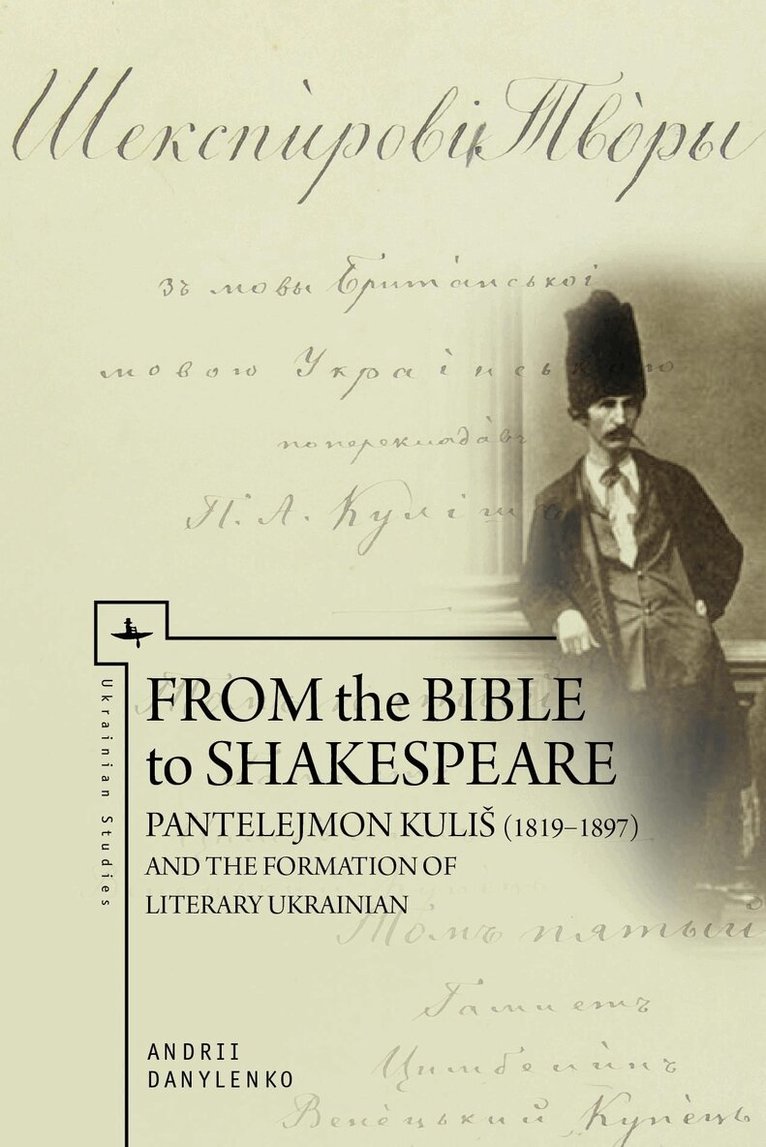
    From the Bible to Shakespeare

    Pantelejmon Kuliš (1819–1897) and the Formation of Literary Ukrainian

    AvAndrii Danylenko

    Häftad, Engelska, 2019

    Del i serien Ukrainian Studies

    561 kr

    Beställningsvara. Skickas inom 5-8 vardagar. Fri frakt över 249 kr.

    Fler format och utgåvor

    Inbunden

    1 158 kr

    Beskrivning

    This is the first comprehensive study of the language program of the prominent Ukrainian writer and ideologue Pantelejmon Kuliš (1819-1897) whose translations of the Bible and Shakespeare proved most innovative in the formation of literary and the national self-identification of Ukrainians. The author looks at Kuliš's translations from the perspective of cultural and ethnic studies, presenting literary Ukrainian as a process of negotiation among literary traditions, religions (rites), political movements, and personalities.This book may be used in university courses on the history of Slavic languages and literatures, contemporary theories of nation-building and national identity as well as language contact and (historical) sociolinguistics. The discussion of language policy in the Russian Empire and Austria-Hungary can be included in regular university courses on Slavic civilizations, history of Central and Eastern Europe (Russia, Poland, and Ukraine).

    Produktinformation

    • Utgivningsdatum:2019-08-22
    • Mått:155 x 234 x 30 mm
    • Vikt:720 g
    • Format:Häftad
    • Språk:Engelska
    • Serie:Ukrainian Studies
    • Antal sidor:472
    • Förlag:Academic Studies Press
    • ISBN:9781644691359

    Utforska kategorier

    • Kristendom inom Filosofi och religion
    • Litteraturvetenskap inom Skönlitteratur

    Mer om författaren

    Andrii Danylenko is a well-known Slavists who edited and authored several books on Slavic linguistics and philology as well as dozens of studies on a wide array of topics ranging from Indo-European to literary Ukrainian. He is an editorial Board member of several publications and a reviewer for numerous publications and programs in North America, Europe, and Japan.

    Recensioner i media

    There is no figure more important for the development and standardization of literary Ukrainian in the nineteenth century than Pantelejmon Kuliš. As an author, as a scholar, and as an activist, he worked tirelessly for the rejuvenation of Ukrainian culture and particularly its language. Among his most important contributions were his translations of the Bible and of Shakespeare's plays. With painstaking diligence, exhaustive research, and uncompromising analysis, Andrii Danylenko examines the language of these translations at great depth and compares them to the efforts of other translators in similar genres. The result is a masterful study of Kuliš's language and a major contribution to the history of the Ukrainian language."|"The monograph, about the language of Pantelejmon Kuliš's seminal Bible and Shakespeare translations from the 1860s until his death in 1897, is a major contribution to our understanding of the formation of modern literary and standard Ukrainian and a long-due appraisal of Kuliš's contribution. It is based on an impressive wealth of unpublished sources and an extensive range of secondary literature. The principal merit lies in numerous detailed analyses of Kuliš's and his contemporaries' language and the assessment of the forms and words found with respect to their provenance. This is a notoriously difficult undertaking, which very few scholars in Ukrainian philology are able to carry out with the same care, expertise and balanced approach."|"The learning and industry [of this book] are deep and wide. Modern technology has enable Danylenko to display and discuss different systems of transliteration and fonts accomodating variations in Cyrillic spelling, including Church Slavonic. Documentation occurs internal to the text in streamlined form ... well worth the price as a reference tool."|"From the Bible to Shakespeare represents a truly innovative and fundamental study of an important contribution to the Ukrainian linguistic culture, made by the famous Ukrainian writer and cultural figure Pantelejmon Kuliš. . . . the volume also appears to be a very useful text for university studies. It provides a great deal of facts and theoretical concepts for reconstruction of the history of biblical studies on the Ukrainian terrain in the nineteenth and early twentieth centuries."|This is a well-researched, meticulous and erudite analysis that offers a wealth of information on the development of literary Ukrainian and Kulish's lasting contribution to the effort. It is a remarkable achievement and a welcome contribution to Ukrainian studies.|Andrii Danylenko's From the Bible to Shakespeare: Pantelejmon Kuliš (1819-1897) and the Formation of Literary Ukrainian is a profound study that offers an insight into a complex process of the development of language, embracing the formation of the literary and the national. Kuliš's translations represent an intriguing study case not only for the exploration of linguistic synthesis, but also for investigation of identity fluidity that stems from openness towards linguistic and cultural dialogism.|"This book could be rightly considered as a further steptowards the realization of an 'integral history of the new Ukrainian literary language'which Danylenko is striving for. … Overall, the book can be read with theutmost curiosity and recommended to those scholars with a keen interest in theformation process of modern literary Ukrainian. Danylenko's detailed analysisof the language used in the exemplified translation fragments by Kuliš and the comparison withthe translations made by his, more or less famous, contemporaries, inserted in broadersocio-historic and cultural-literary context, adds a fundamental milestone inthe history of the Ukrainian language." —Salvatore Del Gaudio, Richerche Slavistiche Vol. 1 (LXI)

    Innehållsförteckning

    • AcknowledgementsAbbreviationsIntroduction: Writing a Linguistic Biography of a Ukrainian MaverickPart I: The BibleChapter 1: Exploring PsalmodyThe Book of PsalmsAlexandrine Verse or Trochaic Foot?Invoking Gavrila DeržavinChurch Slavonicisms"Kulišisms"Xarkiv Chimes InThe 1897 Poetic CrowningChapter 2: The Makings of the Rusian BibleA Pentateuch ProlusionGearing Up for New Challenges"Poison and Ruin for the Rusian People""The Labor Pangs of a Unified Ukrainian Literary Language"Reception of the TranslationThe Sloboda BulwarkThe Archangel HavryloWho Else Bears a Grudge?The Creation of the New Biblical StyleMeans of ArchaizationMeans of VernacularizationChapter 3: Galicia "Writes Back"The West or the East?Fostering "Rusian Church Vernacular"Any Palliative Solution?Lost in DiacriticsTo "Secularize" or "Synthesize"?Chapter 4: Here Comes the Bible!The Holy Writ Doesn't BurnTobit and JobAt the Crossroads of Poetry and ProseIvan Nečuj-Levyc´kyj Takes It PersonallyThe Pranks of Ivan FrankoIvan Puljuj Makes His RiposteHow Should It Sound?How to String Words?How to Choose Words?How to Spell Words?Ivan Nečuj-Levyc´kyj Is Shuffled BackstageInterpreting Hebrew PoetryThe Book of JobLamentationsThe Song of SongsThe Versified BibleSummaryPart II: ShakespeareChapter 5: "Oh, Shakespeare, Our Father, Native to All Peoples"Ethics Avant la Lettre!Bringing Forth the "Ukrainian Shakespeare"The First (Over)ReactionThe Language of the "Ukrainian Shakespeare"On the Threshold of a New Secular High StyleChapter 6: Expanding the Literary Canon of the "Ukrainian Shakespeare"The First Step Is the Hardest?"Huculia Did Not Appear; Rather Shakespeare Was Merely Hidden"Hamlet or Hamljet? That Is the QuestionHamlet in Peasant Leather ShoesThe Younger Generation Steps to the Fore"We Are All Peasants Today"One or Multiple Homesteads?Conclusion: Detours Offered But Never TakenBibliographyIndicesGeographical and Personal NamesSubjects and Titles of Literary Works and TranslationsWord-forms