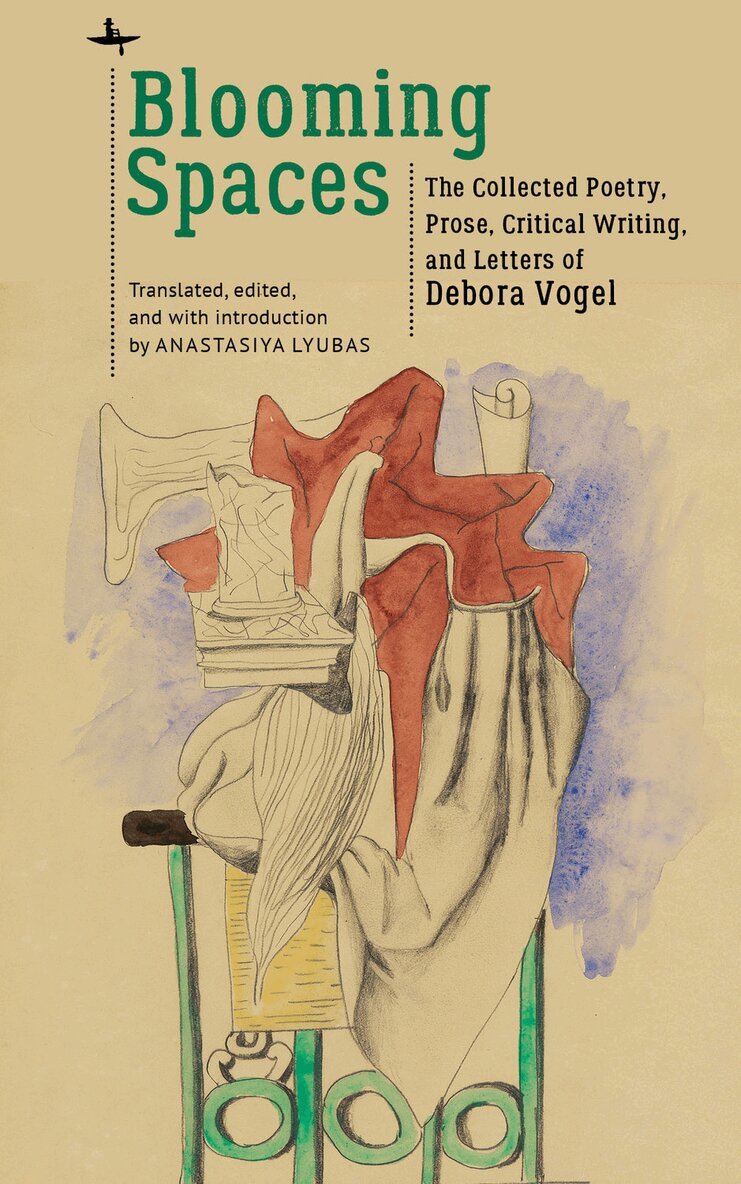
Blooming Spaces
The Collected Poetry, Prose, Critical Writing, and Letters of Debora Vogel
Del i serien Jews of Poland
462 kr
Beställningsvara. Skickas inom 5-8 vardagar. Fri frakt över 249 kr.
Beskrivning
Produktinformation
- Utgivningsdatum:2020-11-19
- Mått:155 x 234 x 23 mm
- Vikt:658 g
- Format:Häftad
- Språk:Engelska
- Serie:Jews of Poland
- Antal sidor:436
- Förlag:Academic Studies Press
- ISBN:9781644693919
Utforska kategorier
Mer om författaren
Anastasiya Lyubas, PhD (Binghamton University), is the Visiting Research Fellow at the Northrop Frye Centre at the University of Toronto (2020-2021). She is the author of White Words: Essays, Letters, Reviews and Polemics by Debora Vogel published in Kyiv (2019). She has been a Research Fellow at MLCRC at Ryerson University, a Max Weinreich Research Fellow at YIVO, a Translation Fellow at the Yiddish Book Center, and a Fulbright Scholar.
Recensioner i media
“Vogel’s Yiddish writing, notoriously difficult, has not attracted much critical attention until very recently, and her critical and literary works have gone untranslated. Anastasiya Lyubas’s ambitious and comprehensive volume changes that by bringing this brilliant, experimental Yiddish and Polish writer to English-language readers. Lyubas’s introduction offers the first English language biography of the writer, situating Vogel’s life and work in her Galician and European modernist contexts and offering important critical contexts to begin the project of interpreting Vogel’s work and assimilating it into the larger narratives of interwar Jewish and Polish modernisms. This immense volume contains Vogel’s poetry, experimental prose poems, essays in both Polish and Yiddish, the extant correspondence, as well as published reviews of her writing. The book is a mobile archive that makes visible Vogel’s development as both a major artist and a Jewish intellectual. … Lyubas’s volume is essential reading for anyone interested in the history of Yiddish letters. It returns to readers a major intellectual and cultural figure of Jewish modernity, a woman whose voice demands to heard.”— Allison Schachter, Nashim 40 (2022)“Regrettably, Vogel’s writing has until now remainedvirtually unknown to English-language readers. With the invaluable newcollection Blooming Spaces, Anastasiya Lyubas, a researcher at theUniversity of Toronto, at last rescues Vogel from [Bruno] Schulz’s shadow,restores the obliterated lines of continuity between her and us, and bringsVogel the attention commensurate with the full profusion of her talents. Intranslations that beautifully convey the cadences of the original, Lyubas givesus for the first time not only generous selections from Vogel’s three books butalso her essays—many with a sharp polemical bite—on photomontage and literarymontage, on abstract art, on the painter Marc Chagall (whom she knewpersonally), on racism and antisemitism (‘Exoticized People’), on the role ofintellectuals, and on the history of secular Yiddish writing in Galicia.”—Benjamin Balint, Jewish Review of Books“As a poet and an intellectual, Debora Vogel worked at the limits of language. She insisted, as Lyubas writes, that ‘everything is art, and everything matters.’ This volume demonstrates how much Vogel's own work matters for the study of Modernism, art history, poetics, and philosophy. Through Lyubas's deep research and deft translations, Vogel’s full voice now reaches into English—vivid, iridescent, melancholy, and thrilling.”—Anna Elena Torres, Assistant Professor, Comparative Literature, University of Chicago“Debora Vogel was one of the most original Jewish writers from Lviv, publishing in Polish and Yiddish in the interwar period. Vogel’s radically avant-garde, experimental creativity was consciously and consistently based on cogent philosophical and theoretical assumptions. This volume is the first publication in the world to contain such an extensive and comprehensive selection of Vogel’s writings. Lyubas presents Vogel as poet, prose writer, essayist, and art critic; the correspondence section included in the volume also provides an intimate insight into the author's more privately expressed opinions and contacts with her community of New York Yiddish writers and others. Lyubas’s review of the works of Vogel gives the reader an appreciation of how difficult it was for a woman to be heard in a world of avant-garde poetry dominated by male writers. The excellent introduction brings us closer to Deborah Vogel as an individual, in both her private and public lives. This book additionally contains valuable sources for anyone interested in modernism, Yiddish literature and its relationship to Polish literature, and women's literary achievements.”—Joanna Lisek, Taube Department of Jewish Studies, University of Wrocław“Debora Vogel was an author creating an irresistible and headstrong linguistic universe. In Lemberg she co-founded, and supported, circles of young writers and artists. Like other pioneers, she was both idealistic and uncompromising. In 1931, in a letter to New York, Vogel noted audaciously and bitterly: ‘We write poems and essays, we work like lamed-vovniks, and one beautiful day […] we will discover ourselves even if nobody from the wider world comes to discover us.’The (re)discovery of the Polish-Yiddish avant-gardist set in several decades after her death. Recent interest in her works resulted in new editions in Poland, Ukraine, Germany and Japan. Blooming Spaces, the first collection of her poems, prose works, essays, and letters in English, wisely selected, is a milestone in American studies on Yiddish literature and a true find for booklovers and literary scholars alike. Anastasiya Lyubas’ synoptic translation of the prose montages are a special treat and allow a comparison of both original versions; Vogel’s selected essays represent and reflect her intellectual and artistic weltanschauung; her correspondences are witness of a woman struggling to find a place due to her as a driving force in new Yiddish literature; her poems create a sound cool and bold even today and render compulsive reading.”—Dr. Anna Maja Misiak, author of Debora Vogel. Die Geometrie des Verzichts: Gedichte, Montagen, Essays, Briefe
Innehållsförteckning
- A Note on TransliterationAcknowledgementsTimeline of Vogel’s Life and WorkTranslator’s Scholarly IntroductionPart I: “An Attempt at New Style”: Debora Vogel’s PoetrySelections from Day FiguresForeword to Day Figures Poetry CollectionRectangles (1924)Houses and Streets (1926)Tired Dresses (1925-1929)Tin (1929)Selections from MannequinsMannequins (1930-1931)Drinking SongsShoddy BalladsAfterword to Mannequins collectionPart II: “Marching Soldiers, and Blooming Acacias”: Debora Vogel’s Lyrical Philosophical ProseSelections from the Polish and Yiddish bilingual collection, Acacias Bloom. Montages.Flower Shops with Azaleas (1933)Acacias Bloom (1932)Building of the Train Station (1931)Selections of prose from published and unpublished manuscriptsPart III: Transformation of Form: Debora Vogel’s Art of EssayEssays on Poetics“White Words in Poetry”“First Yiddish Poets”“Stasis, Dynamism, and Their Relevance for Art”“Montage as a Literary Genre”“Literary Montage. An Introduction”Anastasiya Lyubas/ book proposal/ 10“The Dialectical Novel”Essays on Aesthetics, Applied Arts, and Individual Artists“Theme and Form in Chagall’s Art. An Aesthetic Critique”“On Abstract Art”“Henryk Streng, a Constructivist Painter”“Genealogy of Photomontage”“Legend of Contemporaneity in Children’s Literature. Fragments”“Dwelling in its Psychic and Social Functions”Essays on Socio-Critical Issues“A Few Remarks on the Contemporary Intellectual Elite”“Lwów Jewry. An Expose for the Monograph about the Jewish Quarter in Lwów”“Exoticized People”“Courage in Solitude”Part IV: LettersA Note on the Letters to Bruno SchulzLetters to Marcus EhrenpreisLetters to Aaron Glantz-LeyelesLetters to Moshe StarkmanLetters to Shlomo BiklLetters to Ezekiel BrownstoneLetters to Melech RavitchPart V: Reviews and Polemics around Vogel’s Work in the Yiddish and Polish PressReviews of Day Figures & MannequinsBer Shnaper. “Cards on the Table. On Poetry, Market, and Cliches. (A Few Remarks on the New Collection of Poetry)”J. A. Weisman. “Debora Vogel and Her Monotony”Itsik Schwartz. “Modern Poetry. On Debora Vogel’s Day Figures”Mendel Neugroschl. “The Last Generation of Yiddish Poets in Galicia. Debora Vogel and Hirsch Weber”Joshue Rapoport. “Apotheosis of Monotony”Ber Shnaper.”The Lyric of Cool Stasis”“Debora Vogel’s New Book Mannequins”Aaron Glantz-Leyeles “Undzer Bukh”Reviews of Acacias BloomDiscussions of the Yiddish Edition of Acacias BloomB. Alquit. “Modern Prose”Debora Vogel. “Response to B. Alquit’s review of Akatsies”B. Alquit. “Response to Debora Vogel’s Letter”Joshua Rapoport. “Like a Squirrel on a Wheel”Debora Vogel. “A Couple Remarks Regarding my book Akatsies Blien”Reviews of the Polish Edition of Acacias BloomZofia Nalkowska. “Acacias Bloom”Marian Prominski. “Acacias Bloom”Emil Breiter. “Debora Vogel. Acacias Bloom. Montages”Bruno Schulz. “Acacias Bloom”NotesIndex
Du kanske också är intresserad av
Creativity and Conflict. Jews in Interwar Poland.
Gershon C. Bacon, Adam S. Ferziger, Moshe Rosman, Shaul Stampfer
1 279 kr