• Fri frakt över 249 kr
  • •
  • Snabba leveranser
  • •
  • Billiga böcker
Kundservice

Du är på sajten för privatpersoner.

Företag, bibliotek eller offentlig verksamhet?

Du handlar på classic.bokus.com, där alla dina funktioner finns intakta.
Till classic.bokus.com
Bokus logotyp. Gå till startsidan.
  • Erbjudanden
  • Nyheter
  • Student
  • Topplistor
  • Barn & ungdom
  • Bokus Play
  • E-böcker
  • Pocketböcker
  • Spel & pussel

10% rabatt på allt med kod NYSTART10 →

Sidfot

Mina sidor

    Hjälp

    • Kundservice
    • Vanliga frågor och svar
    • Frakt och leverans
    • Retur vid ångerrätt
    • Reklamera vara
    • Betalning
    • Köpvillkor
    • Allmänna villkor
    • Information om webbplatsens tillgänglighet

    Om Bokus

    • Om oss
    • Pressrum
    • För studenter
    • För företag
    • För bibliotek och offentlig verksamhet
    • För leverantörer
    • Hållbarhet

    Populärt

    • Aktuella erbjudanden
    • Presentkort
    • Studentlitteratur
    • Nya böcker
    • Topplistor
    • Signerade böcker
    • Engelska böcker

    Inspiration

    • Boktips
    • BookTok
    • Populära bokserier
    • Barnbokskaraktärer
    • Populära författare
    Logotyp för Bokus
    Följ oss på Facebook (extern länk)Följ oss på Instagram (extern länk)Följ oss på YouTube (extern länk)Följ oss på TikTok (extern länk)
    bokus @ CookiesAnpassa cookiesIntegritetspolicyKöpvillkor
    Till Citymail hemsida (extern länk)Till Budbee hemsida (extern länk)Till Postnord hemsida (extern länk)Till Schenker hemsida (extern länk)Till Early Bird hemsida (extern länk)Till Walleys hemsida (extern länk)
    1. Ekonomi och Ledarskap
    2. Företagsekonomi
    3. Organisation och ägarskap

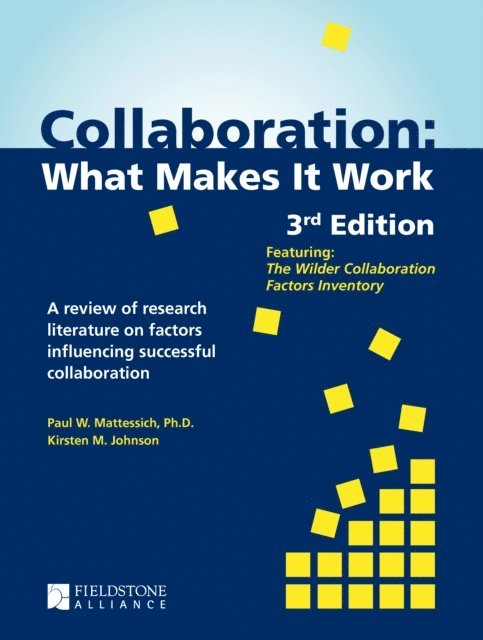
    Collaboration

    What Makes It Work

    AvPaul W. Mattessich,Kirsten M. Johnson

    Inbunden, Engelska, 2018

    351 kr

    Beställningsvara. Skickas inom 5-8 vardagar. Fri frakt över 249 kr.

    Fler format och utgåvor

    E-bok

    375 kr

    Häftad

    305 kr

    Beskrivning

    This third edition of Collaboration: What Makes It Work—written nearly 25 years after the first edition was published—is an example of the enduring importance of collaboration.Reaction to the first edition, published in 1992, showed that researchers and practitioners alike found it a useful tool. They appreciated its emphasis on providing a practical reference for decision-making that built upon credible, research-based information. The 21st century has brought with it rapid changes and increasingly complex challenges. This third edition in large part responds to the complexity witnessed daily in the authors' work with community, nonprofit, and government organizations. It offers new research and insights paired with practitioner wisdom, adding a “how-to” perspective to help readers put the success factors to work. Nearly 25 years after the first edition was published, it is not just the "how" of collaboration that has changed—who we are collaborating with has changed as well. Today, nearly every collaboration involves some degree of working across difference. Bringing together diverse people, organizations, or sectors in a way that will foster collaborative success requires a unique set of skills.This third edition will ground you in the factors that support successful collaboration and assist you in incorporating those factors into your work.

    Produktinformation

    • Utgivningsdatum:2018-08-09
    • Mått:216 x 279 x 15 mm
    • Vikt:586 g
    • Format:Inbunden
    • Språk:Engelska
    • Antal sidor:104
    • Upplaga:3
    • Förlag:Turner Publishing Company
    • ISBN:9781683367925

    Utforska kategorier

    • Organisation och ägarskap inom Ekonomi och Ledarskap
    • Karriärplanering inom Ekonomi och Ledarskap

    Mer om författaren

    PAUL W. MATTESSICH, Ph.D., is Executive Director of Wilder Research, which dedicates itself to improving the lives of individuals, families, and communities through applied research. Mattessich has assisted local, national, and international organizations with strategic planning, organizational improvement, and evaluation. He travels regularly to Northern Ireland and the United Kingdom, where he learns from, and consults with, organizations addressing youth development, community development, and the promotion of peace and acceptance of diversity among groups from divided communities. Mattessich has been involved in applied social research since 1973 and is the author or coauthor of more than three hundred publications and reports. He has also served on a variety of task forces in government and the nonprofit sectors. He received his Ph.D. in sociology from the University of Minnesota, where he currently serves as an adjunct faculty in the School of Social Work. KIRSTEN M. JOHNSON is the Director of Community Engagement and Systems Change at the Amherst H. Wilder Foundation where she manages a portfolio of community-driven projects aimed at creating equity. Johnson’s work focuses on engagement, collaboration, and systems change addressing complex challenges impacting the communities that Wilder serves. Johnson brings the lenses of emotional intelligence, intercultural competence, and network weaving to all of her work. Johnson studied Political Science and Women’s Studies at the University of Minnesota and has worked in the nonprofit sector on collaboration and community development for over fifteen years. Prior to coming to the Wilder Foundation, Johnson’s work supported a variety of nonprofit organizations including the StreetWorks Collaborative, VEAP, and Arc Greater Twin Cities.

    Innehållsförteckning

    • About the Authors AcknowledgmentsPreface to the Third EditionWhat's New in the Third Edition?Goals of This BookChapter 1: Collaboration: An Effective Way to Work"Collective Impact" = or = Collaboration?Addressing Key QuestionsWorking DefinitionsA Theoretical Basis for CollaborationHow to Use This BookChapter 2: The Twenty-Two Success Factors Factors Related to the ENVIRONMENTFactors Related to MEMBERSHIP CHARACTERISTICSFactors Related to PROCESS AND STRUCTUREFactors Related to COMMUNICATIONFactors Related to PURPOSEChapter 3: Understanding the FactorsFactors Related to the ENVIRONMENTFactors Related to MEMBERSHIP CHARACTERISTICSFactors Related to PROCESS AND STRUCTUREFactors Related to COMMUNICATIONFactors Related to PURPOSEFactors Related to RESOURCESChapter 4: Putting the Factors to WorkFactors Related to RESOURCESFactors Related to PURPOSEFactors Related to COMMUNICATIONFactors Related to PROCESS and STRUCTUREFactors Related to MEMBERSHIP CHARACTERISTICSFactors Related to the ENVIRONMENTAn Important Question: When Should Organizations Collaborate?Chapter 5: Collaborating Across DifferenceUnderstanding CultureNavigating Power DynamicsAvoiding Tokenism and BrownwashingEquitably Collaborating Across Differences in Organizational SizeCollaborating Across SectorsChapter 6: Examining Your Own Collaborative ProjectThe Wilder Collaboration Factors InventorySuggested Uses for The Wilder Collaboration Factors InventoryA Case Example: Using The Wilder Collaboration Factors InventoryChapter 7: Summary and ConclusionsWhat We Have LearnedUsing the InformationTo the FutureAppendix A: Definition of CollaborationAppendix B: Methodology1. Identification and Assessment of Research Studies2. Systematic Codification of Findings from Each Study3. Synthesis of Findings from Individual StudiesAppendix C: Collaborating Across Difference—Our ProcessAppendix D: Author Factor MatrixAppendix E: Reflection Questions1. History of collaboration or cooperation in the community2. Collaborative group seen as a legitimate leader in the community3. Favorable political and social climate4. Mutual respect, understanding, and trust5. Appropriate cross section of members6. Members see collaboration as being in their self-interest7. Ability to compromise8. Members share a stake in both process and outcome9. Multiple layers of participation10. Flexibility11. Development of clear roles and guidelines12. Adaptability to changing conditions13. Appropriate pace of development14. Evaluation and continuous learning15. Open and frequent communication16. Established informal relationships and communication links17. Concrete, attainable goals and objectives18. Shared vision19. Unique purpose20. Sufficient funds, staff, materials, and time21. Skilled leadership22. Engaged stakeholdersBibliography