• Fri frakt över 249 kr
  • •
  • Snabba leveranser
  • •
  • Billiga böcker
Kundservice

Du är på sajten för privatpersoner.

Företag, bibliotek eller offentlig verksamhet?

Du handlar på classic.bokus.com, där alla dina funktioner finns intakta.
Till classic.bokus.com
Bokus logotyp. Gå till startsidan.
  • Erbjudanden
  • Nyheter
  • Student
  • Topplistor
  • Barn & ungdom
  • Bokus Play
  • E-böcker
  • Pocketböcker
  • Spel & pussel

10% rabatt på allt med kod NYSTART10 →

Sidfot

Mina sidor

    Hjälp

    • Kundservice
    • Vanliga frågor och svar
    • Frakt och leverans
    • Retur vid ångerrätt
    • Reklamera vara
    • Betalning
    • Köpvillkor
    • Allmänna villkor
    • Information om webbplatsens tillgänglighet

    Om Bokus

    • Om oss
    • Pressrum
    • För studenter
    • För företag
    • För bibliotek och offentlig verksamhet
    • För leverantörer
    • Hållbarhet

    Populärt

    • Aktuella erbjudanden
    • Presentkort
    • Studentlitteratur
    • Nya böcker
    • Topplistor
    • Signerade böcker
    • Engelska böcker

    Inspiration

    • Boktips
    • BookTok
    • Populära bokserier
    • Barnbokskaraktärer
    • Populära författare
    Logotyp för Bokus
    Följ oss på Facebook (extern länk)Följ oss på Instagram (extern länk)Följ oss på YouTube (extern länk)Följ oss på TikTok (extern länk)
    bokus @ CookiesAnpassa cookiesIntegritetspolicyKöpvillkor
    Till Citymail hemsida (extern länk)Till Budbee hemsida (extern länk)Till Postnord hemsida (extern länk)Till Schenker hemsida (extern länk)Till Early Bird hemsida (extern länk)Till Walleys hemsida (extern länk)
    1. Medicin
    2. Medicin: icke kliniska discipliner
    3. Fysiologi

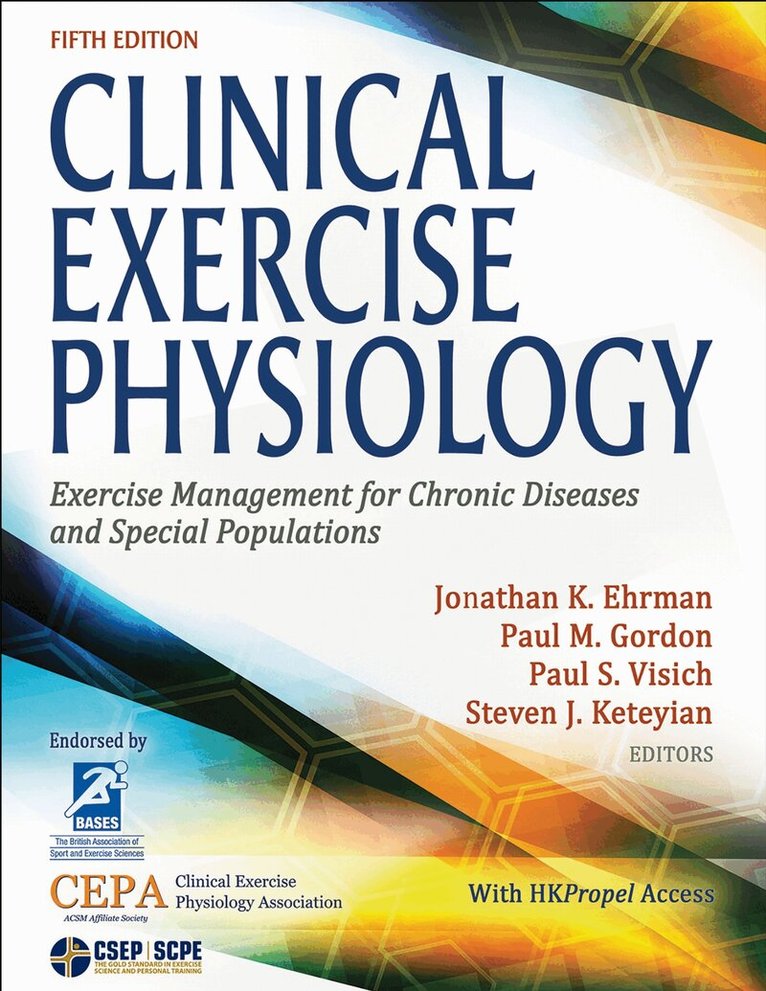
    Clinical Exercise Physiology

    Exercise Management for Chronic Diseases and Special Populations

    AvJonathan K. Ehrman,Paul Gordon

    Häftad, Engelska, 2022

    1 389 kr

    Beställningsvara. Skickas inom 5-8 vardagar. Fri frakt över 249 kr.

    Beskrivning

    Clinical Exercise Physiology, Fifth Edition With HKPropel Access, is a comprehensive guide to the clinical aspects of exercise physiology, investigating 24 chronic diseases and conditions and addressing a variety of populations. The text has been a mainstay in the field since its inception in 2003 and is an ideal resource for students preparing for clinical exercise certifications, including those offered by the American College of Sports Medicine (ACSM-CEP), American Council on Exercise (Medical Exercise Specialist), Canadian Society for Exercise Physiology (CSEP-CEP), and Exercise & Sports Science Australia (ESSA-AEP).Clinical Exercise Physiology, Fifth Edition, employs a logical progression of content to provide greater coverage and depth of diseases than is typically found in most clinical exercise physiology textbooks. It examines the effects of exercise on 24 chronic conditions, with each chapter covering the epidemiology, pathophysiology, clinical considerations, drug and surgical therapies, and exercise testing and prescription issues for the chronic condition. Other chapters are devoted to examining exercise-related issues for four special populations.Each chapter in this fifth edition is revised and updated to include the latest research, clinical guidelines, and position statements from professional organizations. In addition, it incorporates the following new elements:An upgrade to a full-color layout, for a more engaging learning experience and enhanced presentation of dataNew Clinical Exercise Bottom Line sidebars that highlight key information a clinical exercise physiologist needs when working with clinical populationsA new chapter on clinical exercise programming that offers detailed recommendations for clinical populationsA completely rewritten chapter on spinal cord injury and updates throughout each chapter to reflect the most up-to-date guidelines and position statementsExpanded coverage of clinical exercise physiology certification optionsIn addition to practical application sidebars throughout the text, the fifth edition also has related online tools to support student learning. Delivered through HKPropel, more than 60 case studies are presented in a SOAP note format so students can explore clinical evaluations, looking closely at subjective and objective data, assessments, and plans. Discussion questions and interactive key term flash cards foster better understanding and retention, while chapter quizzes can be assigned by instructors through the platform to assess student comprehension.Endorsed by the Clinical Exercise Physiology Association (CEPA), the Canadian Society for Exercise Physiology (CSEP), the British Association of Sport and Exercise Sciences (BASES),and Exercise & Sports Science Australia (ESSA), Clinical Exercise Physiology, Fifth Edition, offers a contemporary review of the variety of diseases and conditions that students and professionals may encounter in the field. New and veteran clinical exercise physiologists, as well as those preparing for clinical exercise certification exams, will appreciate the in-depth coverage of the clinical populations that benefit from physical activity.Note: A code for accessing HKPropel is included with this ebook.

    Produktinformation

    • Utgivningsdatum:2022-04-21
    • Mått:216 x 279 x 34 mm
    • Vikt:1 746 g
    • Format:Häftad
    • Språk:Engelska
    • Antal sidor:656
    • Upplaga:5
    • Förlag:Human Kinetics Publishers
    • ISBN:9781718200449

    Utforska kategorier

    • Fysiologi inom Medicin
    • Anatomi inom Medicin
    • Människans biologi inom Naturvetenskap och teknik

    Mer om författaren

    Jonathan K. Ehrman, PhD, is the associate program director of preventive cardiology at Henry Ford Hospital in Detroit, where he also serves as chair of the institutional review board. He has a 36-year background in clinical exercise physiology and is certified by the American College of Sports Medicine (ACSM) as a clinical exercise physiologist and as a program director. He previously served as the chair of the clinical exercise physiologist credentialing committee for ACSM.Dr. Ehrman is the author of more than 200 manuscripts and abstracts as well as several textbooks and chapters. He currently serves as editor in chief of the Journal of Clinical Exercise Physiology and was an associate editor of the 10th edition of ACSM’s Guidelines for Exercise Testing and Prescription. He is also the coeditor of the sixth edition of the American Association of Cardiovascular and Pulmonary Rehabilitation’s Guidelines for Cardiac Rehabilitation Programs. He is a fellow of ACSM and the American Association of Cardiovascular and Pulmonary Rehabilitation and is a member of the American Heart Association and the American College of Cardiology. Dr. Ehrman earned his PhD in clinical exercise physiology from The Ohio State University.Paul M. Gordon, PhD, MPH, is a professor and head of the department of health, human performance, and recreation at Baylor University. He is certified by the American College of Sports Medicine (ACSM) as a clinical exercise physiologist and has over 20 years of experience teaching clinical exercise physiology curricula and directing cardiopulmonary rehabilitation programs. Gordon’s areas of expertise include physical activity and lifestyle-based research related to obesity and its comorbidities across the life span. He has published more than 200 papers and abstracts as well as several chapters, including contributions to ACSM’s Guidelines for Exercise Testing and Prescription. He has also served as an examiner and coordinator for ACSM certification and credentialing.Dr. Gordon is a fellow of ACSM, the Obesity Society, and the Centers for Disease Control Physical Activity Research Program. He is an international member of the Royal Society of Medicine. He earned his PhD in exercise physiology and an MPH in epidemiology from the University of Pittsburgh.Paul S. Visich, PhD, MPH, is a professor and chair of the exercise and sports performance department at the University of New England. He has over 20 years of experience in clinical exercise physiology and previously served as director of the Human Performance Laboratory in the College of Health Professions at Central Michigan University. He worked for 12 years in a clinical setting that included cardiac and pulmonary rehabilitation and primary disease prevention. His research interests involve the assessment of cardiovascular disease risk factors in children, the influence of resistance training in elderly populations, and altitude physiology.Dr. Visich previously served as a member of the American College of Sport Medicine (ACSM) exercise physiology credentialing committee and as chair of their professional education committee. He is the author of more than 70 published scientific articles and abstracts. He earned a PhD in exercise physiology and an MPH in epidemiology from the University of Pittsburgh.Steven J. Keteyian, PhD, has more than 40 years of experience working as a clinical exercise physiologist. He is program director of preventive cardiology at the Henry Ford Hospital in Detroit. He is also an adjunct professor in the department of physiology at Wayne State University in Detroit. Over the course of his career, Dr. Keteyian has focused on exercise and physical activity in both healthy individuals and those with chronic diseases. He is the author of more than 250 scientific articles and book chapters, as well as four textbooks, and he previously served as editor in chief for ACSM's Health & Fitness Journal.Dr. Keteyian is a member of the American Association of Cardiovascular and Pulmonary Rehabilitation and the American Heart Association. He earned his PhD from Wayne State University in Detroit.

    Recensioner i media

    “The fifth edition of Clinical Exercise Physiology is the ideal resource for students, clinicians, and researchers. With the growth and advancement of the profession, it is paramount for clinical exercise physiologists to remain up to date with the vast array of health conditions and special considerations needed for quality patient care. The text illustrates evidence-based guidelines, normal and abnormal responses to physical activity, assessments, exercise prescriptions, and clinical case studies. The information is comprehensive, and the text is a much-needed key resource for safe and effective implementation of clinical exercise physiology.”-Laura A. Richardson, PhD, RCEP, FACSM, Past President of the Clinical Exercise Physiology Association (CEPA)“Clinical Exercise Physiology, Fifth Edition, is a valuable resource for candidates pursuing the CSEP Clinical Exercise Physiologist™ certification. It provides scientific, evidence-based information that ensures clinical exercise physiologists have the knowledge they need to understand and treat common clinical issues with exercise.”-Kirstin Lane, PhD, CSEP-CEP“The Clinical Exercise Physiology text is essential for any student worldwide looking for a career as an accredited exercise physiologist. It has the latest evidence regarding the effects of exercise on chronic diseases. The breadth and depth of the text ensure exercise physiologists have the core knowledge required to treat most conditions practitioners will encounter in the real world.”-Anita Hobson-Powell, former Chief Executive Officer of Exercise & Sports Science Australia (ESSA)“Clinical Exercise Physiology, Fifth Edition, is a comprehensive guide to the clinical aspects of exercise physiology. It is a great resource for students as well as for U.K. clinical exercise physiologists registered by the Registration Council for Clinical Physiologists(RCCP).”-Ian Wilson, Executive Director of the British Association of Sport and Exercise Sciences (BASES)“This comprehensive, insightful, and evidence-based guide for the assessment and management of chronic diseases is perfectly suitable for the training or continuous professional development of a biokineticist.”-Jacolene Kroff, Director of Education and Training for the Biokinetics Association of South Africa“Clinical Exercise Physiology, Fifth Edition, is a thorough guide and great resource for students working towards accreditation as Accredited Exercise Physiologist (AEP) with Sport and Exercise Science New Zealand (SESNZ).”-Glynis Longhurst, Accredited Exercise Physiologist (AEP) and academic committee member, of Sport & Exercise Science New Zealand (SESNZ)“Both students and instructors are exposed to actual case studies, meaningful discussions, and up-to-date information that provides the knowledge and skills assessed in the ACSM clinical exercise physiologist examination.”-© Doody’s Review Service, 2023, Zacharias Papadakis, PhD, Barry University (4-star review)

    Innehållsförteckning

    • Part I. Introduction to Clinical Exercise PhysiologyChapter 1. The Profession of Clinical Exercise PhysiologyJonathan K. Ehrman, PhD, Paul M. Gordon, PhD, MPH, Paul S. Visich, PhD, MPH, and Steven J. Keteyian, PhDThe Past, Present, and Future of Clinical Exercise PhysiologyProfessional Organizations and Certifications Throughout the WorldProfessionalization of Clinical Exercise PhysiologyConclusionChapter 2. Promoting a Physically Active LifestyleAnna G. Beaudry, BS, Danielle A. Young, PsyD, and Annie T. Ginty, PhDBenefits of Physical ActivityParticipation in Regular Physical ActivityConclusionChapter 3. General Principles of PharmacologySteven J. Keteyian, PhDGeneral Properties of DrugsRoutes of AdministrationPhases of Drug EffectMechanism of ActionPharmacotherapyConclusionChapter 4. General Interview and Examination SkillsLizbeth R. Brice, MDGeneral InterviewPhysical ExaminationConclusionChapter 5. Graded Exercise TestingSteven J. Keteyian, PhDIndicationsContraindicationsProcedures for Preparing, Conducting, and Interpreting a Graded Exercise TestGraded Exercise Testing With Diagnostic ImagingConclusionChapter 6. Exercise PrescriptionSteven J. Keteyian, PhDExercise Training SequenceGoal SettingPrinciples of Exercise PrescriptionCardiorespiratory EnduranceSkeletal Muscle Strength and EnduranceFlexibility TrainingConclusionChapter 7. Clinical Exercise ProgrammingJonathan K. Ehrman, PhDCardiac RehabilitationPulmonary RehabilitationSupervised Exercise Therapy for Patients With Peripheral Artery DiseaseCancer RehabilitationRenal RehabilitationGeneral Exercise Programs for Patients With Chronic DiseaseConclusionPart II. Diseases of the Endocrine System and Metabolic DisordersChapter 8. DiabetesSheri R. Colberg, PhDDefinitionScopePathophysiologyClinical ConsiderationsExercise PrescriptionExercise TrainingConclusionChapter 9. ObesityDavid C. Murdy, MD, Dennis J. Kerrigan, PhD, and Jonathan K. Ehrman, PhDDefinitionScopePathophysiologyClinical ConsiderationsExercise PrescriptionExercise TrainingConclusionChapter 10. HypertensionYin Wu, PhD, and Linda S. Pescatello, PhDDefinitionScopePathophysiologyClinical ConsiderationsExercise PrescriptionExercise TrainingConclusionChapter 11. Hyperlipidemia and DyslipidemiaPaul G. Davis, PhD, Peter W. Grandjean, PhD, Stephen F. Crouse, PhD, and J. Larry Durstine, PhDDefinitionScopePathophysiologyClinical ConsiderationsExercise PrescriptionExercise TrainingConclusionChapter 12. Metabolic SyndromeJames R. Churilla, PhD, MPH, MSDefinitionScopePathophysiologyClinical ConsiderationsExercise PrescriptionExercise TrainingConclusionChapter 13. Chronic Kidney DiseaseSamuel Headley, PhD, Kenneth Wilund, PhD, and Michael Germain, MDDefinitionScopePathophysiologyClinical ConsiderationsExercise PrescriptionExercise TrainingConclusionPart III. Diseases of the Cardiovascular SystemChapter 14. Acute Coronary SyndromesRay W. Squires, PhDPathophysiologyClinical AssessmentExercise Training: Inpatient Cardiac RehabilitationExercise Training: Early Outpatient Cardiac RehabilitationExercise PrescriptionConclusionChapter 15. Revascularization of the HeartNeil A. Smart, PhDDefinitionScopePathophysiologyClinical ConsiderationsExercise Prescription and TrainingConclusionChapter 16. Chronic Heart FailureSteven J. Keteyian, PhDDefinitionScopePathophysiologyClinical ConsiderationsExercise PrescriptionExercise TrainingConclusionChapter 17. Peripheral Artery DiseaseRyan J. Mays, PhD, MPH, Ivan P. Casserly, MB, BCh, and Judith G. Regensteiner, PhDDefinitionScopePathophysiologyClinical ConsiderationsExercise PrescriptionExercise TrainingConclusionChapter 18. Cardiac Electrical PathophysiologyKerry J. Stewart, EdD, and David D. Spragg, MDDefinitionScopePathophysiologyClinical ConsiderationsExercise Prescription and TrainingConclusionPart IV. Diseases of the Respiratory SystemChapter 19. Chronic Obstructive Pulmonary DiseaseSatvir S. Dhillon, MSc, Dennis Jensen, PhD, and Jordan A. Guenette, PhDDefinitionScopePathophysiologyClinical ConsiderationsExercise PrescriptionExercise TrainingConclusionChapter 20. AsthmaLouis-Philippe Boulet, MD, Simon Bacon, PhD, and AndrÉanne CÔtÉ, MDDefinitionScopePathophysiologyClinical ConsiderationsExercise PrescriptionExercise TrainingConclusionChapter 21. Cystic FibrosisKelley Crawford, DPT, CCSDefinitionScopePathophysiologyClinical ConsiderationsExercise PrescriptionExercise TrainingConclusionPart V. Diseases of the Immune System and OncologyChapter 22. CancerDennis J. Kerrigan, PhD, and Karen Wonders, PhDDefinitionScopePathophysiologyClinical ConsiderationsExercise PrescriptionExercise TrainingConclusionChapter 23. Human Immunodeficiency VirusVitor H.F. Oliveira, PhD, MS, Christine Horvat Davey, PhD, RN, and Allison R. Webel, PhD, RNDefinitionScopePathophysiologyClinical ConsiderationsExercise PrescriptionExercise TrainingConclusionPart VI. Disorders of the Bones and JointsChapter 24. ArthritisMelissa Nayak, MD, and Andrew K. Cunningham, MDDefinitionScopePathophysiologyClinical ConsiderationsExercise PrescriptionExercise TrainingConclusionChapter 25. OsteoporosisLora M. Giangregorio, PhDDefinitionScopePathophysiologyClinical ConsiderationsExercise PrescriptionExercise TrainingConclusionChapter 26. Nonspecific Low Back PainPeter Ronai, MSDefinitionScopePathophysiologyClinical ConsiderationsExercise Prescription and TrainingConclusionPart VII. Disorders of the Neuromuscular SystemChapter 27. Spinal Cord InjurySean M. Tweedy, PhD, Emma M. Beckman, PhD, Mark J. Connick, PhD, Anne L. Hart, PhD, Kati Karinharju, PhD, Kelly M. Clanchy, PhD, and Timothy Geraghty, FAFRM (RACP)DefinitionScopePathophysiologyClinical ConsiderationsExercise PrescriptionExercise TrainingConclusionChapter 28. Multiple SclerosisUlrik Dalgas, PhD, and Lars G. Hvid, PhDDefinitionScopePathophysiologyClinical ConsiderationsExercise PrescriptionExercise TrainingConclusionChapter 29. Cerebral PalsyDÉsirÉe B. Maltais, PT, PhDDefinitionScopePathophysiologyClinical ConsiderationsExercise PrescriptionExercise TrainingConclusionChapter 30. StrokeChristopher J. Womack, PhDDefinitionScopePathophysiologyClinical ConsiderationsExercise PrescriptionConclusionChapter 31. Parkinson’s DiseaseAngela L. Ridgel, PhD, and Brandon S. Pollock, PhDDefinitionScopePathophysiologyClinical ConsiderationsExercise PrescriptionExercise TrainingConclusionPart VIII. Special PopulationsChapter 32. ChildrenTimothy J. Michael, PhD, and Carol Weideman, PhDDefinitionScopeClinical ConsiderationsExercise PrescriptionExercise TrainingConclusionChapter 33. Older AdultsJerome L. Fleg, MD, and Daniel E. Forman, MDDefinitionScopePathophysiologyClinical ConsiderationsExercise Prescription and TrainingConclusionChapter 34. DepressionGrace M. McKeon, PhD Candidate, and Simon Rosenbaum, PhDDefinitionScopePathophysiologyClinical ConsiderationsExercise Prescription and TrainingConclusionChapter 35. Intellectual DisabilityTracy Baynard, PhD, and Bo Fernhall, PhDDefinitionScopePathophysiologyClinical ConsiderationsExercise PrescriptionExercise TrainingConclusion