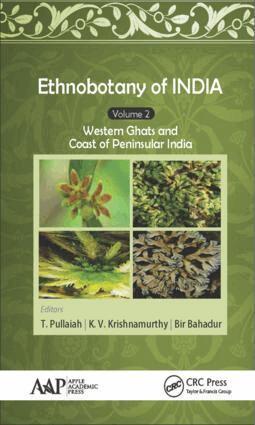
Inbunden, Engelska, 2016
Ethnobotany of India, Volume 2
Western Ghats and West Coast of Peninsular India
Av T. Pullaiah, K. V. Krishnamurthy, Bir Bahadur
Del i serien Ethnobotany of India
1509 kr
Beställningsvara. Skickas inom 7-10 vardagar. Fri frakt över 249 kr.
Beskrivning
Produktinformation
- Utgivningsdatum: 2016-11-28
- Mått: 156 x 234 x undefined mm
- Vikt: 848 g
- Format: Inbunden
- Språk: Engelska
- Serie: Ethnobotany of India
- Antal sidor: 368
- Förlag: Apple Academic Press Inc.
- ISBN: 9781771884044
Utforska kategorier
Mer om författaren
T. Pullaiah, K. V. Krishnamurthy, Bir Bahadur
Recensioner i media
"This volume will serve as a pragmatic and authoritative reference for conservationists and pharmacologists working in India. . . . Readers will also find it credible as a de facto gap and trend analysis for ethnobotanical studies in the Western Ghats. . . . Over the past two decades, there has been an exponential increase in ethnobotanical studies throughout South Asia. Often published in local journals or by independent presses, however, their findings rarely receive the attention needed to drive both innovation and policy. The five-volume Ethnobotany of India series addresses this by extensively reviewing plant resources from the subcontinent. Volume 2 focuses on ethnobotanical knowledge from the Western Ghats and West Coast of Peninsular India, providing not only historical context but also ethnographic insight into the region. The Western Ghats are one of Earth’s most breathtaking biocultural hotspots. Extending south from the humid metropolis of Mumbai through the western tip of Peninsular India, their rolling hills house diverse communities that have (re)shaped each other through time. Volume 2 presents these dynamics in 13 curated chapters structured around standard ethnobotanical tables. However, it is unique in that it supplements them with additional information on global processes, including historical trade in the Arabian Sea. Other chapters shed light on the value of place when assessing plant use and management. Of note, a section on sacred forests highlights mores that may promote community-based conservation of medicinal plants. . . . "—Economic Botany, reviewed by Alexander R. O’Neill, Duke University, Durham, NC, USA
Betyg & recensioner
0 recensioner
Inga recensioner tillgängliga.