• Fri frakt över 249 kr
  • •
  • Snabba leveranser
  • •
  • Billiga böcker
Kundservice

Du är på sajten för privatpersoner.

Företag, bibliotek eller offentlig verksamhet?

Du handlar på classic.bokus.com, där alla dina funktioner finns intakta.
Till classic.bokus.com
Bokus logotyp. Gå till startsidan.
  • Erbjudanden
  • Nyheter
  • Student
  • Topplistor
  • Barn & ungdom
  • Bokus Play
  • E-böcker
  • Pocketböcker
  • Spel & pussel

10% rabatt på allt med kod NYSTART10 →

Sidfot

Mina sidor

    Hjälp

    • Kundservice
    • Vanliga frågor och svar
    • Frakt och leverans
    • Retur vid ångerrätt
    • Reklamera vara
    • Betalning
    • Köpvillkor
    • Allmänna villkor
    • Information om webbplatsens tillgänglighet

    Om Bokus

    • Om oss
    • Pressrum
    • För studenter
    • För företag
    • För bibliotek och offentlig verksamhet
    • För leverantörer
    • Hållbarhet

    Populärt

    • Aktuella erbjudanden
    • Presentkort
    • Studentlitteratur
    • Nya böcker
    • Topplistor
    • Signerade böcker
    • Engelska böcker

    Inspiration

    • Boktips
    • BookTok
    • Populära bokserier
    • Barnbokskaraktärer
    • Populära författare
    Logotyp för Bokus
    Följ oss på Facebook (extern länk)Följ oss på Instagram (extern länk)Följ oss på YouTube (extern länk)Följ oss på TikTok (extern länk)
    bokus @ CookiesAnpassa cookiesIntegritetspolicyKöpvillkor
    Till Citymail hemsida (extern länk)Till Budbee hemsida (extern länk)Till Postnord hemsida (extern länk)Till Schenker hemsida (extern länk)Till Early Bird hemsida (extern länk)Till Walleys hemsida (extern länk)
    1. Psykologi och pedagogik
    2. Psykologi
    3. Psykologiska teorier och skolor
    4. Freudiansk psykologi

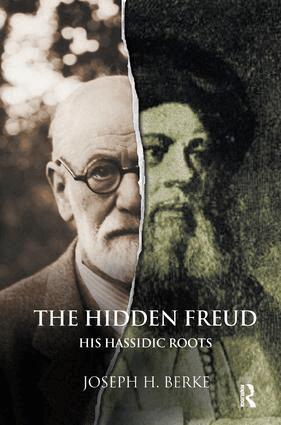
    Hidden Freud

    His Hassidic Roots

    AvJoseph H. Berke

    Häftad, Engelska, 2015

    539 kr

    Beställningsvara. Skickas inom 10-15 vardagar. Fri frakt över 249 kr.

    Fler format och utgåvor

    Inbunden

    2 355 kr

    E-bok

    654 kr

    E-bok

    654 kr

    Beskrivning

    This book explores Sigmund Freud and his Jewish roots and demonstrates the input of the Jewish mystical tradition into Western culture via psychoanalysis. It shows in particular how the ideas of Kabbalah and Hassidism have profoundly influenced and enriched our understanding of mental processes and clinical practices. Freud's own ancestors were hassidim going back many generations, and the book examines how this background influenced both his life and his work. It also shows how he struggled to deny these roots in order to be accepted as a secular, German professional, and at the same time how he used them in the development of his ideas about dreaming, sexuality, depression and mental structures as well as healing practices. The book argues that in many important respects psychoanalysis can be seen as a secular extension of Kabbalah.The author shows, for example, how Freud utilized the Jewish mystical tradition to develop a science of subjectivity. This involved the systematic exploration of human experience, uncovering the secret compartments and deepest levels of the mind (such as the preconscious and unconscious methods of thinking), expanding human consciousness beyond 'objective' reality, and the revelation of hidden, unconscious thought processes by free association and dream analysis (all linked to kabbalistic modalities such as 'skipping and jumping'). The book also explores the close connections between psychoanalysis, quantum physics, and Kabbalah.The Hidden Freud: His Hassidic Roots also uses the meetings that took place in 1903 between Freud and the great hassidic leader, the fifth Lubavitcher Rebbe, the Rebbe Rashab, as a point of departure to consider Freud's Jewish identity. While Freud may have felt himself to be "completely estranged from the religion of his fathers" he still remained a man who "never repudiated his people, who felt that he was in his essential nature a Jew, and who had no desire to alter that nature", as so many of his colleagues had done. Freud lived the life of a secular, sceptical Jewish intellectual. This was his revealed persona. But there was another, concealed Freud, who revelled in his meetings with the Rebbe, Kabbalists and Jewish scholars; who kept books on Jewish mysticism in his library; and who chose to die on Yom Kippur, 1939, the Day of Atonement. This book considers the implications of the 'concealed Freud' on his life and work.

    Produktinformation

    • Utgivningsdatum:2015-06-17
    • Mått:147 x 230 x 19 mm
    • Vikt:362 g
    • Format:Häftad
    • Språk:Engelska
    • Antal sidor:250
    • Förlag:Taylor & Francis Ltd
    • ISBN:9781780490311

    Utforska kategorier

    • Freudiansk psykologi inom Psykologi och pedagogik

    Mer om författaren

    Joseph H. Berke is a psychoanalytic psychotherapist working with individuals and families. He is a lecturer, writer and teacher and has lived in London since 1965. Beforehand he attended Columbia College of Columbia University and graduated from the Albert Einstein College of Medicine of Yeshiva University in New York. Dr Berke moved to London to study with R.D. Laing and assisted in establishing the Kingsley Hall Community. There he helped Mary Barnes, a middle-aged nurse who had been diagnosed with schizophrenia, to pass through a severe regression. Barnes later became a noted artist, writer and mystic. The book which Barnes and Berke co-authored ('Mary Barnes: Two Accounts of a Journey Through Madness') was adapted as a stage play and has been performed in many countries. It has now been optioned as a feature film. Dr Berke and colleagues founded the Arbours Housing Association in London in order provide personal, psychotherapeutic care and shelter for people in emotional distress. Later he founded and was the director of the Arbours Crisis Centre. He is the author of many papers and books on psychotherapy, social psychiatry, psychosis, therapeutic communities and transpersonal psychology as well as on Kabbalah and Hassidism.

    Recensioner i media

    'This is a virtuoso performance that consults obscure texts, and re-reads familiar ones. That the practice of psychoanalysis may resemble the mystical contemplations of the religious does not diminish psychoanalysis, nor idolise mysticism. It merely locates important developments in our culture within their proper contexts. But it is the living history of the way our cultural ideas and attitudes grow and bear fruit. This is a book that searches at the heart of the fruitfulness of psychoanalysis.'- Professor R. D. Hinshelwood, University of Essex'The relationship between psychoanalysis and Judaism has long been a topic of controversy. Freud was an atheist and rationalist, yet clearly maintained his Jewish identity. In this ground-breaking book, Joseph Berke retraces the paradoxical visions of Freud and other psychoanalysts, to show how closely their perspectives relate to Jewish mystical concepts. Dr Berke demonstrates both the striking parallels between psychoanalysis and the Jewish mystical tradition, and how each contributes to a psychological and spiritual process of reparation and healing.'- Stephen Frosh, Professor of Psychology, Birkbeck, University of London'A thrilling work uniting rigorous scholarship with profound care and devotion. It compellingly investigates the intertwining of Jewish mysticism and psychoanalysis. Berke adroitly examines Freud's life and relationships, and not only exhumes but brings to life a profound creative spirit. The Freud you meet here is not the Freud you might expect from watered down caricatures. What he tapped was too alive and real to fit into neat borders.'- Michael Eigen, PhD, author of Kabbalah and Psychoanalysis, The Psychoanalytic Mystic, and Faith'Joseph Berke demonstrates brilliant insights into the depth of the human psyche, as well as the teachings of Chassidism and Kabbalah. This remarkable book helps one to appreciate the reach of Chassidism into general culture during the 20th Century.'- Rabbi Shmuel Lew, Principal, Lubavitch Senior Girls' School, London'This book offers a fascinating and thought-provoking tour through Freud's Hassidic ancestry and an extraordinary but plausible discussion of his death on the Day of Atonement. It offers important challenges to overly simple perspectives on Freud's relationship with his Jewishness and his spirituality.'- Kate Miriam Loewenthal, Professor Emeritus, Royal Holloway, University of London'In this highly original book psychotherapy and cultural commentary overlap, as Berke discloses Freud's carefully hidden Jewish self. This is not just a book about Freud, but also a subtle disclosure of the self-deceptions at the heart of western culture.'- Naftali Loewenthal, Director, Chabad Research Unit; Adjunct Lecturer in Jewish Spirituality, Dept of Hebrew and Jewish Studies, University College London

    Innehållsförteckning

    • Introduction -- Sigmund Freud and the Rebbe Rashab -- A tale of two orphans -- The Jewish mystical traditions -- Bion and Kabbalah -- On the nature of the self: and its relationship with the soul -- On the nature of the soul: and its relationship with the self -- The replacement child -- Sigmund Freud and Rabbi Safran -- On opposites -- Lowness of spirit -- Reparation -- Atonement -- Epilogue