• Fri frakt över 249 kr
  • •
  • Snabba leveranser
  • •
  • Billiga böcker
Kundservice

Du är på sajten för privatpersoner.

Företag, bibliotek eller offentlig verksamhet?

Du handlar på classic.bokus.com, där alla dina funktioner finns intakta.
Till classic.bokus.com
Bokus logotyp. Gå till startsidan.
  • Erbjudanden
  • Nyheter
  • Student
  • Topplistor
  • Barn & ungdom
  • Bokus Play
  • E-böcker
  • Pocketböcker
  • Spel & pussel

Må bättre, för mindre! Upp till 50% rabatt på hälsoböcker

Sidfot

Mina sidor

    Hjälp

    • Kundservice
    • Vanliga frågor och svar
    • Frakt och leverans
    • Retur vid ångerrätt
    • Reklamera vara
    • Betalning
    • Köpvillkor
    • Allmänna villkor
    • Information om webbplatsens tillgänglighet

    Om Bokus

    • Om oss
    • Pressrum
    • För studenter
    • För företag
    • För bibliotek och offentlig verksamhet
    • För leverantörer
    • Hållbarhet

    Populärt

    • Aktuella erbjudanden
    • Presentkort
    • Studentlitteratur
    • Nya böcker
    • Topplistor
    • Signerade böcker
    • Engelska böcker

    Inspiration

    • Boktips
    • BookTok
    • Populära bokserier
    • Barnbokskaraktärer
    • Populära författare
    Logotyp för Bokus
    Följ oss på Facebook (extern länk)Följ oss på Instagram (extern länk)Följ oss på YouTube (extern länk)Följ oss på TikTok (extern länk)
    bokus @ CookiesAnpassa cookiesIntegritetspolicyKöpvillkor
    Till Citymail hemsida (extern länk)Till Budbee hemsida (extern länk)Till Postnord hemsida (extern länk)Till Schenker hemsida (extern länk)Till Early Bird hemsida (extern länk)Till Walleys hemsida (extern länk)
    1. Juridik
    2. Särskilda rättsområden
    3. Miljö-, transport- och planeringsrätt
    4. Miljörätt

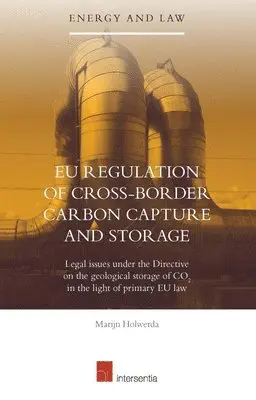
    EU Regulation of Cross-Border Carbon Capture and Storage

    Legal Issues Under the Directive on the Geological Storage of CO2 in the Light of Primary EU Law

    AvMarijn Holwerda

    Häftad, Engelska, 2013

    Del 14 i serien Energy and Law

    2 155 kr

    Tillfälligt slut

    Beskrivning

    In 2009, the EU adopted one of the first dedicated regulatory frameworks for the deployment of carbon capture and storage (CCS) technology worldwide. This book analyses the EU regulatory framework for CCS and examines its suitability for facilitating the deployment of CCS in the longer term. Departing from the growing necessity for CCS projects to go beyond EU Member States' borders, the book identifies a number of potential legal hindrances to the cross-border deployment of CCS in the EU. It examines the interaction of these legal hindrances with EU environmental, competition and free movement rules and answers the question to what extent they could indeed hamper the cross-border deployment of CCS. In doing so, the book addresses a wide variety of topics, ranging from third-party access to CCS infrastructure to the required composition of the CO2 stream for storage. This book is one of the first contributions to examine the EU regulatory framework for CCS in the light of the growing importance of cross-border CCS deployment in the EU.It sketches the legal framework within which market players, EU Member States and the European Commission will have to operate and provides concrete lessons and recommendations for all three parties.

    Produktinformation

    • Utgivningsdatum:2013-12-20
    • Mått:160 x 240 x undefined mm
    • Vikt:500 g
    • Format:Häftad
    • Språk:Engelska
    • Serie:Energy and Law
    • Förlag:Intersentia Ltd
    • ISBN:9781780681900

    Utforska kategorier

    • Miljörätt inom Juridik

    Innehållsförteckning

    • Introduction The CCS Directive Cross-border CCS deployment Approach Contribution Structure Chapter I. Carbon Capture and Storage: Concept and Technology 1.1 Capture technologies 1.1.1 Capture from industrial process streams 1.1.2 Post-combustion capture 1.1.3 Oxy-fuel combustion capture 1.1.4 Pre-combustion capture 1.1.5 Carbon capturing and power plant efficiency 1.2 Compression technologies 1.3 Transport technologies 1.4 Storage technologies 1.4.1 Geological storage of CO2 1.4.1.1 Underground CO2 behaviour 1.4.1.2 CO2 storage mechanisms 1.4.1.3 Storage formations 29 a) Oil and gas fields 29 b) Saline formations 30 c) Unmineable coal beds and other storage options 1.4.1.4 Global geological storage capacity estimates Chapter II. The CCS Directive: A Brief Over view 2.1 Scope of the CCS Directive 2.2 Incentivizing CCS Deployment 2.3 CO2 capture 2.3.1 CO2 stream purity EU Regulation of Cross-border Carbon Capture and Storage 2.3.2 Environmental impact assessment 2.3.3 Obliging CO2 capture 2.4 CO2 transport 2.4.1 Third-party access 2.5 CO2 storage 2.5.1 Pre-storage 2.5.1.1 Storage site selection 2.5.1.2 Permitting procedures 2.5.2 Operation 2.5.2.1 Monitoring 2.5.2.2 Inspections 2.5.2.3 When something goes wrong 2.5.2.4 Liabilities 2.5.3 Closure and post-closure 2.5.3.1 Closure 2.5.3.2 Transfer of responsibility 2.5.3.3 Financial mechanism 2.6 Implementing the CCS Directive Chapter III Co2 Stream-Purity and Member States' Scope to Impose Stricter Norms 3.1 Introduction 3.2 Article 12 of the CCS Directive and the Commission's guidelines 3.2.1 Article 12 of the CCS Directive 3.2.2 The Commission's guidelines on CO2 stream composition 3.3 Qualifying captured CO2 for storage under EU internal market provisions 3.4 Assessing the scope for stricter environmental protection measures 3.4.1 Exhaustion 3.4.2 (Minimum) harmonisation 3.5 Article 193 TFEU and secondary EU environmental law 3.5.1 Case C-318/98 Fornasar 3.5.2 Case C-510/99 Tridon 3.5.3 Case C-6/03 Deponiezweckverband 3.5.4 Other cases (2007 - 2010) 3.6 Member States' scope to adopt stricter CO2 stream-purity criteria 3.6.1 Exhaustion and CO2 Stream Purity under EU Law 3.6.2 The Degree of Harmonisation of Article 12 of the CCS Directive 3.6.3 The conformity of stricter CO2 stream-purity criteria with primary EU law 3.7 Lessons for Member States seeking to adopt stricter CO2 stream-purity criteria Chapter IV. Storage Site Stewardship Financing and The Cross-Border Storage of CO2 4.1 Introduction 4.2 Articles 19 and 20 of the CCS Directive and the financing of storage site stewardship 4.3 Captured CO2 for storage under EU internal market provisions 4.4 Article 110 TFEU 4.4.1 Purpose 4.4.2 Scope and content 4.4.3 Article 110(1) TFEU 4.4.4 Article 110(2) TFEU 4.4.5 The (exemption) system applied by the ECJ 4.5 Selected Article 110 TFEU cases 4.5.1 Case C-213/96 Outokumpu 4.5.2 Case C-221/06 Stadtgemeinde Frohnleiten 4.5.3 Case C-74/06 Commission v Greece 4.6 Lessons for the design of financial security/mechanism charges Chapter V Refusing Access to CCS Infrastructure and The General EU Law Principle of Loya lty 5.1 Introduction 5.2 Article 21(2)(b) of the CCS Directive 5.3 General principles of EU law 5.4 The general EU law principle of loyalty 5.5 Article 194(1) TFEU 5.6 The conformity of Article 21(2)(b) CCS Directive with Articles 4(3) TEU and 194(1)(c) TFEU 5.7 Articles 4(3) TEU and 194(1)(c) TFEU and Member States' implementation of Article 21(2)(b) CCS Directive 5.7.1 Article 4(3) TEU 5.7.2 Article 194(1)(c) TFEU 5.7.3 The direct effect of Treaty provisions 5.7.4 The direct effect of Article 4(3) TEU 5.7.4.1 The scholarly debate 5.7.4.2 Article 4(3) TEU and the Courts' criteria 5.7.5 The direct effect of Article 194(1)(c) TFEU 5.8 Lessons for the design of Member States' regimes for third-party access to CO2 transport and storage infrastructure EU Regulation of Cross-border Carbon Capture and Storage Chapter VI. Refusing Access to CCS Infrastructure and Article 102 TFEU 6.1 Introduction 6.2 Article 21(2)(c) of the CCS Directive 6.3 Article 102 TFEU: abuse of a dominant position 6.3.1 Dominance and CO2 transport and storage operators 6.3.1.1 A position of 'dominance' 6.3.1.2 The relevant CCS product markets 6.3.1.3 The relevant CCS geographic markets 6.3.1.4 The competitive position of CO2 transport and storage operators 6.3.2 Abuse and dominant CO2 transport and storage operators 6.3.2.1 'Abuse' of a dominant position 6.3.2.2 Refusing to deal 202 a) The concept of refusal to deal 202 b) The requirement of two separate but vertically related markets 204 c) Changes following the Commission's guidance notice 6.3.2.3 Refusing to grant access to CO2 transport and storage infrastructure 6.4 Justifications and exceptions 6.4.1 Objective justification 6.4.2 The 'state action defence' 6.4.2.1 Deutsche Telekom: Decision 2003/707/EC and Cases T-271/03 and C- 280/08 P 6.4.3 Article 106(2) TFEU 6.5 Lessons for CO2 transport and storage operators Chapter VII The Development and Management of CO2 Transport Infrastructure and EU Antitrust Law 7.1 Introduction 7.2 Comparing natural gas and CO2 transport (infrastructure) 7.3 GDF (39.316) 7.4 RWE (39.402) 7.5 E.ON (39.317) 7.6 ENI (cases A358 and 39.315) 7.6.1 The Italian ENI case (A358) 7.6.2 The EU ENI case (39.315) 7.6.2.1 Case 39.315 7.6.2.2 The concept of strategic underinvestment a) Debating the concept of strategic underinvestment 257 b) The (economic) validity of the concept of strategic underinvestment 7.7 Lessons for the development and management of CO2 transport infrastructure Chapter VIII. Centralising CO2 Storage Site Selection under EU Law 8.1 Introduction 8.2 Articles 192 and 194 TFEU 8.2.1 Article 192 TFEU 8.2.1.1 Measures affecting quantitative management of water resources 8.2.1.2 Measures affecting land use 8.2.1.3 Measures significantly affecting a Member State's energy source choice 8.2.2 Article 194 TFEU 8.3 Article 345 TFEU 8.3.1 Literature 8.3.2 Case law 8.3.2.1 General lessons 8.3.2.2 Selected Article 345 TFEU cases 296 a) The golden shares cases 296 b) Cases C-491/01 British American Tobacco and T-65/98 Van den Bergh Foods 301 c) The implications of an amended Article 4(1) of the CCS Directive 8.4 Lessons for an amendment of Article 4(1) of the CCS Directive Chapter IX. Public Funding of CCS Infrastructure and EU State Aid Law 9.1 Introduction 9.2 Article 107 TFEU 9.3 Article 107(1) TFEU and the financing of services of general economic interest 9.4 Case C-280/00 Altmark 9.4.1 The ruling 9.4.2 Interpretation of the ruling 9.5 The (fourth) Altmark efficiency criterion 9.5.1 Interpreting the Altmark efficiency criterion 9.5.2 Joined Cases C-83/01 P C-93/01 P and C-94/01 P Chronopost EU Regulation of Cross-border Carbon Capture and Storage 9.5.3 Interpreting Chronopost 9.6 The efficiency criterion in post-Altmark decision practice and case law 9.6.1 The Commission's post-Altmark decision practice on infrastructure development 9.6.1.1 Case N 475/2003 CADA 9.6.1.2 Cases N 381/2004, N 382/2004 and N 331/2008 French broadband cases 9.6.1.3 Case C 35/2005 Breedbandnetwerk Appingedam 9.6.1.4 Case N 362/2009 Societes concessionaires d'autoroutes 9.6.1.5 Case N 630/2009 Projet T3 Est Pariesien 9.6.2 The Commission's 2011 Altmark package 9.6.3 The post-Altmark case law 9.6.3.1 Case T-289/03 BUPA 9.6.3.2 Case T-442/03 SIC II 9.6.3.3 Case T-274/01 Valmont 9.6.3.4 Joined Cases T-309/04, T-317/04, T-329/04 and T-336/04 TV2/Danmark 9.6.3.5 Case T-388/03 Deutsche Post and DHL 9.7 Lessons for public funding of CO2 transport and storage infrastructure Conclusions Bibliography Nederlandse samenvatting Curriculum Vitae