• Fri frakt över 249 kr
  • •
  • Snabba leveranser
  • •
  • Billiga böcker
Kundservice

Du är på sajten för privatpersoner.

Företag, bibliotek eller offentlig verksamhet?

Du handlar på classic.bokus.com, där alla dina funktioner finns intakta.
Till classic.bokus.com
Bokus logotyp. Gå till startsidan.
  • Erbjudanden
  • Nyheter
  • Student
  • Topplistor
  • Barn & ungdom
  • Bokus Play
  • E-böcker
  • Pocketböcker
  • Spel & pussel

10% rabatt på allt med kod NYSTART10 →

Sidfot

Mina sidor

    Hjälp

    • Kundservice
    • Vanliga frågor och svar
    • Frakt och leverans
    • Retur vid ångerrätt
    • Reklamera vara
    • Betalning
    • Köpvillkor
    • Allmänna villkor
    • Information om webbplatsens tillgänglighet

    Om Bokus

    • Om oss
    • Pressrum
    • För studenter
    • För företag
    • För bibliotek och offentlig verksamhet
    • För leverantörer
    • Hållbarhet

    Populärt

    • Aktuella erbjudanden
    • Presentkort
    • Studentlitteratur
    • Nya böcker
    • Topplistor
    • Signerade böcker
    • Engelska böcker

    Inspiration

    • Boktips
    • BookTok
    • Populära bokserier
    • Barnbokskaraktärer
    • Populära författare
    Logotyp för Bokus
    Följ oss på Facebook (extern länk)Följ oss på Instagram (extern länk)Följ oss på YouTube (extern länk)Följ oss på TikTok (extern länk)
    bokus @ CookiesAnpassa cookiesIntegritetspolicyKöpvillkor
    Till Citymail hemsida (extern länk)Till Budbee hemsida (extern länk)Till Postnord hemsida (extern länk)Till Schenker hemsida (extern länk)Till Early Bird hemsida (extern länk)Till Walleys hemsida (extern länk)
    1. Samhälle och politik
    2. Sociologi och antropologi
    3. Antropologi

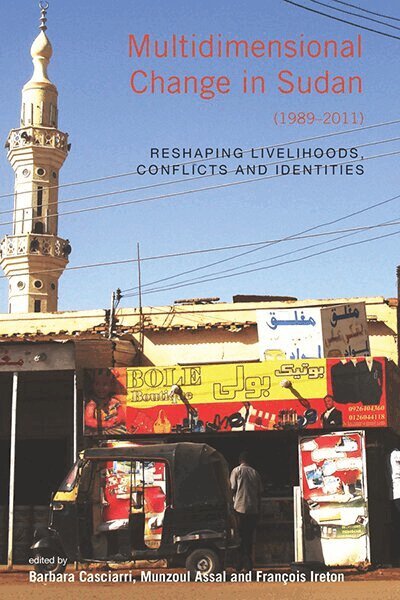
    Multidimensional Change in Sudan (1989–2011)

    Reshaping Livelihoods, Conflicts and Identities

    AvBarbara Casciarri,Munzoul A. M. Assal

    Inbunden, Engelska, 2015

    2 056 kr

    Beställningsvara. Skickas inom 5-8 vardagar. Fri frakt över 249 kr.

    Beskrivning

    Based on fieldwork largely collected during the CPA interim period by Sudanese and European researchers, this volume sheds light on the dynamics of change and the relationship between microscale and macroscale processes which took place in Sudan between the 1980s and the independence of South Sudan in 2011. Contributors’ various disciplinary approaches—socio-anthropological, geographical, political, historical, linguistic—focus on the general issue of “access to resources.” The book analyzes major transformations which affected Sudan in the framework of globalization, including land and urban issues; water management; “new” actors and “new conflicts”; and language, identity, and ideology.

    Produktinformation

    • Utgivningsdatum:2015-04-01
    • Mått:152 x 229 x 26 mm
    • Vikt:694 g
    • Format:Inbunden
    • Språk:Engelska
    • Antal sidor:392
    • Förlag:Berghahn Books
    • ISBN:9781782386179

    Utforska kategorier

    • Antropologi inom Samhälle och politik
    • Referensverk och tvärvetenskap inom Samhälle och politik
    • Geografi inom Naturvetenskap och teknik

    Mer om författaren

    Barbara Casciarri is Associate Professor at the Department of Sociology, University Paris 8. She edited with A. M. Ahmed a special issue of Nomadic Peoples 13, 1 (2009), “Pastoralists under pressure in present-day Sudan” and with M. Van Aken a special issue of Journal des anthropologues 132-133 (2013), “Anthropology and Water(s).” She also edited (with Mohamed A. Babiker) the volume Anthropology of Law in Muslim Sudan. Land, Courts and the Plurality of Practices, Brill, Leiden (2018).

    Recensioner i media

    “It is unusual but refreshing to have a book on contemporary Sudan that does not fixate on the previous and/or ongoing violent conflicts in that country between the north and former southern region, now the independent nation South Sudan… Each contribution is lucid and informative, so those with a special interest in this newly reconstructed country will welcome this volume…Highly recommended.” • Choice“This book is useful to those who are just beginning to learn about Sudan as well as scholars who are more experienced and want to update their knowledge about the country’s recent changes… It is a fundamental resource for those who are interested in the study of contemporary Sudan.” • African Studies Quarterly“This is an essential book to read as a background and springboard for delving into an extremely critical and complex period of modern Sudan… a landmark and ground-breaking contribution in recent Sudanese studies. It opens new paths for further research and analysis in the study of socio-economic change in Sudan, and as such it is a must-read for everyone who wishes to grasp what is happening in Sudan at present, especially for Africanist researchers and those engaged in postgraduate interdisciplinary programmes.” • Égypte/Monde arabe“There really is very little published on some of these topics, and genuine field research of the kind which has been conducted by [this] number of contributors is rare.” • Justin Willis, University of Durham“This book brings together sixteen original, detailed field studies... [which] focus on localities across the northerly provinces of the Sudan as it was constituted [in 1989–2011]… The events and processes of this ‘interim period’ following the civil war have deep roots in the past of the whole region, and continuing relevance to ‘both Sudans’ today.” • Wendy James, University of Oxford

    Innehållsförteckning

    • List of IllustrationsAcknowledgementsNotes on the Transliteration of Arabic TermsList of AbbreviationsGeneral Map of SudanIntroduction: Multidimensional Change in Sudan 1989-2011: Insights from FieldworkBarbara Casciarri, Munzoul A.M. Assal and François IretonPART I: LAND ISSUES AND LIVELIHOODS IN THE CAPITAL REGION AND RURAL AREASChapter 1. Old-timers and New-comers in Al-Ṣālḥa: Dynamics of Land Allocation in an Urban PeripheryMunzoul A.M. AssalChapter 2. Urban Agriculture Facing Land Pressure in Greater Khartoum: The Case of New Real Estate Projects in Tuti and Abū SeʿīdAlice FranckChapter 3. Access Strategies to Some Economic and Social Resources among Recent Migrants in the Outskirts of Khartoum : the Example of Bawga Al-SharīgFrançois IretonChapter 4. Contested Land Rights and Ethnic Conflict in Mornei (West Darfur): Scarcity of Resources or Crises of Governance?Zahir M. Abdal-Kareem and Musa A. Abdul-JalilPART II: WATER RESOURCES AT THE CORE OF LOCAL AND GLOBAL INTERACTIONSChapter 5. Sudan’s Hydropolitics: Regional Chess Games, National Hegemony and Local ResistanceHarry VerhoevenChapter 6. Local Management of Urbanized Water: Exchanges among Neighbours, Household Actions and Identity in Deim (Khartoum)Luisa ArangoChapter 7. Domestic Water Supply and Management in Northern Kordofan Villages: Al-Loweib as an ExampleElsamawal Khalil MakkiChapter 8. Water Management among pastoral Sudanese Pastoralists: End of the Commons or ‘Silent Resistance’ to Commoditization?Barbara CasciarriPART III: NEW ACTORS, NEW SPACES AND NEW IMAGINATION ON CONFLICTSChapter 9. Asian Players in Sudan: Social and Economic Impacts of ‘New-Old’ ActorsIrene PanozzoChapter 10. Oil Exploration and Conflict in Sudan: the Predicament for Pastoralists in North-South Borderline StatesAbdalbasit SaeedChapter 11. What Place in Khartoum for the Displaced? Between State Regulation and Individual StrategiesAgnès de GeoffroyChapter 12. Activist Mobilization and the Internationalization of the Darfur CrisisMaria Gabrielsen JumbertPART IV: RESHAPING LANGUAGES, IDENTITIES AND IDEOLOGIESChapter 13. The Islamic Movement and Power in Sudan: From Revolution to Absorption into the StateGiorgio MussoChapter 14. Language Policy and Planning in the Sudan: From Local Vernaculars to National LanguagesAshraf Abdelhay, Al-Amin Abu Manga and Catherine MillerChapter 15. ‘One Tribe, One Language’: Ethno-Linguistic Identity and Language Revitalization among the Laggorí in the Nuba MountainsStefano ManfrediChapter 16. Between Ideological Security and Intellectual Plurality: ‘Colonialism’ and ‘Globalization’ in Northern Sudanese Educational DiscoursesIris Seri-HerschEpilogue. A New Sudan?Roland MarchalNotes on ContributorsBibliography